

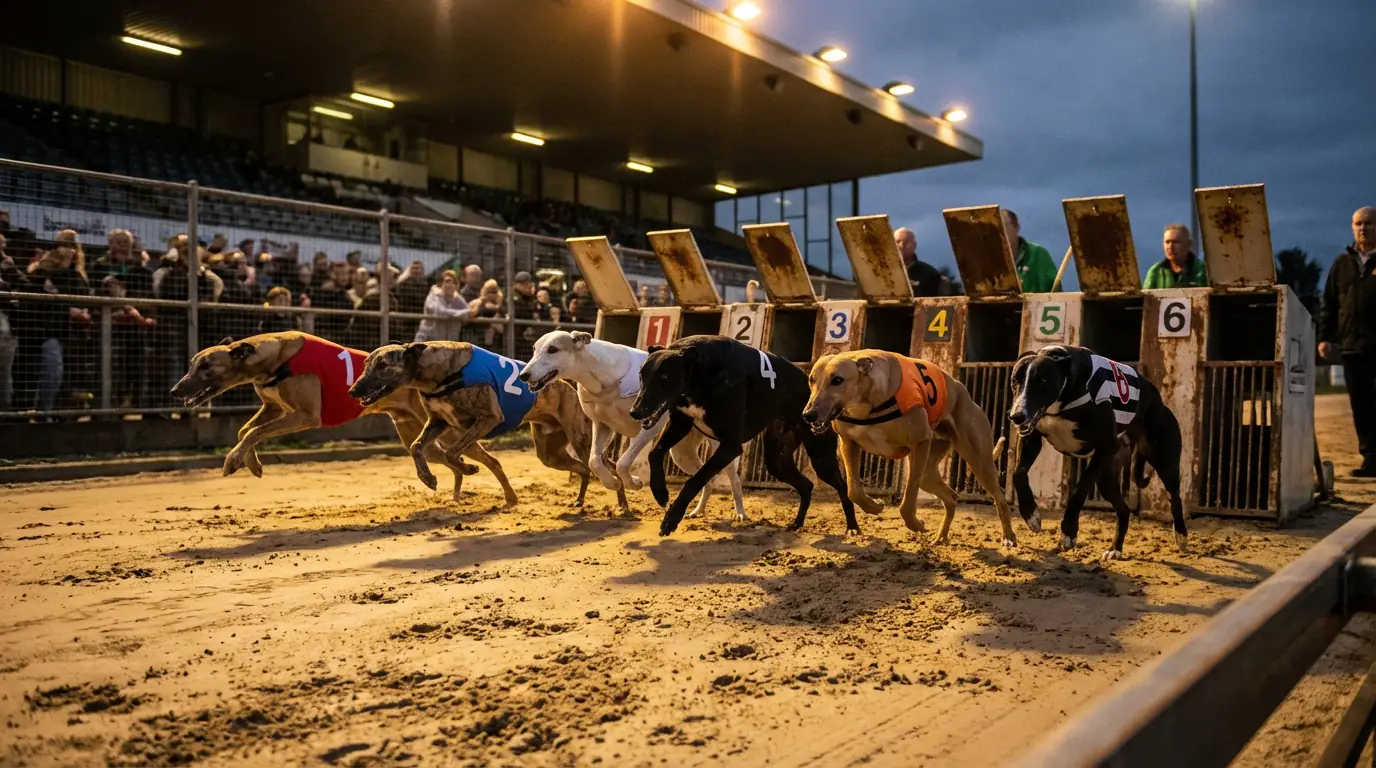
- Six Dogs, One Lure, Thirty Seconds — Here’s How to Bet on It
- How a UK Greyhound Race Works — From Parade to Result
- Core Greyhound Bet Types — Win, Place, Each-Way
- Forecast, Tricast and Exotic Bets for Greyhounds
- Greyhound Racing Odds — Fractional, Decimal and SP
- Placing Your First Greyhound Bet — Step by Step
- Reading the Greyhound Race Card — Quick Start
- The Thirty-Second Learning Curve
Six Dogs, One Lure, Thirty Seconds — Here’s How to Bet on It
Greyhound racing is the fastest turnaround in sports betting. A new race every fifteen minutes. Six dogs per event. Results in under thirty seconds. No jockey decisions, no tactical riding, no drawn-out finishes that take five minutes to resolve. The traps open, the lure moves, and within half a minute you either have a winner or you don’t.
For anyone used to horse racing, football accumulators, or waiting ninety minutes for a single result, the pace of the dogs takes some adjustment. Meetings run throughout the day and into the evening at tracks across the country, with BAGS and BEGS fixtures filling afternoon cards and evening sessions drawing bigger fields at venues like Romford, Towcester, and Monmore Green. The Greyhound Board of Great Britain licenses tracks from Newcastle to Brighton, and on a typical Saturday you might have over a hundred individual races to choose from.
That volume is part of the appeal and part of the risk. Unlike a Premier League Saturday where you might study five or six matches in depth, greyhound racing offers enough action to fill an entire afternoon from a single armchair. The smart approach is not to bet on everything. It is to understand how the product works, learn which bets make sense for which situations, and develop a framework that stops volume becoming a liability.
This guide is written for someone placing their first greyhound bet, or their tenth, who wants to understand the mechanics properly before building any kind of regular habit. It covers how races are structured, what the core bet types do, how odds work in this specific market, and how to read the basic information on a race card. Nothing here assumes prior knowledge, but none of it is filler. Every section is designed to help you make a sharper decision the next time six dogs load into the traps.
How a UK Greyhound Race Works — From Parade to Result
Before you bet, you need to understand what you are actually watching. A UK greyhound race is a deceptively simple event with a few moving parts that matter enormously once money is involved.
Every race at a GBGB-licensed track features six runners. This is standard across Britain and has been for years, though older punters may remember the occasional eight-runner race before safety reviews phased them out. Six dogs means a tighter, faster field where early pace and trapping position have a proportionally larger impact than in horse racing, where fields of twelve or sixteen spread the probabilities more widely.
The race itself follows a fixed sequence. Dogs are paraded beforehand so that trackside punters can assess their condition and demeanour. They are then loaded into numbered traps — one through six, each assigned a specific jacket colour. Trap 1 wears red, trap 2 blue, trap 3 white, trap 4 black, trap 5 orange, and trap 6 wears the black-and-white striped jacket. If a reserve runner is called in to replace a late withdrawal, it wears a green-and-white striped jacket and takes the withdrawn dog’s trap position.
Once the traps open, dogs chase an electric hare — the mechanical lure — around the track. Most UK tracks are oval circuits, though the precise geometry varies from venue to venue. Distances range from around 250 metres for sprints up to 700-plus metres for staying races, with the standard distance at most tracks falling between 460 and 500 metres. At Towcester, the home of the English Greyhound Derby, the standard distance is 500 metres on a sand track.
A typical race lasts between 28 and 32 seconds at standard distance. Photo finishes are adjudicated by track officials, and the judge’s decision is final. The key racing detail for any bettor is that the first two bends often decide the outcome. A dog that traps well and secures a clear run to the first bend has a significant advantage, which is exactly why trap draw and early pace are such central factors in greyhound form analysis.
Oversight of the sport sits with the GBGB, which regulates everything from track licensing and trainer registration to anti-doping controls and welfare standards. All race results, form data, and grading changes are recorded centrally, which means the data you see on a race card is standardised across all licensed tracks. That consistency is one of the things that makes greyhound form analysis more accessible than some punters realise.
Core Greyhound Bet Types — Win, Place, Each-Way
The three bets you will use most often in greyhound racing are the win bet, the place bet, and the each-way. They are the foundation of everything else, and understanding how they work here — specifically in the context of six-runner races — is essential before you move to anything more complex.
A win bet is exactly what it sounds like. You back a dog to finish first. If it wins, you collect your stake multiplied by the odds. If it finishes second, third, or anywhere else, you lose your stake. In a six-runner field, the raw probability of any single dog winning — assuming equal ability — is roughly 16.7 per cent. Of course, dogs are not equal, and the odds reflect that disparity. The favourite in a typical graded race might be priced at 2/1, implying a roughly 33 per cent chance, while an outsider could be 10/1 or longer.
A place bet backs your dog to finish in the top two. In standard UK greyhound racing, two places are paid. This is different from horse racing, where larger fields mean three or four places. The reduced field size in greyhound racing means place terms are tighter: bookmakers typically pay a quarter of the win odds for a place. So a dog at 8/1 would return 2/1 for the place portion if it finishes second. One practical consequence of this structure is that place-only bets on short-priced dogs are rarely worth taking. A 2/1 favourite with quarter-the-odds place terms pays just 1/2 for a place — you risk a pound to win fifty pence. The maths improves sharply at longer prices.
Each-way betting is where most experienced greyhound punters settle. An each-way bet is two bets in one: a win bet and a place bet, at equal stakes. If you put five pounds each-way on a dog at 8/1, you are staking ten pounds total — five on the win and five on the place. If your dog wins, you collect on both halves: the win at 8/1 returns forty pounds plus your five-pound stake, and the place at 2/1 returns ten pounds plus your five-pound stake, for a total of sixty pounds from a ten-pound outlay. If it finishes second, you lose the win half but collect on the place: ten pounds plus the five-pound stake, returning fifteen pounds from your ten-pound outlay — a five-pound profit.
The beauty of each-way betting in greyhound racing is that the six-runner field makes second place a realistic outcome even for dogs that are not favourites. In a twelve-runner horse race, backing an outsider each-way still requires it to beat eight or nine rivals just to place. In a six-runner greyhound race, your outsider only needs to beat four of the other five. This mathematical reality is why each-way is the default bet type for many regular greyhound punters, and why it is particularly effective at longer odds.
One thing to watch: not every bookmaker applies the same each-way terms across all greyhound races. The standard is quarter odds for two places, but some promotions or specific events may offer different terms. Always check before you place the bet, especially in ante-post markets for events like the Greyhound Derby where place terms can vary between three and four places depending on the bookmaker.
Forecast, Tricast and Exotic Bets for Greyhounds
Exotic bets are where greyhound betting gets interesting — and where most beginners lose money. The reduced field size that makes each-way attractive also makes forecasts and tricasts more achievable than in horse racing, which is why they account for a significant portion of the greyhound betting handle. But achievable and easy are not the same thing.
A straight forecast requires you to select the first and second dog home in the correct order. You are not just picking a winner — you are predicting the exact finishing sequence of the top two from a field of six. The payout is determined by a computer forecast dividend calculated after the race, based on the starting prices of the two dogs involved. This means the return is not fixed when you place the bet. If two outsiders fill the first two spots, the dividend will be large. If the 1/1 favourite beats the 2/1 second favourite, the dividend will be modest. Minimum stakes for a straight forecast are typically 50p, making it an accessible bet for small stakes.
A reverse forecast covers both possible finishing orders of your two selected dogs. If you fancy trap 3 and trap 5, a reverse forecast pays out whether trap 3 wins with trap 5 second, or trap 5 wins with trap 3 second. Because you are covering two outcomes, a reverse forecast costs twice the unit stake — a 50p reverse forecast is one pound total. The dividend will be calculated on whichever combination finishes in the top two, and you receive the payout for that specific straight forecast.
Combination forecasts extend the concept further. You select three or more dogs and cover every possible first-and-second combination between them. With three selections, that is six possible outcomes, so a 50p unit stake costs three pounds. With four selections, you are covering twelve combinations at a cost of six pounds per 50p unit. The maths escalates quickly, and this is where beginners sometimes get caught out — the cost of covering multiple combinations can erode any profit if the dividend is modest.
Tricasts raise the difficulty another level. A straight tricast requires you to predict the first three finishers in exact order. In a six-runner field, that is one correct outcome from 120 possibilities — the odds are inherently against you, but the dividends can be enormous. A combination tricast lets you select three or more dogs to fill the first three places in any order. With three dogs, that is six possible arrangements, costing six times your unit stake. With four dogs, you are looking at twenty-four combinations.
The practical question for any bettor is when exotics offer genuine value versus when they are lottery tickets. The answer depends on the race. In a heat with one dominant dog and two obvious contenders for the places, a straight forecast or tricast can represent solid value because you are capitalising on a race that is likely to produce a predictable top three. In a wide-open graded race where any of the six could finish anywhere, you are essentially guessing, and the cost of covering enough combinations to be confident usually exceeds the likely return.
One useful rule of thumb: if you cannot narrow the race down to three serious contenders, avoid the tricast. If you cannot identify a clear first and second, avoid the straight forecast. Exotic bets reward conviction, not hope.
Accumulators and Multiple Bets on Dogs
Greyhound accumulators work the same way as any other sport: you combine multiple selections and the odds multiply. A double on two greyhound races, a treble on three, or a four-fold and upward. The appeal is obvious — small stakes generating potentially large returns. A four-fold on four dogs at 3/1 each turns a one-pound stake into a two-hundred-and-fifty-six-pound return.
The reality is less glamorous. Each leg of an accumulator multiplies not just the odds but the probability of failure. Even if every dog in your acca has a genuine 33 per cent chance of winning, the probability of all four winning is roughly 1.2 per cent. Bookmakers love accumulators because the built-in margin compounds across every leg. The overround on a single race might be 15 to 20 per cent; across four races, the compounded margin works heavily in the bookmaker’s favour.
That said, some bookmakers offer acca insurance on greyhounds — if one leg of your accumulator lets you down, you receive your stake back as a free bet. This changes the maths enough to make certain accumulators worth considering, particularly if you are linking short-priced selections where each leg has a reasonably high probability of landing. Without that insurance, the honest advice is that greyhound accumulators are entertainment, not strategy. Singles and each-way bets are where sustainable profits live.
If you do want to play multiples, keep the number of legs small — doubles and trebles are far more realistic than six-folds — and avoid combining selections from the same meeting where late withdrawals could disrupt several legs at once. Patience is the least exciting betting skill, but it is the one that separates regular punters from former punters.
Greyhound Racing Odds — Fractional, Decimal and SP
Odds tell you two things: what the market thinks about a dog’s chances, and what the bookmaker wants you to think. Learning to read both signals is fundamental to greyhound betting, and it starts with understanding the formats.
In the UK, greyhound odds are most commonly displayed as fractions. A dog at 5/2 returns five pounds for every two pounds staked, plus your original stake back. At 7/4, you receive seven pounds for every four staked. The first number is always the profit; the second is the stake. Evens — written as 1/1 or simply EVS — means you double your money. Odds-on prices like 4/6 mean you stake six to win four, which tells you the market considers that dog a strong favourite.
Decimal odds, more common in European markets and increasingly used on betting exchanges, express the same information differently. A dog at 3.50 in decimal returns three pounds fifty for every one pound staked, including your stake. To convert from fractional to decimal, divide the first number by the second and add one. So 5/2 becomes (5 divided by 2) plus 1, which equals 3.50. Decimal odds are often easier for quick calculations, especially when comparing prices across multiple bookmakers or working out accumulator returns.
Starting price, commonly abbreviated to SP, is the official price of a dog at the moment the traps open. It is determined by the on-course market — the prices offered by trackside bookmakers — and it is the default settlement price if you have not taken a fixed early price. SP matters in greyhound racing because prices can move significantly between the time a race card is published and the moment the race begins. If a dog opens at 5/1 on the morning card but is heavily backed down to 3/1 by the off, anyone who took 5/1 early has captured better value than SP bettors.
This is where the concept of Best Odds Guaranteed becomes important. Several major UK bookmakers offer BOG on BAGS and BEGS greyhound meetings, which means that if you take an early price and the SP is higher, they will pay you at the larger odds. This eliminates the risk of taking an early price that drifts in your favour — you get the best of both worlds. Not every bookmaker extends BOG to all greyhound meetings, and it rarely applies to ante-post markets, so checking the terms before you bet is worth the thirty seconds it takes.
Understanding odds also means understanding implied probability. A dog at 3/1 has an implied probability of 25 per cent — the market is saying this dog wins roughly one in four times. At 10/1, the implied chance drops to about 9 per cent. These percentages never add up to exactly 100 per cent across all six runners; the excess is the bookmaker’s margin, or overround, which typically sits between 115 and 125 per cent on a standard greyhound race. The lower the overround, the better the value available to punters. Odds comparison tools make it straightforward to identify which bookmaker is offering the most competitive prices on any given race.
Placing Your First Greyhound Bet — Step by Step
Your first greyhound bet should not be complicated. The mechanics are straightforward whether you are betting online, through a mobile app, or at a bookmaker’s shop. Here is the sequence, stripped of jargon.
Start by picking a meeting. Online bookmakers list the day’s greyhound fixtures under a dedicated greyhound racing section, usually with a “Next Off” tab showing the next race about to start and a meetings tab listing all the day’s cards. Afternoon cards are predominantly BAGS fixtures — races broadcast to betting shops via the satellite information service — while evening meetings tend to be the bigger events. For a first bet, an evening meeting at a well-known track like Romford, Towcester, or Crayford is a sensible starting point because these tend to attract stronger fields and better coverage.
Next, pick a race and read the card. Every race has a card showing the six runners with their trap number, dog name, trainer, recent form figures, best time at the distance, and sectional time. Do not worry about absorbing all of this at once. For a first bet, focus on two things: the form figures, which show recent finishing positions in a string of numbers, and the price, which tells you what the market thinks. A dog showing “111” in recent form has won its last three races. One showing “654” has been gradually improving but has not won recently. These patterns give you a starting point.
Choose your dog and select your bet type. For a first bet, a simple win bet or an each-way are the sensible options. On most platforms, clicking the dog’s name or odds adds it to your bet slip. You then choose the bet type — win or each-way — enter your stake, and confirm. Minimum stakes on most platforms are as low as ten pence for online bets, though forecast and tricast minimums are typically 50p.
If you are betting in a shop, the process is nearly identical but on paper. You write the time of the race, the track name, the trap number and dog name, your bet type, and your stake on a betting slip, then hand it to the cashier. Results are displayed on screen within the shop, and winning slips can be cashed immediately.
One detail that catches beginners: make sure you know whether you are taking a fixed price or SP before confirming. Online, you are usually offered the current price with the option to accept changes. If you want to lock in the current price, most platforms allow you to do so explicitly. If you leave it to SP, you accept whatever the market price is at the off. With BOG available on BAGS races at many bookmakers, taking the early price is almost always the right call — you capture the current odds and still benefit if the SP ends up higher.
Reading the Greyhound Race Card — Quick Start
The race card is your one-page cheat sheet. Once you can read it, you can bet with confidence — or at least with information instead of instinct.
Every UK greyhound race card presents the same core data points for each runner. The trap number and jacket colour identify where the dog starts. The dog’s name is followed by its trainer, which matters more than most beginners realise — certain trainers have significantly higher strike rates at specific tracks or in specific grades. The dog’s weight is listed in kilograms, and while it is not the most critical factor, significant weight changes between runs can indicate issues or improvements in condition.
Form figures are the compressed history of a dog’s recent performances. They appear as a string of numbers — for example, “312641” — read from left to right with the most recent run on the right. Each number is the finishing position from that race: 1 means the dog won, 6 means it finished last. A zero means it was unplaced beyond sixth, which can happen in handicap races or at tracks that previously ran larger fields. Letters sometimes appear in the string: “F” indicates a fall, and sometimes you will see a dash indicating a break in racing.
Best time, usually listed in seconds, shows the fastest time a dog has recorded over the race distance at that track. This figure needs context — a best time of 28.50 at Towcester is meaningless compared to 28.50 at Romford because the tracks are different lengths and geometries. Always compare times within the same track. Sectional time, the split time recorded at the first timing point near the first bend, tells you about a dog’s early pace. A fast sectional means the dog trapped well and got to the front quickly. A slow sectional with a still-competitive finishing time suggests a dog that runs on from the back — useful information when assessing how a dog might perform from a specific trap.
Comment codes provide shorthand for what happened during a race. SAw means the dog was slow away from the traps. QAw means it was quick away. Bmp1 indicates it was bumped at the first bend. Crd means it was crowded during the running. Led tells you the dog led at some point. RnOn means it ran on strongly in the finish. These codes, once learned, turn a dry race card into a narrative. A dog showing “SAw, Crd, RnOn” was slow out, got into trouble, but finished well — suggesting it might have won with a cleaner run.
Gradings are the final piece. UK greyhound racing uses a grading system with Open class at the top for elite dogs, then A1 as the highest standard graded level down through to A11 at the lowest. A dog’s grade changes based on performance — winners generally move up (towards A1), losers move down (towards A11). The grade tells you the quality of opposition a dog typically faces, and a dog dropping in grade can represent value if it has been competitive against better rivals. At the other end, a dog stepping up in grade after a winning streak faces a genuine test.
Reading a race card quickly is a skill that develops with repetition. For your first few bets, focus on recent form, sectional times, and whether the dog has run well from its drawn trap before. That combination alone puts you ahead of the majority of casual punters picking dogs by name or jacket colour.
The Thirty-Second Learning Curve
Greyhound racing is one of the lowest barriers to entry in sports betting. The races are short, the fields are small, and you can go from knowing nothing to placing an informed bet inside an afternoon. That accessibility is both the appeal and the trap.
The speed of greyhound meetings — a new race every twelve to fifteen minutes, results in half a minute — creates a tempo that encourages impulsive betting. The dog you fancied in race three loses on the first bend, so you double up on race four to recover. Race four is a reverse forecast that does not come in, so you switch to a tricast on race five because the dividends are bigger. This is how bankrolls evaporate. Not through a single bad decision, but through a sequence of reactions disguised as decisions.
The bettors who last in greyhound racing are those who treat every race card as a data problem, not a guess. They read the form, check the trap draw, compare the sectional times, and — critically — skip races where the information does not point clearly enough to a selection. The ability to sit out a race is the most profitable skill in this sport, and it costs nothing to develop.
Build a process before you build a bankroll. Decide in advance which bet types you will use, what your maximum stake per race will be, and how many races per meeting you will bet on. These decisions, made calmly before the first trap opens, are worth more than any tip or system. The races are thirty seconds long. The learning curve does not have to be.
