

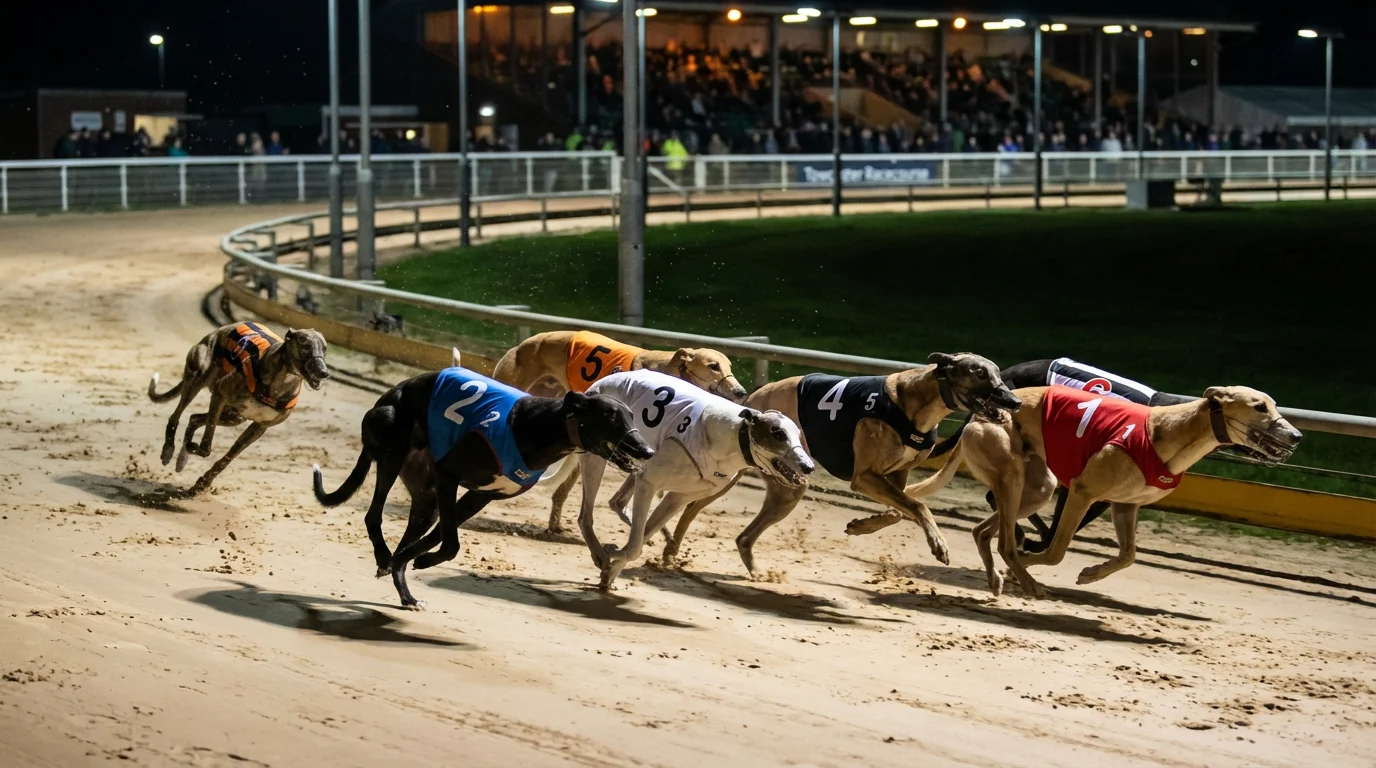
The Race Every Punter Should Know How to Bet
The English Greyhound Derby is not just the biggest race on the calendar — it is the only greyhound event where the betting market reshapes itself six times before a winner crosses the line. From the first round heats to the final at Towcester, the odds shift after every draw, every elimination, every blistering sectional time. No other greyhound race on the planet offers that kind of sustained betting opportunity.
What separates Derby betting from a standard Tuesday evening BAGS meeting is structural. A regular race is a single event: six dogs, one result, move on. The Derby is a six-week campaign fought across thirty-two heats, four quarter-finals, two semi-finals and a final that carries a winner's prize of £125,000 in 2026. That tournament format creates a market where ante-post positions taken in April can triple in value by June — or evaporate entirely when a 4/1 favourite gets bumped at the first bend in round two.
This guide is built for punters who want to approach the Derby with a plan rather than a hunch. It covers how the format works and why that matters for your betting, which markets are worth your money, how to read form in a tournament context, what the trap draw statistics actually say, and how to structure your staking across six rounds without bleeding your bankroll dry. Whether you have been betting on greyhounds for years or the Derby is your entry point into the sport, the principles here apply across the board.
The Derby is fast — roughly twenty-eight seconds from traps to line. The betting market around it is anything but. Understanding that gap is where the edge lives.
Key Fact
The English Greyhound Derby has run since 1927, making it the longest-running and richest greyhound race in the world. The 2026 edition returns to Towcester Racecourse, with the final scheduled for Saturday 6 June. Prize money for the winner: £125,000.
How the Greyhound Derby Works — Format, Rounds & Progression
Six rounds. Thirty-two heats in the first round alone. One final. The Derby's format is the first thing you need to understand before you place a single bet, because it dictates everything — which markets exist, when value appears, and why some dogs that look unbeatable on paper never make it past round three.
The competition begins with the first round, spread across three consecutive nights. In 2025 those heats ran on 8, 9 and 10 May at Towcester. The 2026 Derby starts on Thursday 30 April. Entries typically number between 170 and 200 greyhounds, drawn into heats of six. The top three from each heat progress; the bottom three are eliminated. There is no reprieve, no wildcard, no second chance. One poor trap and your ante-post selection is finished.
The second round follows roughly a week later. The surviving dogs are re-drawn into new heats — different trap positions, different opponents. Again, the top three progress. By round three, the field has narrowed to around 24 dogs, and by the quarter-finals you are down to the best 24 competing across four heats. Semi-finals reduce the field to 12, split across two races, and the final six contest the showpiece.
Each round introduces new information. A dog that looked sluggish in round one might have been feeling out the track. A dog that won its heat in 28.50 might have done so against weak opposition. The progressive elimination creates a form trajectory — and that trajectory matters far more to bettors than any single time.
From a betting standpoint, the format has three critical implications. First, attrition is real. Roughly two thirds of the field is eliminated in the first round alone. If your ante-post pick stumbles at the first bend in heat eight, your money is gone. Second, the draw resets at every round. A dog that drew trap one in round one might face trap six in round two, and that shift alone can move its odds by several points. Third, form builds incrementally. The later rounds produce more reliable data because surviving dogs have already proven they can handle the track, the distance and the pressure of championship racing.
This is why the Derby demands a different betting approach to standard greyhound racing. You are not picking a winner from a single field. You are tracking a cohort through six rounds, adjusting your assessment at each stage, and deciding when the information you have justifies the price you are offered.
First Round
3 nights, 32 heats, top 3 per heat progress
Rounds 2–3
Re-drawn heats, field narrows to ~24
Quarter-Finals to Semis
4 QF heats, 2 semis, top 3 per race
The Final
6 dogs, 500m, ~28 seconds, £125,000 to the winner
How the Derby Draw Shapes Your Bet
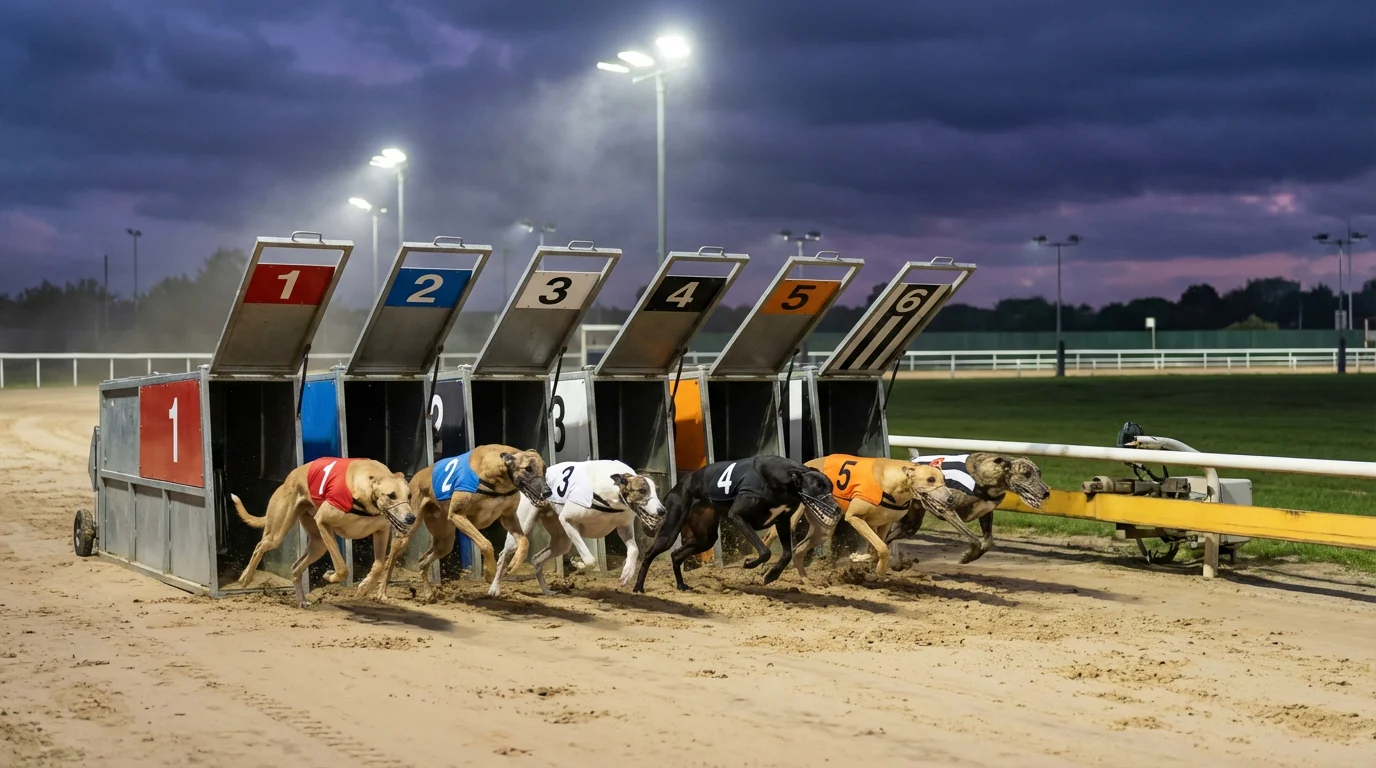
The draw is not random luck — it is the single event that moves Derby odds more than any form line. Before every round, each surviving greyhound is assigned a trap number based on their seeding category: railer, middle seed or wide. The draw is conducted live, often streamed online, and bookmaker odds react within minutes.
Seeding reflects a dog's preferred racing position. A railer — a dog that hugs the inside rail — will typically be drawn in traps one or two. A wide seed gets traps five or six. Middle seeds fill the gaps. The system is designed to produce competitive, balanced heats, but it does not guarantee a dog gets its ideal position. When a confirmed railer draws trap four, its chances shift. When a wide runner draws trap one, it may struggle to find racing room early. These mismatches are where the market overreacts — and where sharp punters find edges.
Consider the 2025 Derby. Bockos Diamond, the ante-post favourite at around 4/1, arrived at the final as the most talented dog in the competition. He drew trap six — a wide berth that suited his running style — and was sent off at 11/10. He ran well, but finished second to Droopys Plunge who capitalised on a cleaner run from the inside. The trap draw did not cost Bockos Diamond the race on its own, but it narrowed the margin for error in a field where every length matters.
Every round produces a new draw. That means your assessment of a dog's chances must be updated not once, but five times across the competition. A dog may look perfectly placed in round two and face an unfavourable trap in the quarter-final. The draw is the variable that keeps Derby betting dynamic from start to finish.
Greyhound Derby Odds — Markets, Movement & Value
Only one in three Derby favourites actually wins. Since 1985, when the race moved to Wimbledon, the market leader or joint-favourite has taken the final just fourteen times from forty-one renewals. Backing every favourite to level stakes across that period would have returned a loss of roughly £11.50 for every £1 staked. That statistic alone should change how you approach this market.
The Derby offers several distinct betting markets, each with its own timing and value profile. The outright winner market opens as soon as entries are confirmed — typically in late March or early April — and runs continuously until the final. Prices at entry stage are wide. You might see a trial winner priced at 8/1, an untested Irish import at 20/1, and the reigning champion at 6/1. By the time the final field of six is confirmed, those prices compress dramatically: the favourite might be 5/4, with the outsider at 12/1.
Heat betting opens for each individual round. These are standard six-runner race markets — win, each-way, forecast, tricast — and they function exactly like any BAGS meeting card. The difference is that Derby heats attract sharper money. Prices are tighter, movement is faster, and starting prices often bear little resemblance to early-morning shows.
Less common but worth knowing: some bookmakers offer without-the-favourite markets on the outright, removing the first or second favourite from the book and repricing the field. These can be useful when you believe the favourite is beatable but cannot identify which specific dog will beat it. Trap markets — betting on which trap number will produce the winner — are also available for the final and occasionally for semi-final nights.
The typical price trajectory of a Derby favourite follows a recognisable pattern. At entry stage, the market leader is usually priced between 4/1 and 8/1 based on Irish or UK trial form. After the first round, if the favourite wins its heat impressively, prices shorten — often to around 3/1 or 5/2. By the semi-finals, a hot favourite can be as short as evens. The market compresses because information replaces speculation. Early prices reflect potential; late prices reflect confirmed ability.
Derby Six-Round Betting Toolkit
Three tools built from the Derby’s own tournament structure — survival odds through the rounds, forecast/tricast costs, and ante-post price value.
Every Derby heat sends the top three of six through and eliminates the rest — a flat 50% survival baseline per round. Five straight top-3 finishes are needed to reach the six-dog final from the entry stage, which is why ante-post prices on unproven dogs stay long even when the dog looks talented on paper.
A six-runner heat has 30 possible straight-forecast outcomes (6 × 5). A reverse forecast doubles your stake to cover both orders of two selections. A three-dog combination tricast covers all six possible finishing orders (3! = 6), so it costs six times your unit stake — £6 for a £1 line, exactly as the guide’s worked example shows.
Value multiple compares what a level stake would have profited at your ante-post price versus a later price on the same dog. Taking the early price is only worthwhile if the dog actually survives to the later stage — this tool shows the reward, not the risk of elimination along the way.
This compression is where most punters either win or lose the Derby. Taking 8/1 ante-post on a dog that reaches the final at 2/1 is profitable regardless of the result — you got four times the price the market eventually settled on. Taking 11/10 on the same dog in the final means you need a very high conversion rate to break even long-term.
Derby Outright — Illustrative Ante-Post Odds
| Trap | Dog | Trainer | Opening Price | Semi-Final Price |
|---|---|---|---|---|
| 1 | Dog A | Trainer UK | 10/1 | 5/1 |
| 2 | Dog B | Trainer IRL | 14/1 | 7/1 |
| 3 | Dog C | Trainer UK | 6/1 | 3/1 |
| 4 | Dog D | Trainer IRL | 4/1 | 11/8 |
| 5 | Dog E | Trainer UK | 20/1 | 8/1 |
| 6 | Dog F | Trainer IRL | 8/1 | 4/1 |
Illustrative prices showing typical compression from entry to semi-final stage. Actual odds vary by year.
Ante-Post vs Day-of-Race — When to Lock In
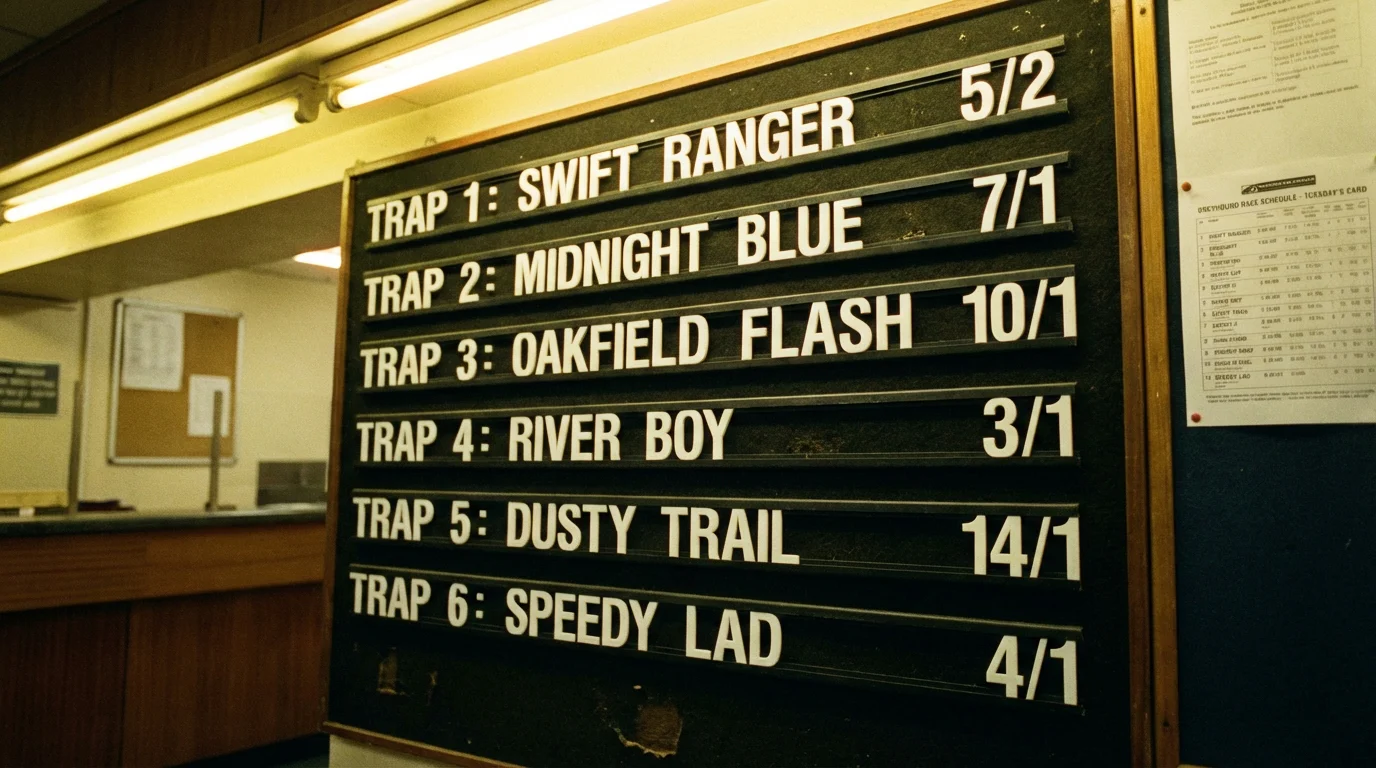
Ante-post is where Derby fortunes are made — and where impatient money goes to die. The fundamental trade-off is simple: you get better odds in exchange for accepting the risk that your selection might not even make it to the final. If a dog you backed at 10/1 ante-post gets injured in training or eliminated in round two, your stake is gone. Most bookmakers do not refund ante-post bets on non-runners.
The question is whether the discount justifies the blind spot. At entry stage, you are betting on a dog based on trial form, trainer reputation and sometimes little more than market sentiment. You have no Towcester-specific data, no draw information, no idea how the dog will handle the first bend at the venue. The odds reflect that uncertainty — which is exactly why they are long.
The sweet spot for many experienced Derby bettors sits between the first round and the quarter-finals. After round one, you know which dogs can handle Towcester. You have seen sectional times, trap behaviour, and how each dog responds to the championship atmosphere. Prices have shortened from their opening marks, but they have not yet compressed to the skinny margins you see by the semi-final stage. A dog that opened at 16/1 and won its first two heats in fast times might be 6/1 after round two. That is still a price worth taking if your form assessment is strong.
After the quarter-finals, prices tighten further and the risk-reward shifts. You know more, but you pay for that knowledge. Some punters prefer to wait until the semi-final draw before committing serious money. Others layer their stakes — a small ante-post bet early, then a larger position after the quarters confirm their assessment. There is no single correct timing. The key is having a reason for your timing that goes beyond wanting to be early.
Bet Types That Work for the Derby
The Derby is not a single race — it is a campaign. Your bet types should reflect that. A punter who uses the same approach for a Saturday afternoon BAGS card and the Derby outright market is leaving money on the table or, worse, burning through it faster than necessary.
The most straightforward Derby bet is a single on the outright winner. You pick a dog to win the final and take a price — either ante-post or on the day of the final itself. Each-way terms on the outright typically pay 1/4 odds for three places, meaning your place portion returns a profit on any dog priced above 4/1 that finishes in the top three of the final. At longer ante-post prices, each-way outright bets are genuinely useful. A 16/1 each-way selection that finishes second in the final still returns 4/1 on your place stake. That is not a consolation — it is a profitable position.
Heat betting is where the Derby becomes a week-by-week proposition. Each round's heats are priced as individual six-runner races. You can back a dog to win its heat (or place, or each-way), bet a forecast on the first two home, or combine multiple heat selections into an accumulator. Heat betting suits punters who want to engage with the Derby round by round rather than committing everything to the outright market. The advantage is that you get fresh information before every bet. The disadvantage is that you are betting on short fields where prices are tight and margins are thin.
Accumulators across rounds are tempting but fragile. A treble on three heat winners from a single night of Derby racing might offer attractive combined odds, but greyhound racing is volatile. One stumble at the first bend in any of your three races, and the acca is dead. If you do use accumulators, keep them short — doubles rather than trebles — and accept that the hit rate will be low.
For the final itself, the full range of bet types is available: win, each-way, straight forecast, reverse forecast, tricast and combination tricast. With only six runners, forecast and tricast bets become more manageable than in horse racing. A straight forecast on the final requires you to name the first and second home in the correct order — a difficult task, but not impossible if your form analysis is sound.
Worked Example: £10 Each-Way on a 12/1 Derby Ante-Post Pick
Total stake: £20 (£10 win + £10 place)
Place terms: 1/4 odds, 3 places
If the dog wins the final:
Win return: £10 x 12/1 = £120 + £10 stake = £130
Place return: £10 x 3/1 (12/1 ÷ 4) = £30 + £10 stake = £40
Total return: £170 from a £20 stake = £150 profit
If the dog finishes 2nd or 3rd in the final:
Win bet loses: -£10
Place return: £10 x 3/1 = £30 + £10 stake = £40
Total return: £40 from a £20 stake = £20 profit
Forecasts & Tricasts in Derby Heats
Six runners. Three progress. That is forecast territory. Derby heats create an unusual dynamic for forecast and tricast betting because the progression rule means the top three finishers all achieve something meaningful. In a normal graded race, finishing second is just losing. In a Derby heat, finishing second means survival.
A straight forecast requires you to name the first and second home in the exact order. In a six-runner field, there are 30 possible straight forecast outcomes (6 x 5). The dividend is calculated by a computer forecast formula and varies depending on the starting prices of the two dogs involved. Typical heat forecast dividends range from £5 to £60 for a £1 unit, depending on whether the first two home are favourites or outsiders.
A reverse forecast covers both permutations of your two selections: AB and BA. It costs twice the stake of a straight forecast but removes the pressure of naming the exact order. In tight Derby heats where two dogs are clearly superior to the rest of the field, a reverse forecast is a practical bet. You are essentially saying: these two will fill the top two spots, I just cannot separate them.
Tricast bets — naming the first three in order — offer larger dividends but require substantially more precision. In Derby heats, combination tricasts (where your three selections can finish in any order among the top three) are worth considering because the progression rule often produces predictable top-three finishes in heats where form separates the field clearly. A three-dog combination tricast costs six times the unit stake. At £1 per line, that is £6 — a manageable outlay for the chance of a dividend that can run into triple figures.
Reading Greyhound Form for the Derby
Form is not about picking the fastest dog — it is about finding the dog whose speed fits Towcester. The Derby is run over 500 metres on a sand track with a long run to the first bend, distinctive turns that test course knowledge, and conditions that can change between afternoon trials and evening racing. A dog that clocked 28.30 at Romford may not reproduce that time at Towcester, and a dog that ran 29.10 at Towcester in round one might be running faster than its raw time suggests if the going was heavy.
When assessing form for the Derby, start with recent race times at the venue. Towcester-specific form is the single most useful data point because it removes the variable of track comparison. A dog that has already run two or three rounds at Towcester has given you information no trial at another track can replicate. Look at the time, but also at the sectional — the split recorded at the first timing point, usually around the first bend. A fast sectional tells you a dog gets into position early. A slow sectional followed by a fast overall time suggests a closer — a dog that makes up ground in the second half of the race.
Next, examine the trap record. Every greyhound has a preferred racing line. Some are confirmed railers that hug the inside rail from box to finish. Others run wide and rely on overpowering the field with raw pace. When a dog is drawn away from its preferred position, its chance diminishes — not because it lacks ability, but because it is being asked to race in a way that does not suit its style. The race card will show a dog's recent trap draws and finishing positions from each trap, which gives you a quick read on whether the current draw helps or hinders.
Form figures on the race card appear as a string of numbers — typically the last six results, with 1 representing a win and 6 representing last place. A form line of 111211 tells one story; 342516 tells another entirely. But form figures alone do not distinguish between graded company and open-class competition. A dog winning A3 races at Sunderland is operating at a different level to one winning open races at Towcester. Context matters more than the numbers on the surface.
Finally, consider the trainer. At Derby level, a handful of kennels dominate year after year. These trainers understand the track, the competition format and the peaking process required to get a dog from the first round to the final in peak condition. When an elite trainer enters a dog, the market adjusts — and your form analysis should account for that signal. Trainer form at the Derby warrants its own closer look.
| What to Prioritise in Heat Form | What to Prioritise in Final Form |
|---|---|
| Trap draw and early pace — can the dog break cleanly? | Overall time and finishing speed — can the dog sustain pace? |
| Sectional time relative to heat rivals | Consistency across all rounds, not just the fastest single run |
| Course experience — has the dog run at Towcester before? | Ability to handle trouble — bumps, crowding, pace changes |
| Trainer record in early rounds — do they peak dogs early or late? | Draw position in the final — inside vs outside, railer vs wide seed |

Trainer Signals — What Kennel Form Tells You
A trainer entering three dogs into the Derby is not hedging — it is a statement about kennel strength. At open-class level, the trainer's influence goes beyond day-to-day care. They decide when a dog trials, which rounds to target for peak performance, and how to manage the six-week schedule to avoid fatigue. The gap between a good trainer and an elite one is most visible at the Derby, where preparation and timing matter as much as raw ability.
Charlie Lister holds the all-time record with seven Derby wins, a total that earned him the title "Derby King" and an OBE for services to greyhound racing. His era spanned the Wimbledon years, but the principle he demonstrated remains relevant: sustained excellence at the Derby requires not one great dog but a system for producing championship-ready animals. In the modern era, Graham Holland has taken up that mantle. Holland, an Irish-based Englishman, has won the Derby twice in the last three years prior to 2025 and regularly steers three or four runners through to the semi-finals. His 2025 campaign was typical — he had three dogs in the final, including heavily fancied Bockos Diamond. Patrick Janssens, a Belgian-born trainer based at Towcester, trained 2021 winner Thorn Falcon and 2025 champion Droopys Plunge. Liam Dowling prepared De Lahdedah for his title defence in 2025 after winning the 2024 renewal. These names recur in Derby betting markets for good reason.
For bettors, trainer form at the Derby is a practical signal. When a trainer with proven championship pedigree enters multiple dogs, it tells you the kennel is in strong form and the trainer is confident enough to split their resources across several campaigns. It also means that at least one of their entries is likely to be underpriced in the market, because attention concentrates on the kennel's leading entry while their second or third string drifts to longer odds. That drift can represent value — if you have the form data to back it up.
Sectional time — the split time recorded at the first timing point, typically around the first bend. It measures early pace, not overall speed. A dog with a fast sectional is leading or close to the lead at the first bend; a slow sectional suggests it is racing from behind and relying on late pace.
Trap Draw Statistics — What the Data Really Says
Trap statistics do not predict winners. They expose patterns that the market has not fully priced in — and that distinction matters. Raw trap data tells you how often each trap position has produced a winner at a given track over a given period. What it does not tell you is whether that pattern reflects a genuine track bias or simply the distribution of quality dogs assigned to each position.
At Towcester, the Derby venue since its return in 2021 (having previously been held there in 2017 and 2018), the track geometry creates identifiable tendencies. The long run to the first bend — around 90 metres from the traps — gives dogs in middle and outside traps enough room to cross over and find their preferred racing line before the field bunches. This reduces the extreme inside-trap advantage seen at tighter tracks like Romford, where the first bend comes up quickly and railers have a structural edge. At Towcester, traps two and three have historically performed well in open-class racing because they offer a clean run to the bend without the rail pressure of trap one or the width of traps five and six.
The trap one narrative in the Derby is worth understanding. For decades, there was a theory that the noise of the mechanical lure — which travels along the rail on the outside of the track — disadvantaged trap one dogs because they were positioned furthest from the hare's sound and sometimes reacted slower at the break. Changes to trap mechanisms have reduced this effect, but the statistical underperformance of trap one persists at certain venues. Whether this is a genuine bias or a self-fulfilling prophecy — with punters and bookmakers discounting trap one runners, leading to better value elsewhere — is debatable.
More striking is the trap five drought. No Derby winner has come from trap five since Kinda Ready in 2009. That is over fifteen years without a winner from the orange jacket. The sample size is not large enough to declare trap five cursed, but it is large enough to make you think twice before backing a trap five runner at short odds in the final.
The practical application of trap data is as a tiebreaker, not a primary filter. If your form analysis has produced two equally rated contenders for a heat, and one is drawn in trap two while the other sits in trap five, the statistics give you a marginal reason to lean towards the inside draw. But if trap five holds the clearly superior dog on form, the trap data should not override that assessment. A strong form profile always outweighs a weak trap draw.
Where trap statistics become genuinely useful is in identifying market overreactions. When a short-priced favourite draws an unfavourable trap, the market often panics — the price drifts from 6/4 to 3/1 on the strength of the draw alone. If you have assessed the dog's ability to handle that trap based on its racing style and previous trap record, you may find that the drift has created value where none existed before.
Important: Trap statistics describe what has happened, not what will happen. Never let a trap number override a strong form assessment. Use the data as context — not as a decision.
Staking Strategy for a Six-Round Tournament
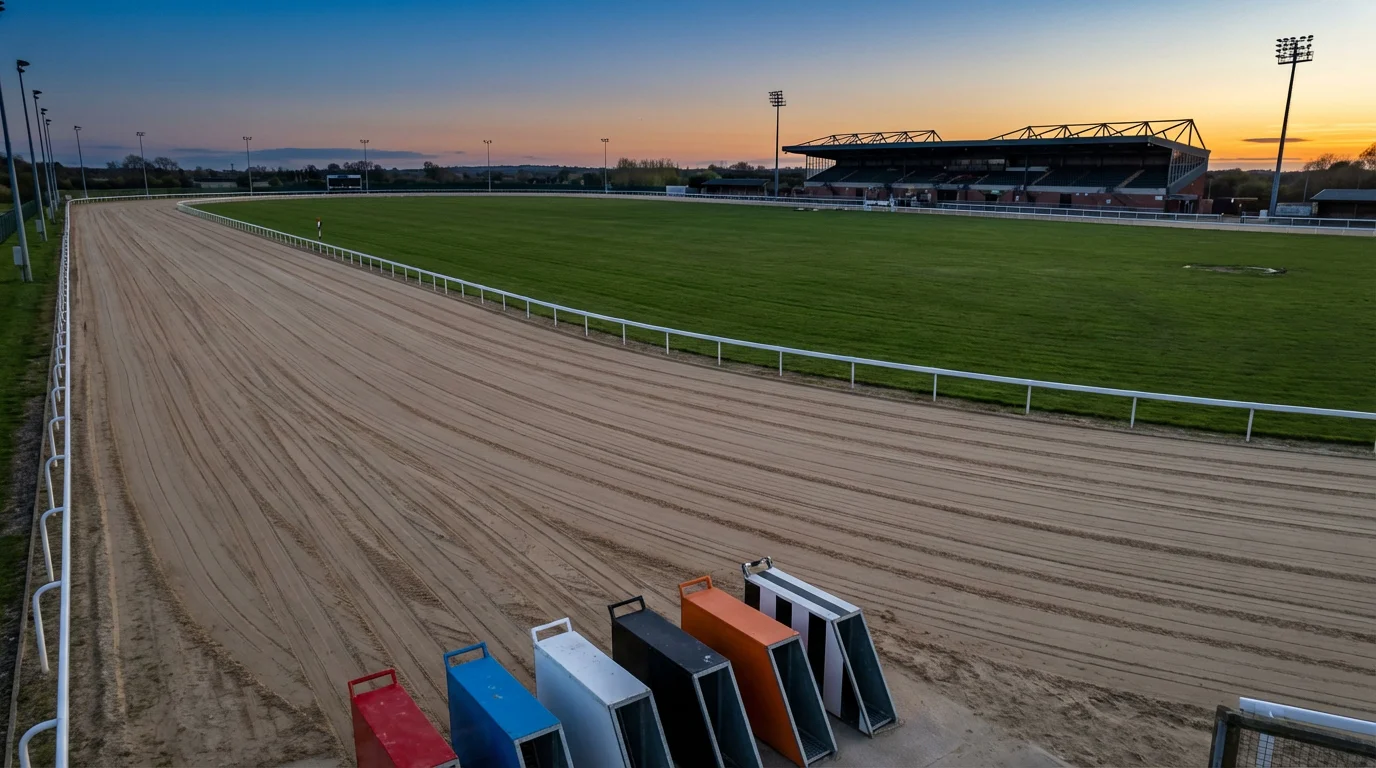
You do not have to bet every round. But if you do, you need a plan that does not bleed you dry by the quarter-finals. The Derby runs for six weeks. That is six rounds of heats, each generating betting opportunities across multiple markets. Without a staking framework, it is remarkably easy to spend more on Derby betting than you intended — death by a thousand small wagers rather than one catastrophic loss.
The simplest approach is to set a total Derby bankroll at the start of the competition and divide it across the rounds. A common split is to allocate 15–20% for ante-post positions before the first round, 10–15% per round for heat betting through rounds one to three, and reserve 20–25% for the quarter-finals through to the final, where information quality is highest and your bets should carry the most conviction.
A more sophisticated method is the each-way ladder. In the early rounds, when the field is large and uncertainty is high, use each-way bets on the outright market to gain positions at long prices. If your 16/1 each-way ante-post pick survives the first two rounds and firms to 6/1, you already have a profitable position regardless of the outcome. As the competition progresses and prices compress, switch from each-way to win-only bets. By the semi-finals and final, each-way terms offer diminishing value because the shortest-priced runners may not return enough on the place portion to justify the doubled stake.
Stop-loss discipline is essential. Decide before the Derby begins how much you are prepared to lose in total, and stick to it. If your ante-post picks are eliminated in the early rounds, do not chase by increasing stakes on later heats. The temptation to recover Derby losses by doubling up in the quarter-finals is one of the most reliable ways to turn a manageable loss into a painful one. The Derby will happen again next year. Your bankroll needs to survive until then.
Track every bet. A simple spreadsheet recording the date, round, dog, bet type, stake and return gives you a clear picture of where your money is going and whether your approach is working. After the Derby concludes, review your record. Did your ante-post positions provide value? Were your heat bets profitable? Did you stick to your bankroll limits? The answers inform next year's strategy.
Do
- Set a per-round budget before the competition starts
- Use each-way bets early, switch to win-only as prices compress
- Track every bet in a spreadsheet or app
- Reserve your largest stakes for the rounds with the best information
Don't
- Chase eliminated picks by increasing stakes on later rounds
- Bet every heat — selectivity beats volume
- Increase stakes after losses to try to recover
- Treat the final as a must-win event for your bankroll
How to Watch & Bet Live on the Greyhound Derby
You do not need to be at Towcester to follow every stride — but you do need to know where to look. Live coverage of the Greyhound Derby is available through several channels, and accessing it is essential if you are betting on the competition. Watching the races rather than relying on results alone gives you form information that no race card can capture: how a dog travels around the bends, how it responds to pressure from a rival, whether it finishes strongly or tires in the closing metres.
The primary broadcast source is SIS Racing, the supplier that provides live feeds to most UK bookmakers. If you have a funded account with a major bookmaker, you can typically watch Derby heats live through their website or app. Some bookmakers require you to have placed a bet on the race (even a small one) to unlock the stream; others simply require a positive account balance. Check your bookmaker's streaming terms before the first round.
RPGTV — Racing Post Greyhound TV — provides studio coverage including expert analysis and previews for Derby rounds. The Gone To The Dogs YouTube channel has become a popular free alternative, streaming Derby action live with commentary and offering catch-up replays of all heats. For punters who cannot access bookmaker streams, this is the most reliable free option.
In-play betting on greyhound racing is limited compared to football or horse racing. Most bookmakers do not offer live markets during a greyhound race because the event is too short — roughly 28 seconds — for meaningful in-play trading. However, some exchange platforms occasionally offer very short in-play windows on major finals. For the Derby specifically, the practical in-play opportunity is minimal. Your bets need to be placed before the traps open.
What live watching does enable is a better assessment of form for future rounds. If you watch a dog win its second-round heat but notice it was slow out of the traps and only prevailed because the leader faded, that observation is worth more than the bare result line of "1st, 29.05" on the race card. Build that observation into your assessment for the next round.
Pre-Bet Checklist — Before Every Derby Round
- Check the draw result and confirm your selection's trap number
- Review round form — watch replays if you missed the previous heats live
- Compare odds across at least two bookmakers before placing
- Set your stake within the per-round budget you defined at the start
- Confirm your bet type: each-way for early rounds, win-only for semis and final

Greyhound Derby Betting — Common Questions
Three questions that come up every Derby season — answered without the fluff.
How does the Greyhound Derby format work — and why does it affect betting?
The English Greyhound Derby is a six-round knockout tournament run over 500 metres at Towcester. Entries — typically around 180 dogs — are drawn into first-round heats of six, with the top three from each heat progressing. This continues through a second round, third round, quarter-finals and semi-finals until six finalists remain. For bettors, the format matters because it creates a progressive information environment. You gain more data with each round — track times, trap behaviour, response to pressure — which means the quality of your betting decisions improves as the competition advances. It also means ante-post prices in the early rounds carry more risk, since roughly two thirds of the field is eliminated before the quarter-finals.
What happens to my bet if a greyhound is withdrawn or a non-runner?
It depends on the bet type and timing. For ante-post bets on the outright Derby winner, most bookmakers operate a "stakes lost" policy — if your selection is withdrawn, injured or eliminated before the final, you lose your stake. This is standard across the industry and is the trade-off for the longer odds available ante-post. For individual heat bets placed on the day of racing, standard non-runner rules apply: your stake is typically refunded if the dog is a confirmed non-runner before the race. If a reserve dog is substituted into the trap, bets on the original dog are usually voided. Always check your bookmaker's specific greyhound non-runner rules, as policies can differ on edge cases like late withdrawals and reserve substitutions.
Does the trap draw actually matter — what do the statistics say?
Trap draw matters, but less than most casual bettors assume. At Towcester, the long run to the first bend reduces the extreme inside-trap advantage seen at tighter circuits. Traps two and three have historically performed well in open-class racing at the venue. The most notable statistical outlier is trap five, which has not produced a Derby winner since 2009 — a drought spanning over fifteen years. However, the sample size of Derby finals is small enough that this could be coincidence rather than systemic bias. The practical advice: use trap data as a tiebreaker when form analysis cannot separate two contenders, not as a primary decision tool. A clearly superior dog on form should not be dismissed solely because of an unfavourable trap draw.
The 28-Second Market Nobody Talks About
Twenty-eight seconds from traps to line. Six weeks from entry to final. That gap is where the smart money lives.
The Greyhound Derby is an anomaly in UK betting. No other major event compresses the actual competition into so brief a moment while stretching the betting market across such a long campaign. A Premier League season runs for nine months. A horse racing festival lasts four days. The Derby's final is over before you have finished your drink — but the market that surrounds it has been forming, shifting and repricing since March. That contrast is what makes it compelling, and it is what makes it exploitable.
The punters who consistently do well at the Derby are not the ones with the best tips or the luckiest trap draws. They are the ones who treat it as a structured exercise. They set a bankroll, define a staking plan, analyse form methodically, and adjust their positions as new information arrives with each round. They understand that the ante-post market rewards patience and the heat markets reward attention. They know when to bet and — just as critically — when not to.
The 2026 English Greyhound Derby returns to Towcester on 30 April, with the final set for 6 June. Entries will be confirmed in March. The ante-post market will open shortly after. Between now and then, the preparation you do — understanding the format, studying the trainers, building your form assessment framework — is what separates a flutter from a strategy.
The race lasts half a minute. The thinking that goes into a good Derby bet takes considerably longer. That is the point.
