Best Greyhound Betting Sites – Bet on Greyhounds in 2026
Loading...
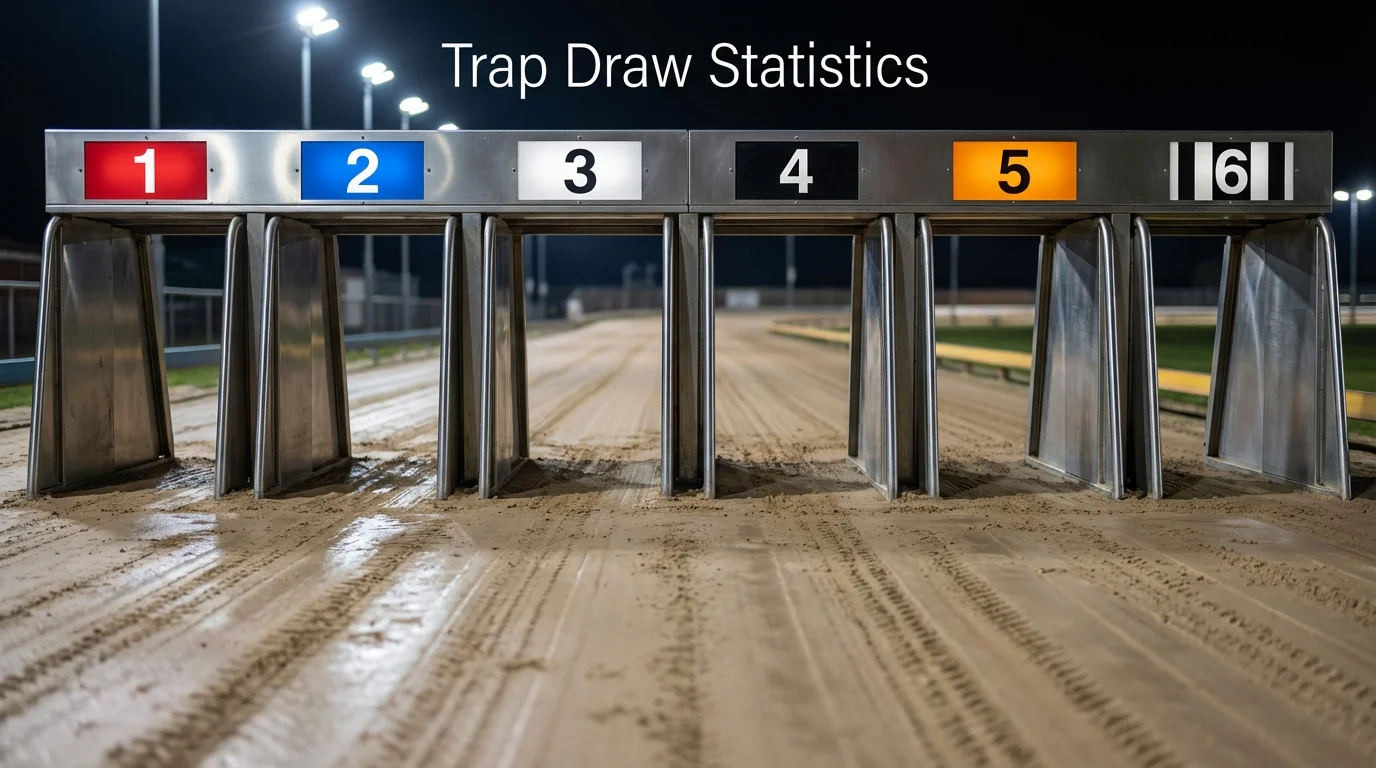
Trap Bias Isn’t a Myth — But It’s Not What You Think
Ask any greyhound punter about traps and you’ll get an opinion. Trap 1 is the place to be. Trap 6 is a graveyard. The inside boxes win more than the outside. Some of these beliefs have a basis in data. Others are folklore passed down from punters who watched a handful of races at one track and decided they’d cracked the code.
The reality is more nuanced and more useful. Trap bias exists in UK greyhound racing. Certain positions do win more often than statistical expectation at certain tracks. But the bias varies enormously depending on the track layout, the distance of the race, and the running styles of the dogs in the field. A blanket rule — “always back trap 1” or “avoid trap 6” — will lose you money just as reliably as any other blanket rule in betting.
What the data actually shows is that trap performance is a track-specific phenomenon. National averages smooth out the differences between venues to the point where they’re almost meaningless. The useful information lives in the track-level data, where the geometry of the course, the position of the first bend, and the hare rail create genuine, repeatable advantages for certain starting positions.
This article presents the national picture first, then drills into the track-specific data that actually matters for betting. If you’re going to use trap statistics, you need to use the right ones — and that means knowing which numbers apply to the race you’re about to bet on.
UK-Wide Trap Statistics — Win Rates by Position
In a perfectly balanced six-dog race, each trap would win approximately 16.7% of the time — one in six. Across all UK GBGB tracks aggregated over thousands of races, the actual figures deviate from this baseline, but not by as much as most punters assume.
National data generally shows trap 1 winning slightly below expected frequency, somewhere in the 15% to 16% range across all tracks and distances combined. Trap 6 tends to sit in a similar range, marginally below expectation. The middle traps — 2, 3, 4, and 5 — tend to cluster close to or slightly above the 16.7% baseline, with trap 3 and trap 4 often showing the highest aggregate win rates nationally.
These numbers feel meaningful until you consider what they’re averaging across. The UK currently has around twenty licensed greyhound tracks, [GBGB – Racecourses] each with a different layout, different bend configurations, and different first-bend distances. Aggregating trap data across Romford (a tight, short-running track that heavily favours railers) and Towcester (a galloping track with a long run to the first bend) produces a national average that accurately describes neither venue. The aggregate number sits in the middle and tells you nothing actionable about either track.
Where national data does have some limited use is in establishing the baseline expectation. If you know that, across all tracks, trap 1 wins roughly 15.5% of races, you can then compare that against a specific track’s trap 1 win rate. If Romford’s trap 1 wins 21% of its races, you know the bias at Romford is significant — not because 21% sounds high, but because it’s five percentage points above the national average. Without the baseline, track-specific numbers lack context.
The national data also reveals one consistent pattern: the extremes — traps 1 and 6 — tend to be the most variable. They produce both the highest and lowest win rates across individual tracks, depending on how the track geometry treats inside runners versus wide runners. The middle traps are more stable across venues. For the bettor, this means that trap-based betting decisions should focus most carefully on traps 1 and 6, where the track-specific bias is most likely to create a genuine edge.
One important caveat: publicly available trap statistics in greyhound racing are less standardised than you might expect. Different data providers use different sample sizes, different time periods, and different race-type filters. The figures cited here are directional rather than exact, drawn from patterns consistent across multiple sources. For precise, current trap data at a specific track, services like Timeform and specialist greyhound racing databases offer the most detailed breakdowns.
Track-by-Track Trap Bias — Where It Matters Most
Track geometry is the single biggest driver of trap bias. The distance from the traps to the first bend, the radius of that bend, and the position of the hare rail all determine whether inside or outside traps gain an advantage in the opening seconds of a race. Those opening seconds are where most greyhound races are decided.
At Romford, the tight track and short run to the first bend create a pronounced advantage for inside traps. Trap 1 at Romford consistently outperforms the national average, often winning above 20% of races at sprint distances. The geometry is simple: with a short run-up, inside dogs reach the bend first and take the rail position. Outside dogs have to cover more ground and risk getting squeezed wide. The effect is strongest in sprint races (400m or less) and diminishes somewhat at longer distances where the field has more time to sort itself out.
Towcester presents a different picture. The track’s longer run to the first bend reduces the inside advantage, and the sweeping nature of the bends means wider-running dogs are not as disadvantaged as they would be at a tighter venue. Trap data at Towcester tends to show a more even distribution across positions, with no single trap dominating in the way trap 1 does at Romford. For the Greyhound Derby, which is run over 500m at Towcester, this means the trap draw is a factor but not the factor — a well-drawn dog has an edge, but a badly drawn dog with superior ability can overcome it.
Nottingham, when it was operational for the Derby in 2019 and 2020, [GBGB – Derby 2019] showed a moderate inside bias similar to many standard-sized UK tracks. Hove, a popular south-coast venue, has historically favoured traps 1 and 2 at sprint distances. Central Park in Sittingbourne, before its closure, was known for a pronounced trap 6 advantage at certain distances — a rare example of an outside bias driven by the angle of the first bend.
The lesson from track-by-track data is that trap bias is not a universal phenomenon — it’s a local one. A punter who knows that trap 1 at Romford wins 21% of sprint races has actionable information. A punter who knows the national trap 1 average is 15.5% has a statistic. The difference between those two numbers is the difference between an edge and a fact.
For bettors who follow a specific track regularly — as many greyhound punters do — building a personal database of trap performance over time is one of the most reliable ways to identify value. The official results are publicly available. Tallying them by trap, distance, and race grade produces a dataset that most casual bettors never bother to compile, which is precisely why it can give you an advantage.
Trap Performance in the Greyhound Derby
The Greyhound Derby adds a layer of complexity to trap analysis because the draw is not random in the traditional sense. Derby runners are seeded as railers, middle seeds, or wide seeds based on their running style, and the draw within each category is then conducted publicly. This means a confirmed railer is more likely to end up in traps 1 or 2, while a wide runner draws from traps 5 and 6. The seeding system reduces the impact of raw trap statistics, because dogs are generally matched to positions that suit their style.
Even so, the Derby finals tell an interesting story. No dog has won the Derby from trap 5 since Kinda Ready in 2009, [OLBG – Greyhound Derby Guide] a drought that stretches across more than fifteen finals. Whether this reflects genuine disadvantage at the trap or is simply a quirk of small sample sizes is debatable — the Derby final happens once a year, so the total data set for any single trap is limited. But the streak is long enough to give punters pause when a fancied runner draws trap 5.
Trap 1 has produced its share of winners but also notable failures, particularly when the first-round draw produces awkward matchups in heats. In the earlier rounds, where the draw is more fluid and less carefully seeded than the final, trap statistics at Towcester are more relevant to betting decisions. A dog who consistently traps quickly from inside has a genuine edge in a heat race over 500m at Towcester, where getting to the first bend with a clear run is half the battle.
The semi-finals are where trap analysis matters most from a betting perspective. By the semi-final stage, the field is down to twelve dogs across two races, and the draw becomes the single most discussed pre-race factor. A semi-final favourite who draws trap 6 at Towcester faces a different proposition than the same dog from trap 2. The odds move accordingly — sometimes dramatically. Bettors who understand the track’s trap characteristics can identify when the market has overreacted to a draw result and when the concern is justified.
Derby-specific trap data should be treated as context, not commandment. The sample sizes are small, the seeding system distorts raw numbers, and the quality of the field means that individual ability matters more than positional advantage. A top-class greyhound will overcome a marginal trap disadvantage more often than not. But in a tight final where two or three dogs are separated by fractions on form, the trap draw can be the deciding factor — and that’s where the data earns its place in your analysis.
How to Use Trap Data in Your Betting
Trap statistics work best as a tiebreaker, not a primary selection method. If your form analysis has narrowed a race down to two contenders and one has a significantly better trap draw at a track with a known bias, the trap data helps you make the final call. That’s its highest and best use.
What trap data should never do is override strong form. A dog with three recent wins, good sectional times, and a proven record at the distance does not become a poor selection because it drew trap 6. The running style matters more than the raw trap number — a wide-seeded dog from trap 6 can be perfectly comfortable there if it’s a natural wide runner. Trap bias hurts dogs who are drawn against their running style, not dogs who are drawn on the outside per se.
The practical application: before betting on a race at a track you follow, check the trap statistics for that specific track at the relevant distance. If the data shows a meaningful bias, factor it into your assessment of each dog’s chances. If the data shows a roughly even distribution, ignore the trap draw and focus on form. The worst approach is using national averages or gut feelings about “good” and “bad” traps — both will cost you money over time.
The Track Decides More Than the Trap
Trap draw statistics are one of the most accessible data sets in greyhound racing. Every result is public. Every trap number is recorded. The temptation to build a betting system around this data is understandable — it looks like a pattern, and patterns feel like edges.
The real edge comes from understanding that the trap number is a proxy for track geometry. Trap 1 doesn’t win more often because of the number on the box. It wins more often at certain tracks because of where that box sits relative to the first bend, the hare rail, and the natural racing line. Change the track and you change the bias. The punter who knows this uses trap data selectively and accurately. The punter who doesn’t applies the same rules everywhere and wonders why the numbers don’t add up.
Know the track. Know the bias. Use the data where it’s relevant and ignore it where it isn’t. Trap statistics are a tool. Like any tool, they work when applied to the right job.