Best Greyhound Betting Sites – Bet on Greyhounds in 2026
Loading...
The First Split Tells a Different Story to the Finish Time
Every greyhound race in the UK records at least two times: the overall race time and the sectional time at the first timing point. That first split — typically measured around the first or second bend — tells you how quickly the dog reached the early stages of the race. It’s a separate data point from the final time, and the two numbers together reveal more about a dog’s racing style than either one alone.
A fast sectional doesn’t always mean a fast dog. It means a dog that got away sharply and led the field to the first timing beam. That dog might hold on to win, or it might fade in the closing stages as stronger finishers close the gap. A slow sectional doesn’t mean a slow dog either — it means the dog was behind early, which could reflect a tardy start, crowding at the first bend, or a deliberate racing style that favours closing from off the pace.
Understanding how to read and compare sectional times adds a layer of analysis that many casual bettors skip entirely. For those willing to dig into the numbers, sectionals are one of the sharpest tools available.
How Sectional Times Work in UK Greyhound Racing
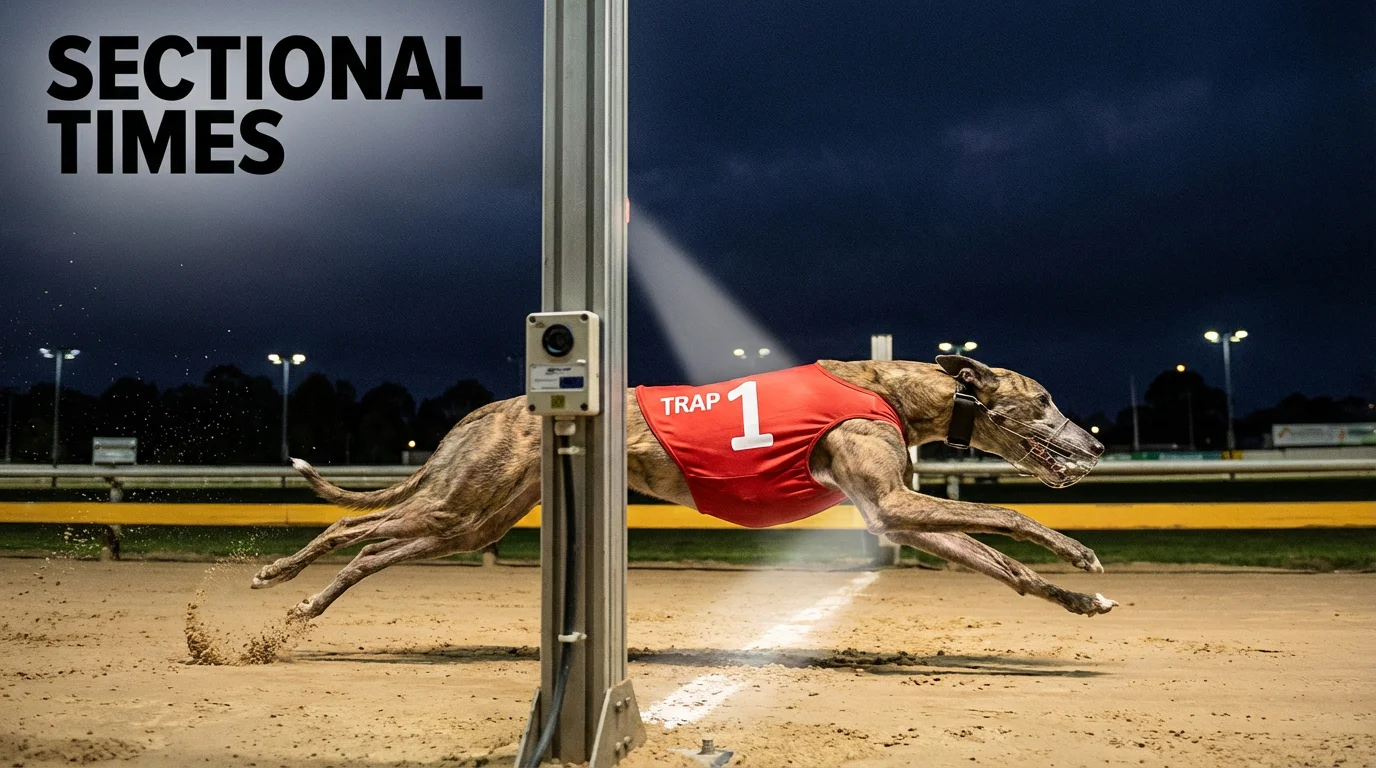
The sectional time is recorded by an electronic beam positioned at a fixed point on the track, typically around the first or second bend depending on the venue. When the traps open, the clock starts. When the leading dog — or each dog individually, depending on the timing system — breaks the beam, the sectional is recorded.
At most UK tracks, the sectional time published on the race card is the time of the dog in question, not the leader. This means you can compare sectionals between dogs in the same race to see who was in front at the first split and by how much. If dog A recorded a sectional of 5.22 seconds and dog B recorded 5.45 seconds, dog A reached the timing point roughly a length and a half ahead.
The exact position of the timing beam varies by track. At Towcester, the first split is measured around the second bend on the 500m trip. At shorter-running tracks like Romford (400m standard), the sectional captures an earlier portion of the race. This means sectional times are not directly comparable across different tracks — a 5.30 sectional at Towcester covers a different portion of the race than a 5.30 at Romford.
Some modern timing systems record multiple splits, providing a more detailed speed profile of each dog’s run. However, the standard race card typically shows only the first sectional. For more granular data, specialist services like Timeform offer expanded sectional breakdowns for selected meetings.
The sectional time is always read alongside the overall finishing time. The gap between the two — informally called the “run-in time” or “closing sectional” — tells you how the dog performed after the first split. A fast first sectional with a slow overall time means the dog led early but faded. A slower first sectional with a competitive overall time means the dog was closing ground through the race. Both patterns have betting implications that are different from what the overall time alone would suggest.
Early Pace vs Finishing Speed — What Running Styles Mean for Betting
Greyhound running styles broadly fall into three categories based on sectional times: front-runners, mid-pack runners, and closers. Each style has different betting profiles depending on the race conditions, and the sectional data is the primary tool for classifying them.
Front-runners show consistently fast first sectionals. They break sharply, take the lead by the first bend, and attempt to maintain that advantage to the finish. The betting advantage of a front-runner is predictability — if the dog traps quickly, it controls the race. The disadvantage is vulnerability. A front-runner that gets bumped at the first bend or meets another fast trapper from an adjacent box loses its primary weapon. Two front-runners drawn side by side in traps 1 and 2 will often compromise each other’s runs, creating opportunities for dogs behind them.
Closers show slower first sectionals but faster closing splits. They settle behind the pace, avoid the first-bend traffic, and pick up tiring dogs in the final hundred metres. The advantage is that closers are less affected by poor draws and first-bend interference. The disadvantage is that they need the race to unfold in a specific way — fast early pace that produces tired leaders. In a tactical race with a moderate early tempo, the closer never gets the opportunity to unleash its finishing speed.
Mid-pack runners fall between the two extremes. Their sectionals are neither notably fast nor notably slow. These dogs tend to be versatile but rarely spectacular. In betting terms, they’re the hardest to assess because their performance depends heavily on the pace dynamics of each individual race. A mid-pack runner can look like a world-beater when the pace collapses ahead of it and invisible when it gets stuck behind a wall of dogs on the bend.
The practical betting application: match running styles to race conditions. If a race features three fast trappers drawn in traps 1, 2, and 3, the early pace will be fierce and the closing ground will open up for a dog drawn wider with a strong finishing split. If the race has only one genuine front-runner, that dog is likely to get a soft lead and control the race from the front. Sectional times are the data that makes this analysis possible — without them, you’re guessing at running styles instead of measuring them.
Derby heats are a particularly good arena for sectional analysis. The quality of the field means that pace dynamics are more predictable than in a standard graded race, and the consequences of getting trapped behind a wall of traffic on the first bend are magnified because every dog in the race is capable of capitalising on a mistake. Knowing which dogs have the sectional speed to lead from the traps — and which have the closing power to come from behind — shapes your assessment of how each heat is likely to unfold.
Comparing Sectionals Across Different Tracks
The most common mistake with sectional times is comparing them between different venues. A first sectional of 5.20 at Towcester and 5.20 at Hove look identical on paper but measure different things. The timing beam is in a different position relative to the traps. The track surface differs. The distance to the first bend differs. A direct comparison is misleading at best and actively harmful to your analysis at worst.
What you can compare is the relative sectional within the same race. If dog A clocked 5.22 and dog B clocked 5.38 in the same heat at Towcester, the gap of 0.16 seconds represents roughly a length and a half at race speed. That relative comparison is valid because both dogs ran on the same track, on the same night, under the same conditions. The absolute numbers vary by venue, but the relative gaps within a race are consistent and meaningful.
You can also compare a dog’s sectional times across multiple runs at the same track. If a dog consistently records sectionals of around 5.25 at Towcester but clocks 5.40 on its latest run, something changed — a slower break, interference at the first bend, or a loss of early speed. Tracking a dog’s sectional trend at a given venue reveals form changes that the overall finishing time might mask, because a slower sectional can be compensated by a faster closing split without the overall time moving significantly.
For bettors following the Greyhound Derby, where every round takes place at Towcester, this simplifies matters considerably. You’re comparing sectional times at the same track across consecutive weeks, which makes the data directly comparable. A dog that improves its sectional by 0.10 seconds between the first round and the quarter-finals is showing sharpened early pace — and that trend is more predictive of future performance than a single snapshot time.
What Sectional Times Don’t Tell You
Sectional times have real limitations. The first and most important: they don’t account for interference. A dog that was bumped at the first bend and lost two lengths will record a slow sectional, but the slow time reflects the incident, not the dog’s natural pace. Without watching the race — or reading the comment codes on the card — you’d look at that sectional and conclude the dog lacks early speed. In reality, it simply had its run disrupted.
Track conditions also affect sectionals. A heavy, rain-softened sand track produces slower times across the board. A fast, dry surface produces quicker splits. If you’re comparing a dog’s sectional from one week to the next and the track conditions changed significantly, the comparison isn’t straightforward. Some data providers adjust for track conditions; most don’t.
The timing technology itself introduces variability. Not all UK tracks use the same precision of timing equipment. Beam positions can be affected by maintenance and recalibration. While these variations are small — fractions of a second — they can matter when you’re making fine comparisons between closely matched dogs.
Finally, sectionals tell you about pace, not about class. A dog can have blazing early speed and still lose because it lacks the stamina to maintain it, the temperament to handle pressure on the bend, or the class to compete against better opposition. Sectional times are one input into your assessment, not the assessment itself. They’re most powerful when combined with form figures, comment codes, and an understanding of the race conditions.
Speed Is Data — Use It Like Data
Sectional times turn an opinion about how a dog runs into a measurable fact. That front-runner you think leads every race? The sectional confirms it — or exposes the assumption. That closer you assume is always finishing fast? The data shows whether the closing split supports the theory or contradicts it.
The most effective use of sectionals is systematic. Track them across multiple runs at the same venue. Compare them within races, not across tracks. Watch for trends — improving sectionals signal sharpening form, deteriorating sectionals flag potential problems. And always cross-reference with the comment codes, because the numbers alone don’t capture the full picture of what happened on the track.
Sectional times are not a secret weapon. They’re available to anyone who checks the race card. The advantage comes from actually using them, which most casual bettors don’t.