
The Other Derby That Matters
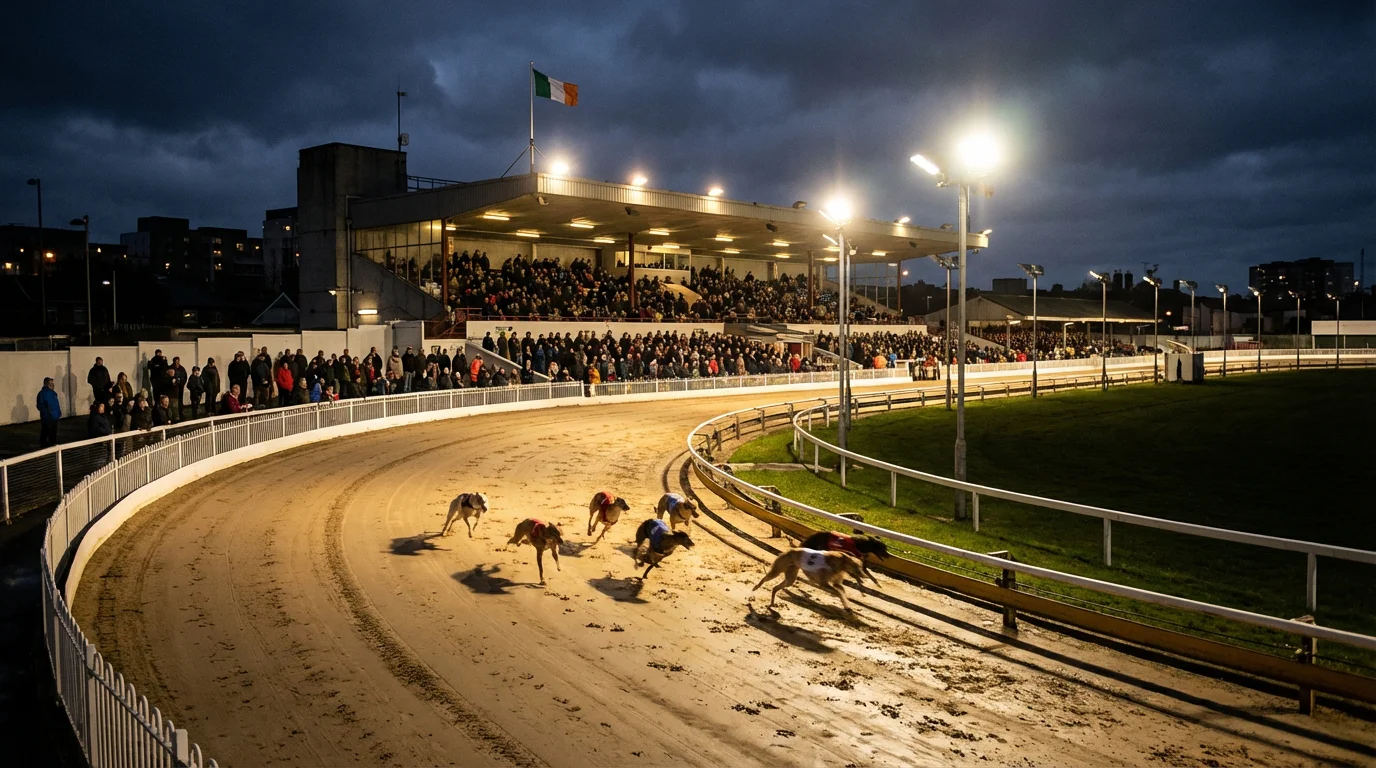
The English Greyhound Derby gets the majority of UK betting attention, but it is not the only Derby on the calendar. The Irish Greyhound Derby, held at Shelbourne Park in Dublin, is the premier greyhound event in Ireland and one of the most prestigious dog races in the world. For UK-based punters, it occupies a curious position — widely known, occasionally bet on, but rarely studied with the same rigour as its English counterpart.
That is a missed opportunity. The Irish Derby draws elite-level greyhounds from both sides of the Irish Sea, produces form that directly feeds into the English racing calendar, and offers a betting market that is less scrutinised by UK punters than the English equivalent. Understanding the Irish Derby — its format, its differences from the English version, and how to read cross-Derby form — adds a dimension to your greyhound betting that most UK punters ignore entirely.
Format — How the Irish Derby Is Structured
The Irish Greyhound Derby is a multi-round knockout tournament run over 550 yards at Shelbourne Park, Dublin. The competition typically begins in late August or early September and runs through to a final in late September or October, though exact dates shift year to year. It is organised by Greyhound Racing Ireland (GRI), which governs the sport in the Republic of Ireland.
The structure follows a similar principle to the English Derby: a large entry field is drawn into first-round heats, with the top finishers progressing through successive rounds to a six-dog final. The number of rounds varies depending on the entry size, but the competition typically involves four to five rounds including quarter-finals and semi-finals. The top finishers from each heat progress, with qualification rules varying by round.
Entries regularly include dogs that have already competed in the English Derby earlier in the year. A dog that reached the semi-finals at Towcester in June might appear in the Irish Derby at Shelbourne Park in September, giving bettors a direct form comparison across the two competitions. Irish-trained dogs dominate the entry lists, naturally, but UK-trained entries travel for the event and the cross-border flow of runners creates a shared form book that savvy punters can exploit.
Prize money for the Irish Derby is substantial by greyhound racing standards, though historically lower than the English equivalent. The event is the centrepiece of the Irish greyhound calendar and generates significant betting interest in Ireland, where greyhound racing enjoys a deeper cultural presence than in the UK.
How the Irish Derby Differs from the English
The most immediately relevant difference is the track. Shelbourne Park is a tight, galloping circuit with sharp bends and a shorter run to the first turn than Towcester. The 550-yard distance is slightly longer than the standard English 500 metres, but the course configuration is tighter, which changes race dynamics. Dogs that thrive on Towcester’s long run-up and generous bends may find Shelbourne’s tighter geometry less forgiving. Conversely, dogs with sharp early pace and the ability to handle tight turns can excel at Shelbourne even if they are not the fastest over a straight.
The trap draw plays out differently at Shelbourne Park. The inside traps carry a stronger advantage at Shelbourne than at Towcester because the first bend comes up quickly and the rail provides a navigational shortcut that wide runners cannot replicate. This is the opposite dynamic to Towcester, where the long run-up neutralises much of the inside-trap advantage. UK bettors who carry their Towcester trap assumptions into Irish Derby markets are likely to misprice the draw.
The going conditions differ too. Shelbourne Park uses a sand surface, like most modern tracks, but the specific sand composition, drainage patterns and maintenance regime produce different running conditions. A time recorded at Shelbourne is not directly comparable to a time at Towcester — the tracks are different shapes, different surfaces in practical terms, and different distances. Cross-track time comparisons are one of the most common errors in greyhound betting, and the English-Irish comparison is particularly prone to it.
The market structure also differs. The Irish Derby betting market is smaller than the English equivalent, with less bookmaker competition and less public money. Irish bookmakers price the event competitively, but the market depth is thinner, which means prices can be more volatile and less reflective of true probabilities. For UK bettors accessing the Irish Derby through UK bookmakers, the available prices may differ from the Irish on-course market, creating potential discrepancies.
Cross-Derby Form — Reading Between the Two Competitions
The most valuable aspect of the Irish Derby for UK bettors is the cross-over form. Dogs that run both Derbys provide direct data points: how they performed at Towcester, how they recovered over the summer, and how they adapted to a different track configuration. This form crossover is a genuinely useful analytical tool if you use it correctly.
A dog that reached the English Derby final in June and then enters the Irish Derby in September has three months of form trajectory to assess. Did it come out of the English campaign fresh or fatigued? Has the trainer given it time to recover or has it raced through the summer? Did it perform better in the early rounds at Towcester — suggesting it peaks early — or did it improve as the competition progressed — suggesting it handles a long campaign well?
Irish-trained dogs that skipped the English Derby but enter the Irish version are harder to assess from a UK perspective. Their form may be strong at Irish tracks but invisible to UK form databases. Checking Irish results through the Greyhound Racing Ireland website gives you access to race cards, results and times from Irish meetings. This is not a deep form analysis service, but it provides the raw data you need to evaluate an unfamiliar dog rather than relying on bookmaker prices alone.
The crossover works in the other direction too. A dog that won or placed in the Irish Derby and then enters a UK open race in the autumn carries form that most UK punters have not seen. If you have followed the Irish Derby and noted which dogs impressed, you have an information advantage when those dogs appear on UK race cards weeks later.
Betting Angles for UK Punters
UK bookmakers offer ante-post and heat betting on the Irish Derby, though the market depth and price range are typically narrower than for the English event. The ante-post market opens later — usually after entries are confirmed in August — and compresses more quickly because the competition runs over a shorter period.
The key angle for UK bettors is exploiting the information gap. Most UK punters do not follow Irish greyhound form closely. They may recognise the name of an English Derby finalist that enters the Irish Derby, but they will not have watched the Irish trial form, assessed Shelbourne-specific trap data, or evaluated the Irish-trained entries that constitute the majority of the field. The punter who fills that gap — even partially — has a material edge over the UK market.
Trap draw is a sharper tool at Shelbourne than at Towcester. If you are betting on Irish Derby heats, weighting your assessment towards inside-trap speed and early-pace dogs is more important than it would be for the equivalent English heats. The track geometry demands it. A strong dog drawn wide at Shelbourne faces a more significant disadvantage than the same dog drawn wide at Towcester.
One Calendar, Two Derbys, Twice the Information
The Irish Derby is not a lesser version of the English event. It is a parallel competition that tests many of the same dogs on a different track with different dynamics and a different market. For the UK bettor willing to look beyond Towcester, it is a source of form data, betting opportunities and information advantages that most of the market does not bother to collect. The dogs run both. The form connects. The only question is whether you are paying attention to both sides of the Irish Sea.
