Best Greyhound Betting Sites – Bet on Greyhounds in 2026
Loading...
Six Dogs, One Lure, Thirty Seconds — The Basics Explained
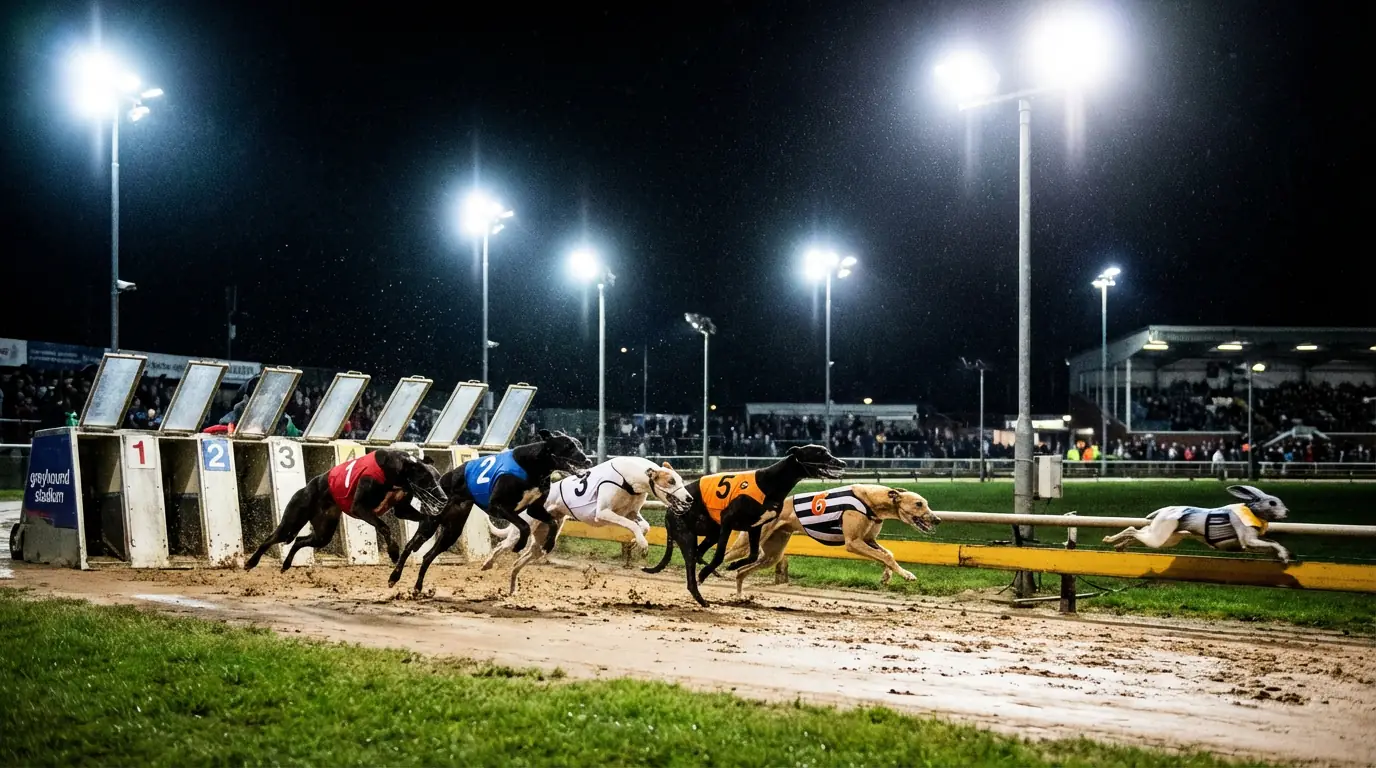
Greyhound racing is one of the simplest spectator sports to understand. Six dogs chase a mechanical lure around an oval track. The first dog across the finish line wins. Races last roughly twenty-five to thirty-five seconds depending on the distance, and there are no jockeys, no tactics mid-race, and no team strategies. The dogs run on instinct, and the result is determined by speed, early positioning, and whatever happens at the bends.
Behind that simplicity sits a structured sport with licensed tracks, grading systems, regulated race conditions, and a governing body that oversees welfare and competition standards. For anyone new to the sport — whether as a spectator, a potential owner, or a bettor — understanding the basic mechanics is the essential first step.
This guide covers how UK greyhound racing operates: the tracks, the lure, the runners, the race types, and the rules that govern competition.
UK Greyhound Tracks — Layout, Surface and the Lure
Licensed UK greyhound tracks are oval circuits with four bends and two straights. Track sizes vary — some are tight, compact circuits of around 380 metres in circumference, while others are larger galloping tracks approaching 500 metres around. The running surface is sand-based, maintained by the track’s ground staff and harrowed between races to keep it consistent. Weather affects the surface: rain softens it and slows race times; dry conditions firm it up and produce faster running.
The mechanical lure — often called the hare — runs on a rail positioned on the inside or outside of the track, depending on the venue. In the UK, inside-rail lures are most common. The lure is an artificial object, typically a stuffed fur shape, powered by an electric motor that maintains a fixed distance ahead of the leading dog. The lure operator adjusts its speed throughout the race to keep it just out of reach, maintaining the dogs’ pursuit instinct without allowing them to catch it.
The starting traps are positioned at a fixed point on the straight. Each trap holds one dog, and all six traps open simultaneously at the start of the race. The traps are numbered 1 to 6, with trap 1 on the inside and trap 6 on the outside. The position relative to the first bend determines how much advantage the inside traps have — at tracks with a short run to the first bend, inside traps are heavily favoured. At tracks with a longer run-up, the advantage is reduced.
The UK currently has 18 licensed greyhound stadia operating under the authority of the Greyhound Board of Great Britain. These range from major venues like Towcester, Romford, and Sheffield to smaller regional tracks. The number has declined from a peak of dozens of tracks in the mid-twentieth century, as stadium redevelopment and changing economics have reduced the footprint of the sport. The tracks that remain are purpose-built racing facilities with on-site kennels, veterinary support, and broadcast equipment for SIS Racing coverage.
Race Types — Graded, Open, Handicap and Feature Events
The most common race type in UK greyhound racing is the graded race. Dogs are assigned a grade (A1 through A11, varying by track) based on recent performance, and races are assembled by matching dogs of the same grade against each other. This ensures competitive fields where the six dogs are of roughly similar ability. Graded racing forms the bulk of every BAGS and evening card.
Open races sit above the grading structure. Any dog can be entered regardless of grade, and the field is assembled on merit and connections’ ambition. Open races carry higher prize money and attract the best dogs at the track. The Greyhound Derby, St Leger, and other Category 1 events are all Open races. For bettors, Open race form is the most reliable indicator of a dog’s true class ceiling.
Handicap races use staggered starts to equalise the field. Dogs with faster recorded times start further behind the traps, while slower dogs start closer to them. The aim is to produce a race where all six dogs should, in theory, finish together if they run to their handicap marks. Handicap races are less common than graded races but appear on some evening cards, particularly at larger tracks. They’re popular with bettors because the staggered starts create unpredictability that graded races don’t.
Feature events — Category 1, 2, and 3 competitions — are the major prizes in the greyhound calendar. These are Open races with significant prize money, often run as knockout tournaments over multiple rounds. The Derby is the premier Category 1 event. Others include the St Leger (a staying event), the English Oaks (for bitches), the Golden Jacket, and the Cesarewitch. Feature events attract the best dogs in the UK and Ireland and generate the most betting interest.
Runners, Traps and Jackets — How a Race Comes Together
A standard UK greyhound race features six runners. This is smaller than Australia’s eight-dog fields and significantly smaller than horse racing fields, which can exceed twenty runners. The six-dog format is fundamental to greyhound betting — it limits the number of variables, makes forecast and tricast bets mathematically viable, and produces a sport where each runner has a statistically meaningful chance of winning.
Each dog is assigned a trap and wears a coloured jacket corresponding to its trap number. The colours are universal across UK racing: trap 1 is red, trap 2 is blue, trap 3 is white, trap 4 is black, trap 5 is orange, and trap 6 is black with white stripes. These colours are visible from distance, allowing spectators and punters watching on screen to identify each dog during the race.
Before the race, dogs are paraded in the parade ring. This allows the track veterinarian to inspect each runner and gives bettors a chance to assess the dogs’ physical condition and demeanour. After the parade, the dogs are loaded into the starting traps. The traps are sprung simultaneously, the lure begins its circuit, and the race is underway.
Photo finishes are decided by the track’s camera system, which captures the moment each dog’s nose crosses the finish line. Distances between finishers are recorded in lengths and fractions — a neck, a short head, a length and a half. These margins matter for form analysis: a dog beaten a short head in its last race was effectively as good as the winner, while one beaten six lengths was clearly outclassed.
Reserve runners are maintained for each race. If a dog is withdrawn before the race — due to injury, illness, or failing the pre-race veterinary inspection — a reserve takes its place in the same trap, wearing the same coloured jacket. Reserves are typically lower-grade dogs and may alter the race dynamics when substituted into a higher-grade field.
Governance and Rules — Who Runs the Sport
The Greyhound Board of Great Britain is the sport’s regulatory authority. GBGB licenses tracks, registers greyhounds, employs racing officials, and enforces the rules of racing. Its responsibilities include anti-doping testing, welfare standards, and the integrity of competition. All licensed UK tracks operate under GBGB rules, which provide a standardised framework for race conditions, grading, and disciplinary procedures.
Drug testing is a routine part of greyhound racing. Random samples are taken from runners at every meeting, and positive tests result in disqualification of the result, suspension of the trainer, and potential bans. The testing regime is designed to ensure that race results reflect natural ability rather than pharmaceutical enhancement.
Welfare is an increasingly prominent aspect of GBGB governance. Regulations cover kennel conditions, exercise requirements, veterinary care, and retirement protocols for racing greyhounds. The Greyhound Trust and other rehoming organisations work alongside the industry to ensure that retired racers find domestic homes. Welfare standards have improved significantly in recent decades, though the subject remains a point of public debate and ongoing regulatory attention.
For bettors, the regulatory framework provides a degree of confidence that race results are legitimate and that the competition is conducted fairly. Knowing that the sport is regulated, tested, and subject to disciplinary oversight is a basic assurance that underpins the integrity of the betting market.
Simple to Watch, Worth Understanding Deeply
Greyhound racing’s appeal has always been its accessibility. You can walk into a track, watch a race, and understand what happened in thirty seconds. But beneath that surface simplicity sits a sport with structured competition, measurable form data, and a regulatory framework that ensures the results mean something. The bettor who understands the structure — the tracks, the grades, the race types, the rules — has a richer and more informed foundation than one who just watches the dogs run.
The sport is faster than horse racing, simpler than football, and more frequent than both. Whether you’re watching for entertainment or betting with purpose, understanding how the machinery works is the first step toward getting more from both.