Best Greyhound Betting Sites – Bet on Greyhounds in 2026
Loading...
Your One-Page Guide to Every Dog in the Race
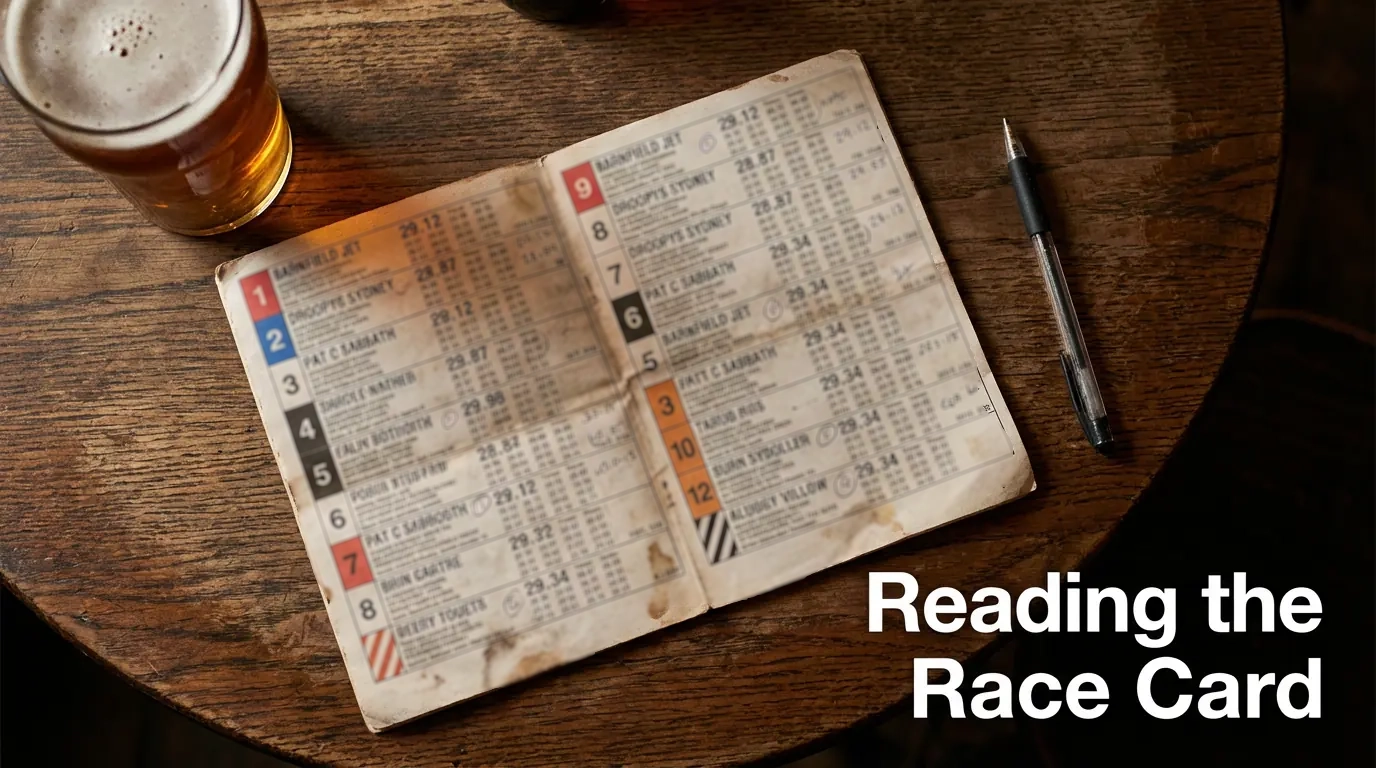
A greyhound race card is a compressed data sheet for each race on a meeting’s schedule. It lists every runner, their recent form, their best times, their trap draw, and a set of abbreviations that summarise how each dog has performed in its last few outings. For anyone new to greyhound racing, the card looks like a wall of numbers and letters with no obvious meaning. For the experienced bettor, it’s the single most important document of the evening.
Every piece of information you need to form a betting opinion on a greyhound race is on the card. The challenge isn’t access — race cards are free on bookmaker websites, the Racing Post, and track-specific apps. The challenge is knowing which data points matter, which ones are decorative, and how to read the shorthand that the sport has used for decades.
This guide walks through each element of a standard UK greyhound race card, from the trap number to the comment codes, and explains how to extract the information that actually helps you make better betting decisions.
Anatomy of a Greyhound Race Card — Column by Column
A standard UK race card for a single greyhound race contains several core columns, presented in a consistent format across most providers. The exact layout varies slightly between the Racing Post, Timeform, and bookmaker platforms, but the data is the same.
The trap number comes first. This is the starting position — trap 1 through trap 6 — and it corresponds to the coloured jacket the dog wears: red (1), blue (2), white (3), black (4), orange (5), black and white stripes (6). [GBGB Rule 118 – Racing Jackets] The trap number tells you where on the track the dog starts, which matters for running style analysis and trap bias at specific venues.
Next is the dog’s name and, on most cards, the trainer. The trainer is listed because kennel form is a legitimate form indicator — a trainer with multiple runners in a race may have a preferred selection, and a trainer whose kennel is in a hot streak brings a statistical edge. Some cards also show the dog’s sire and dam, which is relevant for breeding enthusiasts but rarely for betting purposes at race level.
The form figures follow. These are the finishing positions from the dog’s most recent races, read from left to right (oldest to most recent). A form line of 2-1-1-3-1-2 tells you the dog finished second, then won twice, then third, then won again, then second. The number of form lines shown varies — some cards show the last six runs, others up to ten. A “0” in the form line means the dog finished outside the placed positions (typically worse than third in a six-runner race). A dash or gap means the dog didn’t race in that period.
Best time is typically displayed as the dog’s quickest recorded time at the race distance or at the track. This figure needs context: a best time of 29.50 at Romford over 400m means something different from 29.50 at Towcester over 500m. Times are track-specific and distance-specific — you can compare times between dogs running at the same track and distance, but cross-track comparisons require adjustment for track speed.
The sectional time shows the split time at the first timing point, usually around the first bend. This reveals the dog’s early pace — whether it leads from the traps or finishes strongly from behind. A quick sectional combined with a slower overall time suggests a front-runner that fades. A slower sectional with a competitive overall time points to a closer who picks up dogs in the final stages.
Weight is recorded in kilograms. Greyhounds typically race between 26kg and 36kg, with weight changes between runs sometimes indicating fitness or condition shifts. A significant weight increase might suggest the dog is between peak fitness cycles. A slight drop might indicate the trainer has sharpened the dog for a specific race. Weight is a secondary indicator, not a primary one, but sharp bettors note it.
Season status is marked for female greyhounds. A bitch in season cannot race, and a recent season can affect form for several weeks after the dog returns. Cards mark this with “S” or a similar notation. If a bitch shows a dip in form following a return from season, the explanation may be physical rather than a decline in ability.
Finally, the comment line provides a short coded summary of how the dog ran in its most recent race. This is where abbreviations like SAw (slow away), QAw (quick away), Led (led the race), Crd (crowded), and RnOn (ran on strongly) appear. These codes are dense and essential — they tell you not just where the dog finished but how it got there.
Reading Form Figures — What the Numbers Tell You
Form figures are the first thing most bettors scan when they open a race card. A string of 1s looks impressive. A string of 5s and 6s looks poor. But the story behind the numbers matters more than the numbers themselves.
A dog with recent form of 1-1-1 has won three consecutive races. That’s obviously positive — but it also means the dog has likely been raised in grade after each win. The next race might be at a significantly higher level than the previous three, and the opposition will be stronger. A dog stepping up in grade after a winning run is not the same bet as a dog maintaining its level. The form figures show you wins. The grade of each race tells you the context.
Conversely, a form line of 4-5-6 looks discouraging until you check the grades. If those results came at A1 or Open level against the best dogs in the country, the same animal might be a strong bet when dropping back to A3 or A4. Grade drops are one of the most reliable value angles in greyhound betting, and they’re invisible to anyone who only reads the raw finishing positions.
Consistency matters more than individual peaks. A form line of 2-1-2-2-1-2 is often more bankable than 1-6-1-5-1-6. The first dog reliably finishes in the top two. The second wins or bombs — and the pattern suggests that its wins depend on specific conditions (trap, draw, interference) that may or may not recur. For forecast and each-way betting, the consistent placer is significantly more useful than the occasional winner.
Look at the number of runs between form entries as well. If a dog’s card shows a gap of several weeks between races, it might have been rested, treated for an injury, or given a break after a season. The first run back after a layoff is often below the dog’s best — trainers call it a “pipe opener,” and the results reflect the lack of race fitness. A poor first run back from a break is not necessarily a sign of declining form. It’s often the precursor to improvement on the second or third outing.
Finally, pay attention to trap numbers in previous form. Many cards show which trap the dog ran from in each of its form lines. A dog that won from trap 1 three times running but is now drawn in trap 5 faces a very different challenge. If all the wins came from a favourable draw, the form may not transfer to an unfavourable one. The trap column within the form data is one of the most underused pieces of information on the card.
Comment Codes — The Hidden Story of Every Race
The comment codes on a greyhound race card compress an entire race narrative into a few letters. Learning to read them turns a list of finishing positions into a film of the race. Here are the codes you’ll encounter most often on UK cards.
Start codes: QAw means quick away — the dog broke sharply from the traps. SAw means slow away — the dog was sluggish at the start. MsdBrk means missed break — a more severe version of SAw, where the dog lost significant ground at the boxes. Bmp1 means bumped at the first bend, indicating early interference. These start codes are critical because greyhound races are short. A dog that misses the break by two lengths in a 480m race may never recover that deficit.
Running codes: Led means the dog led the field at some point. EvCh (every chance) means the dog was in a position to win but couldn’t finish the job. Crd means crowded — the dog lost ground due to interference from other runners. Bmp means bumped, with a number indicating which bend (Bmp2 = bumped at bend two). Chl means challenged — the dog made a serious bid for the lead. RnUp means ran up, typically describing a dog that closed ground.
Finish codes: RnOn means ran on — the dog was finishing strongly at the line, suggesting it might prefer a longer distance or was closing fast. Fdd means faded — the dog weakened in the closing stages, which can indicate fatigue, lack of stamina at the distance, or peaking too early. WRnUp means wide ran up, describing a dog that closed from a wide position. These finish codes help you distinguish between a dog that was beaten because it wasn’t good enough and one that was beaten by circumstances.
Context codes: Stb means stumbled. CkRun means checked in running — the dog had its progress interrupted by another runner. Bln means baulked on the line, typically at the final bend. These codes explain why a finishing position might not reflect the dog’s true ability. A dog that finished fourth after being checked at the second bend and crowded on the run-in might be a better bet next time than its form figure suggests.
The practical application: when you see a dog with a form line of 4-3-5 but the comments show Crd, CkRun, and Bmp2 in those races, the picture changes. This isn’t a dog in decline — it’s a dog that has been unlucky. Whether that luck turns is never guaranteed, but the comment codes give you grounds for a reassessment that the raw numbers alone don’t support.
Putting It Together — How to Scan a Card in Two Minutes
You don’t need to memorise every code and column to use a race card effectively. A practical reading process takes less than two minutes per race once you develop the habit. Start with the form figures — identify which dogs have been winning or placing consistently. Then check the grades of those recent runs to see if the form is at a comparable level to tonight’s race. Look at the sectional times to gauge early pace — dogs drawn on the inside with quick early speed from the traps are dangerous in any race. Finally, scan the comment codes for the last two runs to check for excuses or trouble in running.
That four-step scan — form, grade, sectionals, comments — gives you a shortlist of two or three contenders in most six-runner races. From there, you refine based on trap draw, weight, and any trainer patterns you recognise. The full process becomes instinctive within a few meetings, and it’s the foundation on which every more advanced form analysis technique is built.
The Card Is Talking — Are You Listening?
A greyhound race card is the densest source of betting information available for a single race. Every column, every abbreviation, every number is there for a reason. The bettor who can read the card fluently sees things that the casual punter misses — the dog with excuses, the dog stepping up in class, the consistent placer at a generous price.
Learn the codes. Read the form in context. Check the grades. And do it for every race you bet on, not just the ones where you already have a favourite. The card doesn’t play favourites. It gives everyone the same information. What separates the punters is what they do with it.