Best Greyhound Betting Sites – Bet on Greyhounds in 2026
Loading...
Two Dogs, One Order — What Makes Forecasts Click
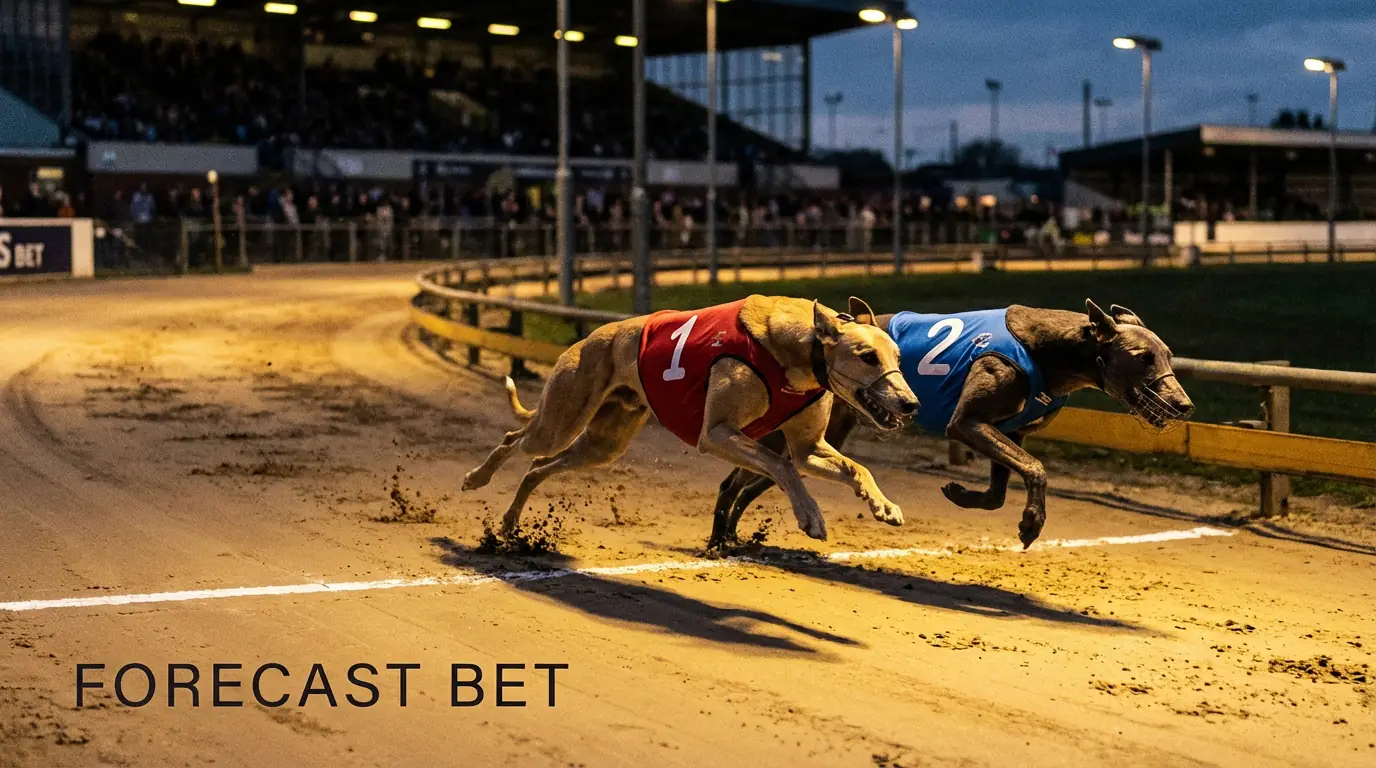
A forecast bet asks you to name the first two finishers in a greyhound race. Not just the winner — the winner and the runner-up, in the correct order. It sounds like a small extra demand, but it changes the nature of the wager entirely. You’re no longer asking which dog wins. You’re asking how the race unfolds.
That distinction is what makes forecasts so well suited to greyhound racing. With only six runners in a standard UK race, the number of possible first-and-second combinations is thirty. That’s manageable. Compare it to horse racing, where a twelve-runner handicap produces 132 possible forecast outcomes, and the appeal of doing this with greyhounds becomes obvious. Six dogs. Thirty combinations. You need to be right about two of them.
The reward for getting it right is significantly higher than a win single. A dog that pays 3/1 to win might be part of a forecast that returns north of 15/1, depending on the second dog’s price. That’s the core attraction: forecasts multiply the returns from a single race without requiring you to string multiple events together in an accumulator. Your edge — or your mistake — lives and dies within one thirty-second contest.
Forecasts are also the bet type where watching races pays the biggest dividend. If you study running styles, you start to recognise which dogs consistently finish in the first two without always winning. The perennial runner-up. The early leader who gets caught on the line. These dogs are forecast gold, and they’re invisible to anyone who only looks at win-or-lose results.
This guide covers the three main types of forecast bet — straight, reverse, and combination — and when each one makes sense.
Straight Forecast — Exact Order, Exact Returns
The straight forecast is the purest version of the bet. You select two dogs: one to finish first, one to finish second. Both must finish in exactly those positions for the bet to win. There is no margin for error and no consolation if they finish the other way around.
In UK greyhound racing, straight forecast dividends are determined by the Computer Straight Forecast, a formula maintained by the industry that calculates the return based on the starting prices of the two dogs involved. This means you don’t get fixed odds when you place the bet — the dividend is declared after the race, once the SP of every runner is confirmed. You’ll see it written as CSF on your betting slip or results page.
The CSF formula weights the calculation based on how the full field was priced. If your two selections were the 2/1 favourite and the 7/2 second favourite, the return might sit in the region of £15 to £20 for a £1 stake. If the winner was 5/1 and the runner-up 10/1, the same stake might return £80 or more. The formula accounts for the improbability of the exact combination, not just the individual prices.
This is where straight forecasts get interesting for the punter who does their homework. If you identify a race where the likely winner is reasonably obvious but the runner-up spot is genuinely open, you can target a decent-priced second dog to boost the CSF return. The classic scenario is a short-priced favourite who should win comfortably, paired with a 6/1 or 8/1 shot you believe will outrun its price for second. The favourite suppresses the return on a win single — 6/4 or shorter — but the combination with a longer-priced runner-up lifts the forecast into worthwhile territory.
The key discipline with straight forecasts is that order matters absolutely. If you fancy two dogs to fill the first two places but can’t separate them, the straight forecast becomes a coin toss — and you’re staking real money on it. In that situation, a reverse forecast is the honest bet.
When to use a straight forecast? When you have a strong opinion on the winner and a reasoned case for a specific runner-up. Not a guess. A case. That might mean a dog who consistently runs second from a particular trap, or one whose sectional times suggest it will close fast without quite catching the leader. Straight forecasts reward specificity, and specificity requires watching races, not just reading form cards.
Reverse Forecast — Same Dogs, Any Order
A reverse forecast is two straight forecasts combined into a single bet. You select two dogs, and you’re covered regardless of which one finishes first and which finishes second. Dog A first, Dog B second — it pays. Dog B first, Dog A second — it also pays. The catch is straightforward: it costs twice the unit stake, because you’re placing two bets.
The return you receive is the CSF dividend for whichever order actually occurs. So if you place a £1 reverse forecast, your total outlay is £2. If your dogs finish first and second, you receive the CSF payout for that specific combination — not both combinations, just the one that happened. This means the return from a reverse forecast is always lower, pound for pound, than a straight forecast on the correct permutation. You’re paying for insurance, and insurance has a price.
That price is worth paying more often than most bettors realise. The reverse forecast isn’t the lazy option. It’s the correct bet whenever two dogs are closely matched and the race shape could go either way. If both are prominent early-pace runners from inside traps, the first bend decides who leads — and that’s a split-second margin you can’t predict from form alone. Insisting on a straight forecast in that situation isn’t confidence. It’s stubbornness.
Consider a practical example. Two dogs, both priced around 3/1, drawn in traps 1 and 2. Both are confirmed railers with quick early speed. A £1 reverse forecast costs you £2. If the CSF for the winning combination is £18.50, you’ve returned more than nine times your outlay. A £1 win single on either dog at 3/1 returns just £4. The reverse forecast doesn’t just beat a single — it demolishes it, provided both dogs finish in the top two.
The reverse forecast also works well when a clear favourite is almost certain to be involved in the finish but the second spot is contested. Rather than picking one straight forecast, you can place separate reverse forecasts pairing the favourite with each second-place candidate. This costs more — £2 per pairing — but it creates coverage that single bets can’t replicate.
Where the reverse forecast loses its appeal is in races where one dog is a heavy odds-on favourite. If trap 3 is 1/3, the CSF return for any combination involving that dog will be suppressed. Your £2 reverse forecast might return £7 — barely worth the effort. In those races, you’re better off looking at the tricast or skipping the bet entirely. And remember: a reverse forecast does not pay out if only one of your dogs finishes in the top two. Dog A wins, Dog B finishes third — you lose both legs. The order is flexible, but both positions must be filled by your selections.
Combination Forecast — More Dogs, More Coverage
A combination forecast expands the concept beyond two dogs. You select three or more runners, and the bet covers every possible first-and-second permutation among your selections. It’s the forecast equivalent of casting a wider net — more coverage, more chance of landing a payout, but a higher total stake to match.
The cost calculation is simple but important. For a combination forecast, the number of bets equals the number of selections multiplied by one less than the number of selections. Three dogs produce six bets (3 x 2). Four dogs produce twelve (4 x 3). Five dogs produce twenty (5 x 4). In a six-runner greyhound race, selecting all six would produce thirty bets — covering every possible forecast outcome. At £1 per line, that’s a £30 stake on a single race. You’d need a substantial CSF return just to break even.
The practical sweet spot for combination forecasts in greyhound racing is three selections. Six bets at your chosen unit stake gives you broad coverage of a race where you’ve identified three dogs likely to fill the top two spots. If any two of your three selections finish first and second in any order, you collect the corresponding CSF dividend. The question is always whether that dividend will exceed your £6 outlay — and in most cases with three reasonably priced dogs, it will.
Let’s put numbers to it. You select three dogs priced at 3/1, 4/1, and 7/1. A £1 combination forecast costs £6. If the 4/1 and 7/1 shots fill the top two places, the CSF return might be £45 to £55. If the 3/1 and 4/1 shots come first and second, perhaps £18 to £22. Even the lower end comfortably clears the £6 stake. The maths works when at least one selection is priced at 4/1 or longer.
Where combination forecasts become dangerous is when you start adding a fourth or fifth selection. Four dogs means twelve bets at £12 per unit stake. In a six-runner greyhound race, selecting four dogs for a combination forecast means you’ve included two-thirds of the field. At that point, you’re not identifying value — you’re paying a premium for uncertainty.
Combination forecasts are particularly effective in open races where the field is competitive and no single dog dominates the market. A six-dog race priced at 3/1, 7/2, 4/1, 5/1, 6/1, and 8/1 is territory for a three-dog combination forecast. The prices suggest genuine uncertainty, the CSF returns will be healthy for most combinations, and the total stake remains modest. Races with a 4/7 favourite surrounded by outsiders are the opposite scenario — the favourite suppresses every CSF dividend, and the combination becomes expensive relative to the likely return.
When Forecasts Beat Singles — A Practical Test
The decision between a forecast and a single isn’t about which bet sounds more exciting. It’s a question you can answer with three pieces of information: how many dogs do you think can realistically finish in the top two, how confident are you in the winner specifically, and what are the prices?
If you’re confident about the winner but the dog is short-priced — say, 6/4 or less — a win single returns very little relative to the risk. A straight forecast pairing that favourite with a longer-priced runner-up magnifies the return without requiring you to bet on additional races. You’re leveraging your confidence in the winner to generate a better payout from a single event.
If two or three dogs look capable of filling the first two positions but you can’t separate them, a reverse or combination forecast lets you express that opinion honestly. A win single forces you to pick one. The forecast reflects the actual state of your knowledge — and that honesty tends to produce better results over time.
When do singles win out? When the favourite is strong enough to back at a decent price and you have no meaningful view on the runner-up. A 3/1 shot you genuinely fancy returns more, more often, than a forecast where the second leg is a hopeful guess. The forecast demands that both halves of your opinion carry weight. If one half is just filling a box, stick with the single.
There’s also a frequency argument. Greyhound meetings feature ten to twelve races in a session. Three combination forecasts across an evening card might cost £18 in stakes, while the same evening approached with win singles might cost £9. The punter who uses forecasts selectively — two or three per card, in races where the form genuinely suggests a forecastable result — will outperform the one who defaults to them on every race.
Two Names on a Slip, One Right Answer
Forecast betting strips away the safety net that a win single provides. There’s no “close enough.” Your two dogs either fill the top two spots or they don’t. That binary outcome is what scares a lot of punters away from forecasts — and it’s exactly what makes them rewarding when you get it right.
The bettors who do well with forecasts are the ones who watch races, not just results. They notice the dog who finishes second three times out of four from trap 5. They spot the early leader who always gets caught by the same closer. A forecast rewards the punter who understands the shape of a race from the traps to the line — not just who crosses first.
Start with straight forecasts in races where you have a genuine view on first and second. Move to reverses when the top two are clear but the order isn’t. Use combinations sparingly, in open races where three dogs stand above the rest. And leave forecasts alone entirely in races where you’re guessing — because a thirty-second race doesn’t give you long enough to be wrong about two things at once.
Forecasts don’t reward luck. They reward attention. If you’re paying it, the returns are there.