Best Greyhound Betting Sites – Bet on Greyhounds in 2026
Loading...
A Six-Round Tournament — Not a Single Race
The Greyhound Derby is not one race. It’s a knockout competition spread across six rounds and several weeks. From the opening heats to the final, the field is progressively whittled down — over sixty entries reduced to six finalists through a process that tests speed, consistency, temperament, and no small amount of luck at the draw.
For bettors, this structure changes everything. You’re not assessing a single race. You’re assessing a campaign. A dog that looks brilliant in round one might be drawn against the wrong rival in the quarters. A dog that scrapes through its heat in third might be the one peaking at the right time for the final. The format creates layers of information, risk, and opportunity that don’t exist in standard one-off races.
Understanding how the Derby is structured — the rounds, the progression rules, the seeding system, and the draw mechanics — is the foundation of any serious Derby betting approach.
Round by Round — How the Derby Unfolds
The Derby typically runs through six rounds, though the exact structure can vary slightly depending on the number of entries. The standard format for the modern Derby at Towcester follows this pattern.
The first round consists of heats spread across two or three nights of racing. The full entry list is divided into heats of six dogs each. At the entry stage, the field can number anywhere from 48 to 72 dogs depending on the year, producing eight to twelve first-round heats. Each heat is a standalone 500m race at Towcester, and the result determines who advances.
The second round follows after the first-round qualifiers have been reshuffled into new heats. Again, six dogs per heat, run over 500m at Towcester. The process is identical to the first round in terms of race format, but the quality of the field has already been filtered. Dogs that couldn’t handle the pace, the track, or the occasion have been eliminated. The second round is faster, tighter, and produces significantly more useful form data for the rounds ahead.
The third round continues the pattern, reducing the field further. By this stage, the Derby is into its middle phase and the contenders are becoming clearer. Dogs with two strong rounds behind them at Towcester have established a track-specific form profile. The betting market reflects this — prices shorten on impressive performers and drift on dogs that have qualified without convincing.
The quarter-finals are typically run on a single night, with four heats of six dogs producing twenty-four runners. This is the first round where the draw takes on heightened significance, because the reduced field means that quality dogs are more likely to face each other directly. A quarter-final heat featuring two pre-tournament favourites is a different proposition from one where the favourite has a clear class advantage over the field.
The semi-finals compress the competition to two heats of six. Twelve dogs remain, and only the top three from each semi-final reach the final. The semi-final draw is the most scrutinised moment of the entire competition — which six dogs end up in which semi-final, and which traps they draw, shapes the betting for the final before a stride has been run.
The final is a single race: six dogs, 500m, Towcester. The culmination of a multi-week campaign, settled in roughly twenty-eight seconds. Prize money for the 2026 Derby is £125,000 for the winner — down from the £175,000 awarded in 2025 — making it the richest race in British greyhound racing.
How Dogs Progress — The Top Three Rule
The standard progression rule in the Greyhound Derby is that the top three finishers in each heat advance to the next round. First, second, and third all qualify. Fourth, fifth, and sixth are eliminated. There are no wild cards, no fastest losers, and no discretionary places. Finish in the top three or go home.
This rule has significant implications for betting. It means that winning a heat is not the only objective — qualifying is. A dog that finishes third in every round still reaches the final. A dog that wins four rounds brilliantly but finishes fourth in a semi-final is out. The format rewards consistency and survival as much as it rewards outright speed.
For forecast and tricast bettors, the top-three progression rule shapes the market in heat races. The three dogs most likely to qualify are not always the three with the best form — they’re the three whose running styles are least likely to compromise each other. Two confirmed front-runners drawn in adjacent inside traps might both finish in the top three, or they might tangle at the first bend and open the door for closers behind them. Reading the heat dynamics, not just individual form, is what separates good Derby bettors from ones who simply back the shortest-priced dog in each race.
Reserve runners are part of the system. If a dog is withdrawn before a heat, a reserve from the original entry list takes its place. The reserve’s form and draw position can disrupt pre-race assessments, so checking for late changes before each round is essential.
Seeding and the Draw — How Heats Are Assembled
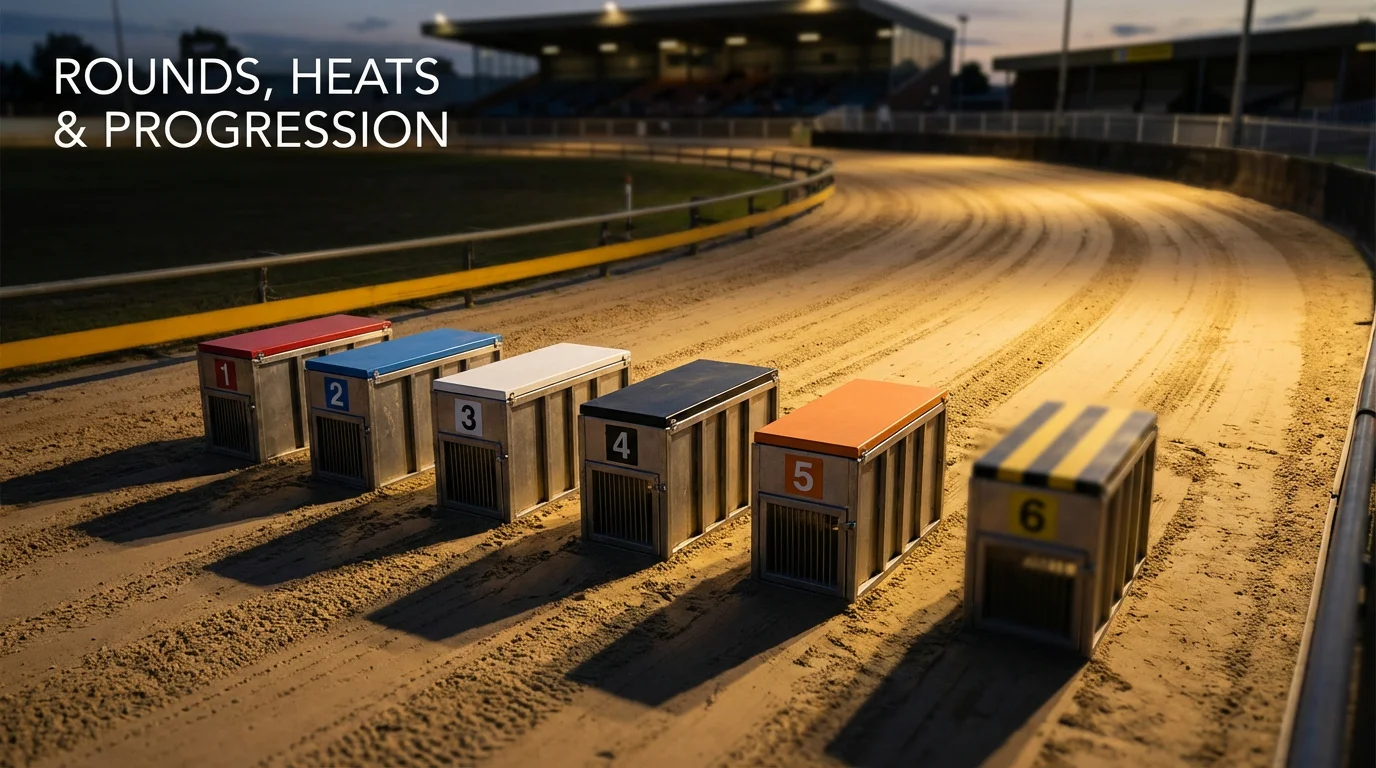
The Greyhound Derby doesn’t assemble heats randomly. Dogs are seeded based on their running style — categorised as railers, middle seeds, or wide seeds. Railers run best from inside traps (1 and 2), wide seeds from outside traps (5 and 6), and middle seeds from traps 3 and 4. This classification is typically made by the racing office based on the dog’s known racing characteristics and recent form.
Within each heat, the draw is conducted publicly to ensure transparency. Two railers, two middle seeds, and two wide seeds are placed into each heat, and a draw determines which specific trap each dog occupies within its seeding band. A railer might draw trap 1 or trap 2, but it won’t draw trap 5. This system ensures that each heat contains a balanced mix of running styles and that no heat is loaded with dogs who all want the same racing line.
The draw takes on increasing importance as the competition progresses. In the first round, with twelve or more heats, the matchups are spread thinly. By the quarter-finals, with only four heats, the draw determines which contenders face each other and which get an easier passage. The semi-final draw is the most impactful — a favourite who ends up in the tougher semi-final faces a harder route to the final than one drawn in the weaker half.
For bettors, the draw announcement is a key moment in the Derby calendar. Ante-post prices move immediately after the draw is revealed. A dog that draws well — inside trap, weaker opposition in its heat — will shorten. A dog that draws badly — outside trap, facing the other pre-tournament favourite — will drift. Bettors who react to draw information quickly, before the market fully adjusts, can capture value in the minutes after the announcement. Those who wait find that the prices have already moved.
The seeding system also means that certain types of races recur. A heat featuring two fast railers in traps 1 and 2 will produce a different race shape than one with two closers in the middle traps. Recognising these patterns and predicting the likely pace scenario from the seeding composition is a skill that improves with experience and is directly applicable to heat-by-heat betting throughout the competition.
Why the Format Creates Unique Betting Opportunities
No other greyhound event in the UK produces the volume and quality of betting opportunities that the Derby format creates. Each round generates six to twelve individual races, each with its own market, its own draw dynamics, and its own form data feeding into the next stage. The outright market reshapes after every round. Heat betting, forecast markets, and each-way opportunities appear at every stage.
The tournament structure also generates information asymmetry. A bettor who watches every heat, tracks every sectional, and notes every comment code from the first round onwards accumulates knowledge that the casual punter — the one who only looks at the outright market before the final — simply doesn’t have. That accumulated knowledge is the Derby bettor’s primary edge, and the format guarantees that the edge deepens with each passing round.
The six-round journey from entry to final is what makes the Derby the most compelling betting event in British greyhound racing. The bet types are familiar. The track is the same every round. What changes is the information — and the bettor who processes that information most effectively has an advantage that grows with every heat.
Six Rounds, One Winner, Twenty-Eight Seconds
The Derby format is the race’s greatest asset and its greatest challenge for bettors. It rewards patience, punishes impulsive early-round wagers, and creates a data trail that builds across weeks of competition. Every round eliminates dogs, clarifies form, and reprices the market. By the time six dogs walk to the traps for the final, the picture is as complete as it will ever be — and the bettor who has studied every frame of it is the one best placed to read what happens next.
Understand the format before you place a penny. Everything else follows from there.