Best Greyhound Betting Sites – Bet on Greyhounds in 2026
Loading...
The One Promotion That Actually Puts Money Back in Your Pocket
Most bookmaker promotions are designed to look generous while costing you nothing extra to take advantage of — and giving the bookmaker nothing extra to worry about. Free bet offers come with wagering requirements. Enhanced odds apply to one race, one time, one new customer. Loyalty schemes reward volume, which is another way of saying they reward losing.
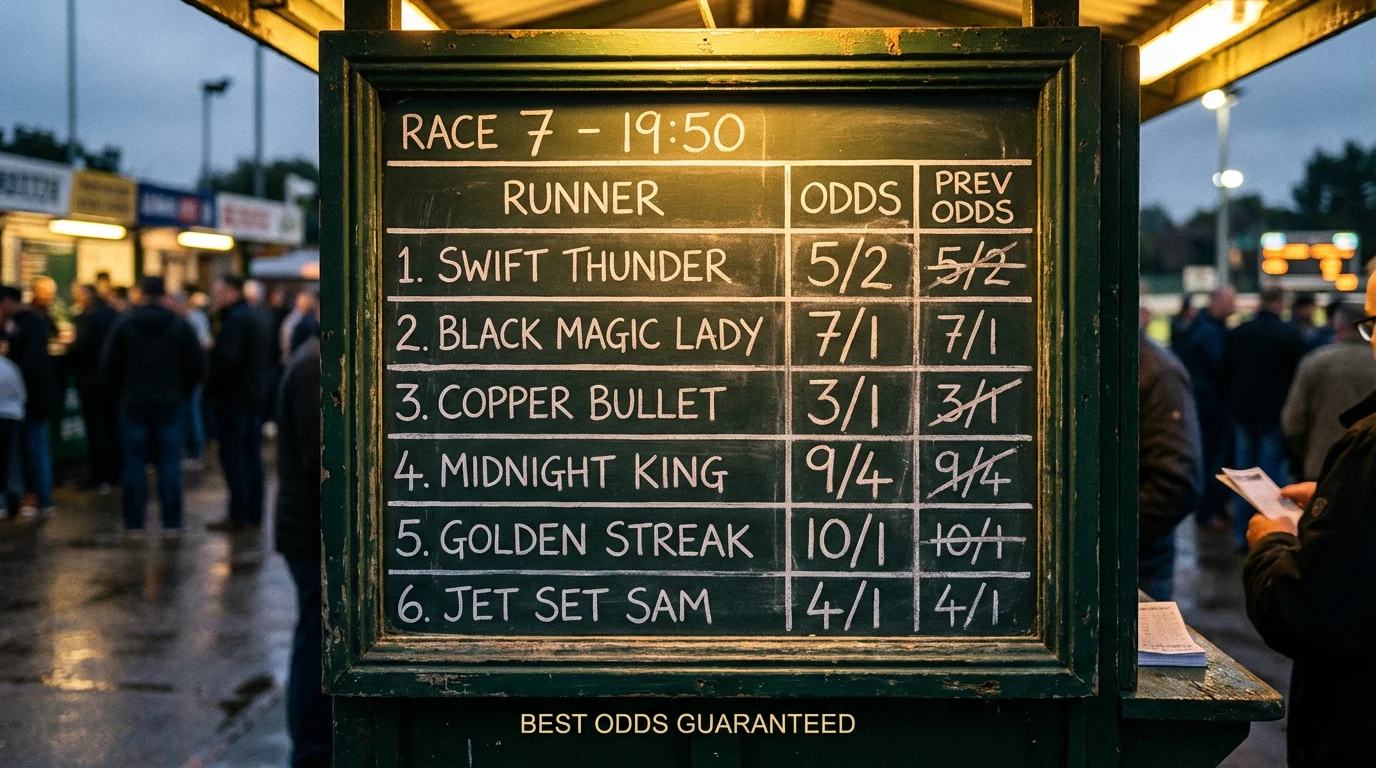
Best Odds Guaranteed is different. It is the single most valuable ongoing promotion available to greyhound bettors in the UK, and it works in your favour every time the starting price drifts above the price you took. You back a dog at 5/1 in the morning. By the time the traps open, the SP has moved to 7/1. With BOG, you get paid at 7/1. No application, no opt-in, no minimum stake threshold. The bookmaker simply pays you the better price.
The catch — and there is always a catch — is that BOG coverage varies enormously across bookmakers, and the variation is sharper in greyhound racing than in any other sport. Some bookmakers offer BOG on every greyhound meeting in the country. Others restrict it to BAGS races only. A few extend it to selected open meetings but exclude the rest. If you do not understand which races qualify, you are leaving money on the table without realising it.
How Best Odds Guaranteed Works in Greyhound Racing
The mechanics are straightforward. You place a bet at a fixed price — the board price or early price offered by the bookmaker before the race. If the starting price at the off is higher than the price you took, the bookmaker settles your bet at the higher SP. If the SP is equal to or lower than your price, nothing changes — you keep the price you originally accepted.
The key word is starting price. In greyhound racing, the SP is determined by the on-course market at the track — the prices offered by the bookmakers at the venue when the traps open. This is distinct from the prices shown on betting websites and apps, which are set by the bookmaker’s own trading team and may not move in the same direction. It is entirely possible for an online price to shorten while the on-course SP drifts outward, or vice versa.
In practice, BOG triggers most frequently on greyhound races because the on-course market for dogs is thinner and more volatile than the horse racing equivalent. There are fewer on-course bookmakers at greyhound tracks, fewer large wagers moving the market, and more scope for price discrepancies between online and on-course. This means SP drift is common, and when it happens, BOG pays.
There are conditions. BOG almost always applies only to win bets and the win part of each-way bets. It does not apply to forecast or tricast bets, where payouts are calculated via a computer formula rather than fixed odds. It does not apply to bets placed via the tote or pool. And it does not apply to bets placed in-play, although in-play greyhound betting barely exists in any meaningful form.
Some bookmakers impose a maximum payout uplift under BOG — if the SP would take your potential return above a certain threshold, the BOG enhancement is capped. Others apply BOG without limit, up to their standard maximum payout for the sport. The terms matter. A bookmaker advertising BOG with a low cap is offering less protection than one advertising BOG with standard limits.
BAGS Races vs All Meetings — Where BOG Actually Applies
This is where greyhound BOG gets complicated, and where most punters make incorrect assumptions. The UK greyhound fixture list is split into two broad categories: BAGS races and independent or open meetings.
BAGS stands for Bookmakers’ Afternoon Greyhound Service, though the acronym now covers both afternoon and evening fixtures. BAGS races are the bread and butter of the greyhound betting calendar — the daily cards from tracks like Romford, Crayford, Sheffield, Sunderland, Kinsley, and Monmore. These meetings are contracted to provide betting content to licensed bookmakers via SIS Racing, and they run almost every day of the year. BEGS — the evening equivalent — extends this into the later slots. Most of what you see when you open a bookmaker’s greyhound section on any given Tuesday is BAGS or BEGS racing.
Independent meetings, also called flapping or unlicensed meetings at some levels, sit outside the BAGS contract. More importantly, major open-race meetings at GBGB-licensed tracks — including Category 1 events like the English Greyhound Derby, the St Leger, the Oaks, and prestigious opens at Towcester, Nottingham, and elsewhere — are not always classified as BAGS for BOG purposes, even though they are held at licensed tracks.
The distinction matters because many bookmakers restrict BOG to BAGS/BEGS races only. If you back a dog in a Derby heat at Towcester thinking BOG applies, and the meeting is classified as an independent fixture, you will be paid at the price you took — not the SP, even if the SP was higher. The bookmaker’s terms will specify this, usually in the small print of their greyhound BOG rules.
A smaller number of bookmakers extend BOG to all UK greyhound meetings, including opens and major events. This is the gold standard, and it is worth knowing which bookmakers offer it. During the Derby, when ante-post prices are taken days or weeks before a heat and SPs can move significantly, BOG on all meetings provides genuine financial protection that BAGS-only BOG does not.
Which Bookmakers Offer BOG on Greyhounds
Bookmaker BOG policies change frequently — promotions are adjusted, terms are tightened or relaxed, and coverage can shift between BAGS-only and all meetings with little notice. Rather than listing specific bookmakers and their current policies, which would be outdated within weeks, the approach that serves you best is knowing what to look for and where to verify it.
Every major UK-licensed bookmaker publishes its BOG terms in the promotions section of its website. The information you need is usually contained in a short terms-and-conditions page linked from the greyhound landing page or the promotions hub. Look for three things. First, whether BOG applies to greyhound racing at all — not all bookmakers offer it for dogs, even if they offer it for horses. Second, whether coverage is restricted to BAGS/BEGS meetings or extended to all UK greyhound fixtures. Third, whether there is a maximum payout uplift or cap on the BOG benefit.
A common pattern in the UK market is that the largest bookmakers — those with the highest turnover and widest customer base — tend to offer BOG on at least BAGS racing as standard. Smaller or newer operators may not offer greyhound BOG at all, or may restrict it to specific tracks or timeframes. The bookmakers that extend BOG to all meetings are typically the ones with a strong greyhound trading desk and a commercial interest in attracting dog racing customers specifically.
The practical advice is to check BOG terms at the start of every major event. Before the Derby begins, look at the greyhound promotions page for your two or three primary bookmaker accounts. Confirm whether BOG covers the specific meetings you plan to bet on. If one bookmaker covers all meetings and another covers BAGS only, that should influence where you place your Derby bets — not just which bookmaker has the marginally better price on the nose.
It is also worth noting that the Gambling Commission requires licensed operators to present promotional terms clearly and not misleadingly. If a bookmaker advertises BOG on greyhounds without specifying BAGS-only restrictions prominently, that may not comply with the advertising codes. Knowing your rights as a customer makes it easier to challenge a bookmaker that fails to honour its published terms.
When BOG Makes a Real Difference to Your Returns
BOG does not affect every bet equally. Its value depends on how much the SP moves relative to the price you took, and how often that movement occurs. In greyhound racing, both factors work in the punter’s favour more than in most other sports.
The races where BOG provides the greatest uplift are those with volatile on-course markets — typically open-class events with strong form contenders and active on-course betting. When the on-course market reacts to late money or kennel confidence, the SP can drift two, three, or even four points above the early price. On a morning price of 4/1 that drifts to 7/1 at the off, BOG adds 75% to your return for free. That is not a marginal benefit. Over a season of betting, it compounds into a measurable edge.
BOG matters less on short-priced favourites in weak races, where the SP tends to be close to the early price and the scope for upward drift is small. It also matters less on races where you are backing very long shots — a 20/1 chance drifting to 25/1 adds relatively less in absolute terms than a 4/1 drifting to 7/1, even though the percentage change is similar. The sweet spot for BOG value sits in the mid-range: selections priced between 3/1 and 10/1 in competitive races with active markets.
The Simplest Edge You Will Ever Find
There are very few genuine edges available to the retail bettor. Most of what the betting industry calls an edge is really just a different flavour of the same margin. BOG is the exception. It is a mechanism that pays you more than the price you accepted, at no additional cost, with no wagering requirement, on bets you were going to place anyway. The only effort required is checking which bookmaker offers it on the races you care about.
If you bet on greyhounds with any regularity, BOG should be a factor in where you place your bets — not the only factor, but a meaningful one. A bookmaker with slightly shorter prices but comprehensive BOG coverage may return more over a season than one with marginally better odds but no BOG at all. The maths is simple, even if the bookmakers would rather you did not think about it too carefully. Take the better price where you can. Let BOG handle the rest.