Best Greyhound Betting Sites – Bet on Greyhounds in 2026
Loading...
The Early Market — Why Ante-Post Exists in Greyhound Racing
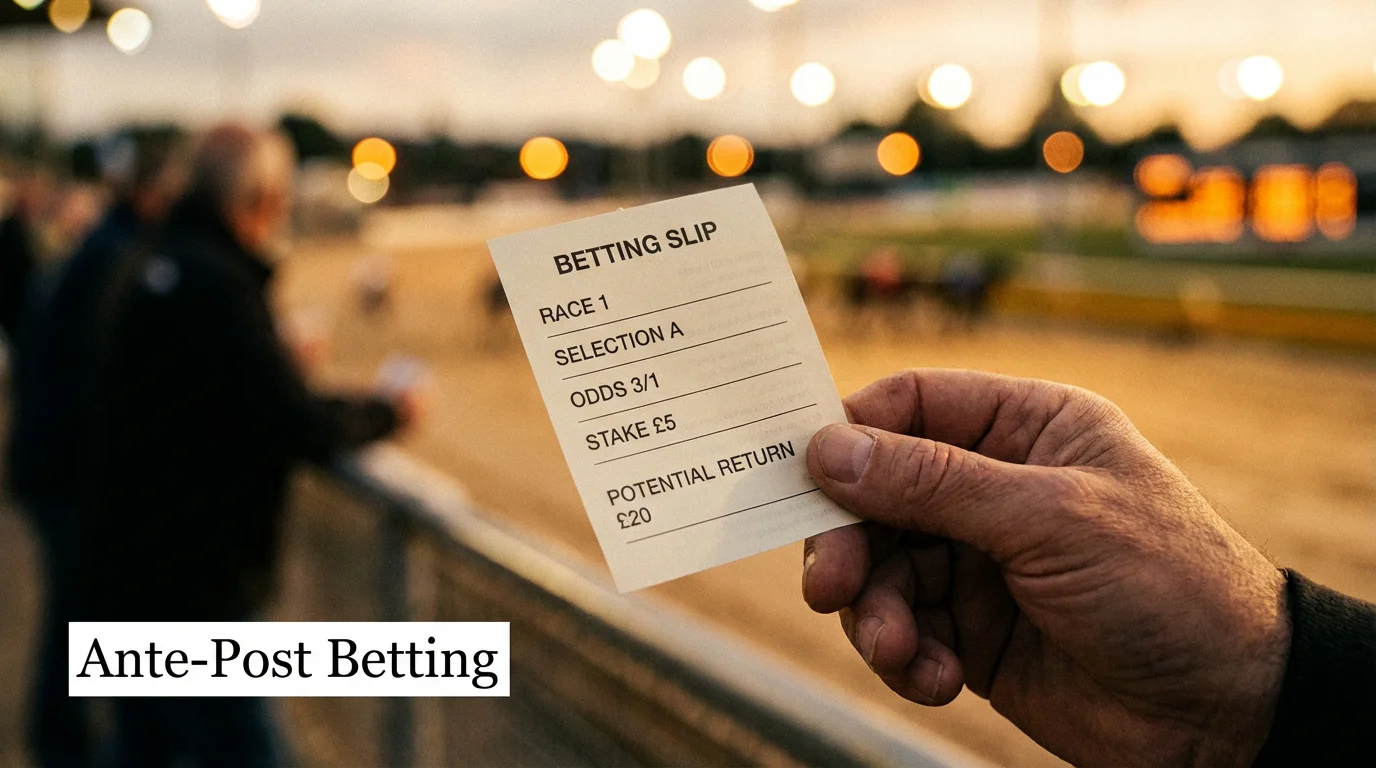
Ante-post betting means placing a wager before the day of the race — sometimes weeks or months in advance. In greyhound racing, this market exists almost exclusively around major tournament events: the Greyhound Derby, the St Leger, the English Oaks, and a handful of other Category 1 competitions. [GBGB – Category One Schedule] For standard evening meetings and BAGS cards, there is no ante-post market. The races are too frequent and the fields too fluid for bookmakers to price them up days in advance.
The appeal of ante-post is straightforward: longer odds. When a bookmaker prices up the Derby outright market six weeks before the final, they’re factoring in every possible variable — injury, elimination, poor draws, off nights. That uncertainty stretches the prices. A dog that might be 4/1 on the night of the final could be 12/1 or 16/1 ante-post, because the market hasn’t yet absorbed the information that will narrow the field.
That gap between ante-post price and race-day price is where the opportunity lives. It’s also where the risk lives, because ante-post bets come with conditions that standard race-day wagers don’t. Understanding those conditions is the difference between smart early betting and expensive guesswork.
What Ante-Post Betting Actually Means
An ante-post bet is a wager placed on an event that has not yet begun, where the standard non-runner rules do not apply. This is the critical distinction. If you back a dog in the Derby outright market ante-post and that dog is withdrawn — injured, fails a trial, or simply isn’t entered by the trainer — your bet is lost. No refund, no void. The stake is gone.
This contrasts with a standard race-day bet, where a non-runner typically results in a refund or a void bet. The bookmaker’s willingness to offer longer ante-post prices is directly tied to the non-runner risk they’re transferring to you. They’re not being generous. They’re pricing the possibility that your selection never makes it to the race.
Ante-post markets for the Greyhound Derby usually open once the entry list is confirmed, several weeks before the first round of heats. At this stage, the bookmaker has a list of sixty or more dogs and limited form data beyond their qualifying performances. Opening prices are based on reputation, trainer connections, trial times, and whatever Irish or UK form exists from recent open races. The market then evolves as each round of the Derby provides new information.
You can place ante-post bets at any point between the market opening and its closure, which typically happens shortly before the final. Some bookmakers keep the outright market open through the semi-final stage, adjusting prices after each round. Others close the ante-post market earlier and switch to standard race-day pricing for the final itself. Knowing when your bookmaker transitions between these markets matters, because the terms of your bet change with the market type.
Each-way ante-post bets are available on most Derby outright markets, usually at 1/4 odds with three places. This is one of the more attractive each-way propositions in greyhound betting, since reaching the final (top six from the semi-finals) and finishing in the top three at long ante-post prices can produce a significant place return even without a win.
The Risks of Betting Before the Traps Open
The primary risk is withdrawal. A greyhound’s racing career is physically demanding and unpredictable. Muscle injuries, track injuries, illness, and loss of form can all end a Derby campaign before it reaches the final. A dog that looked a genuine contender at the entry stage might not make it past the first round. Your ante-post bet doesn’t care about the reason — it only cares whether the dog lines up.
Elimination is the second risk. The Derby’s six-round format [Towcester – Derby 2026] means that dogs are removed from the competition at every stage. Only the top three from each heat progress. A good dog can have a bad night — bumped at the first bend, slow away from the traps, drawn against two rivals with identical running styles. One poor performance in a heat and the Derby campaign is over. Your ante-post bet pays nothing if the dog is eliminated in round two, no matter how strong its form was before.
The draw is the third factor. Ante-post bets are placed before the draw for each round is known. A confirmed railer who draws trap 6 in a crucial heat faces a genuine disadvantage, and the market adjusts immediately. But your ante-post price was set before that information existed. Sometimes the draw works in your favour and you hold a better price than the current market. Sometimes it destroys your position. You can’t control it, and you can’t adjust a settled ante-post bet after the fact.
Finally, there’s the information asymmetry. Trainers and kennel connections know more about a dog’s condition than the betting public does. A dog might trial poorly in private, pick up a minor niggle, or simply lose the sharpness it showed two weeks earlier. By the time this information reaches the market, the price has moved — but your ante-post bet was placed at the old price, which may have been based on outdated assumptions. Early money sometimes catches value. It also sometimes catches ignorance.
None of these risks should prevent you from betting ante-post. They should prevent you from betting ante-post carelessly. The size of your stake should reflect the level of uncertainty, and in ante-post markets, that uncertainty is always higher than it looks.
When to Bet — Timing Your Ante-Post Move
The ante-post market for a major greyhound event like the Derby moves through distinct phases, and each phase offers a different risk-reward profile. Understanding where you are in the cycle is at least as important as understanding which dog you want to back.
At the entry stage — when the full list of entries is published but no heats have been run — prices are at their widest. This is the highest-risk, highest-reward window. You’re betting on a dog that hasn’t yet proven it can handle the specific conditions of this year’s competition. The advantage is price: if the dog progresses to the later rounds, the ante-post price you locked in will look generous compared to the compressed odds available after three rounds of form data.
After the first round of heats, the market recalibrates. Dogs that won their heats impressively shorten. Dogs that scraped through in third lengthen or drift. This is where many sharp ante-post bettors make their first move — they have one round of evidence to validate their pre-tournament assessment, and the prices haven’t fully corrected yet. The information advantage is smaller than at the entry stage, but the risk of backing a dog that never competes is reduced.
The quarter-final stage is the most popular entry point for recreational ante-post bettors. By this point, the field has been cut significantly, survivors have demonstrated competitiveness across multiple rounds, and the draw for the quarters provides new tactical data. Prices are shorter than at the entry stage but still longer than they’ll be for the semi-finals or final. This is the phase where the balance between information and value is closest to equilibrium.
By the semi-final stage, the field is down to twelve dogs. Prices have contracted sharply, and the ante-post value is largely gone for the leading contenders. The remaining opportunities sit with semi-final outsiders — dogs priced at 14/1 or longer who could reach the final if they produce a career-best performance. The value here is narrow and specific, but it exists for bettors willing to accept that most of these wagers will lose.
A common strategy is to stagger your ante-post activity across multiple phases. A small stake at the entry stage on a well-fancied contender, followed by a larger stake after the first or second round if the dog has confirmed your assessment. This approach means your total exposure builds as your confidence grows, rather than concentrating all your risk at the point of maximum uncertainty.
Non-Runner Rules in Ante-Post Greyhound Markets
The core rule is simple: ante-post bets are all-in, run or not. If your dog is a non-runner for any reason — withdrawal, injury, failure to qualify — your stake is lost. There is no refund. This applies to both the win and place portions of an each-way ante-post bet. It applies regardless of whether the withdrawal happens six weeks before the race or the morning of the final.
This rule is universal across UK bookmakers for genuine ante-post markets. It’s the defining characteristic that separates ante-post from standard race-day betting, where non-runners trigger a refund or a void bet. The higher odds available ante-post are the bookmaker’s compensation for the non-runner risk you’re accepting.
There are occasional exceptions. Some bookmakers run promotional ante-post offers on the Derby that include a “non-runner money back” guarantee. These promotions are not standard and they’re not permanent — they appear as marketing tools around major events and typically have conditions attached (minimum odds, maximum stake, specific withdrawal timeframes). If such a promotion is available, it significantly reduces the risk of ante-post betting and is worth seeking out. But don’t assume it exists. Check the terms explicitly before placing your bet.
One grey area: the transition between ante-post and race-day markets. Some bookmakers close their ante-post market for the Derby final and open a standard race-day market for the same event. Bets placed in the race-day market are subject to normal non-runner rules — if a dog is withdrawn from the final, your bet is refunded. The timing of this switch varies by bookmaker, and it’s not always clearly signposted. If you’re betting on the Derby final specifically, check whether you’re placing an ante-post bet or a race-day bet. The difference could be the difference between a refund and a lost stake.
Patience Pays — But Only If You Know What You’re Waiting For
Ante-post betting in greyhound racing is a calculated gamble on incomplete information. The prices are longer because the risk is higher, and the risk is higher because you’re committing your money before the competition has revealed its story. Dogs get injured, draws go wrong, form evaporates. Every ante-post bettor learns these lessons, usually by losing a few bets they thought were solid.
The ones who do well over time share two habits. First, they keep their ante-post stakes small relative to their overall bankroll — acknowledging that the non-runner risk and elimination risk are real, not theoretical. Second, they time their bets to maximise the ratio of information to price. They don’t bet at the entry stage unless the price is exceptional. They don’t bet at the semi-final stage unless they’ve identified a specific overlooked dog. They wait for the moment where what they know and what they’re being offered come into alignment.
That alignment doesn’t happen on every Derby, and it doesn’t happen for every dog. But when it does, ante-post is where the best value in greyhound betting can be found — provided you’ve earned it through patience, discipline, and an honest assessment of what you don’t know yet.