
What Greyhound Odds Tell You — And What They Don’t
Every greyhound race in the UK is priced up before the dogs leave the traps. Those prices — the odds — represent two things at once: the bookmaker’s assessment of each dog’s chance of winning and the margin the bookmaker builds in to ensure a profit regardless of the result. Understanding both sides of that equation is the foundation of intelligent betting.
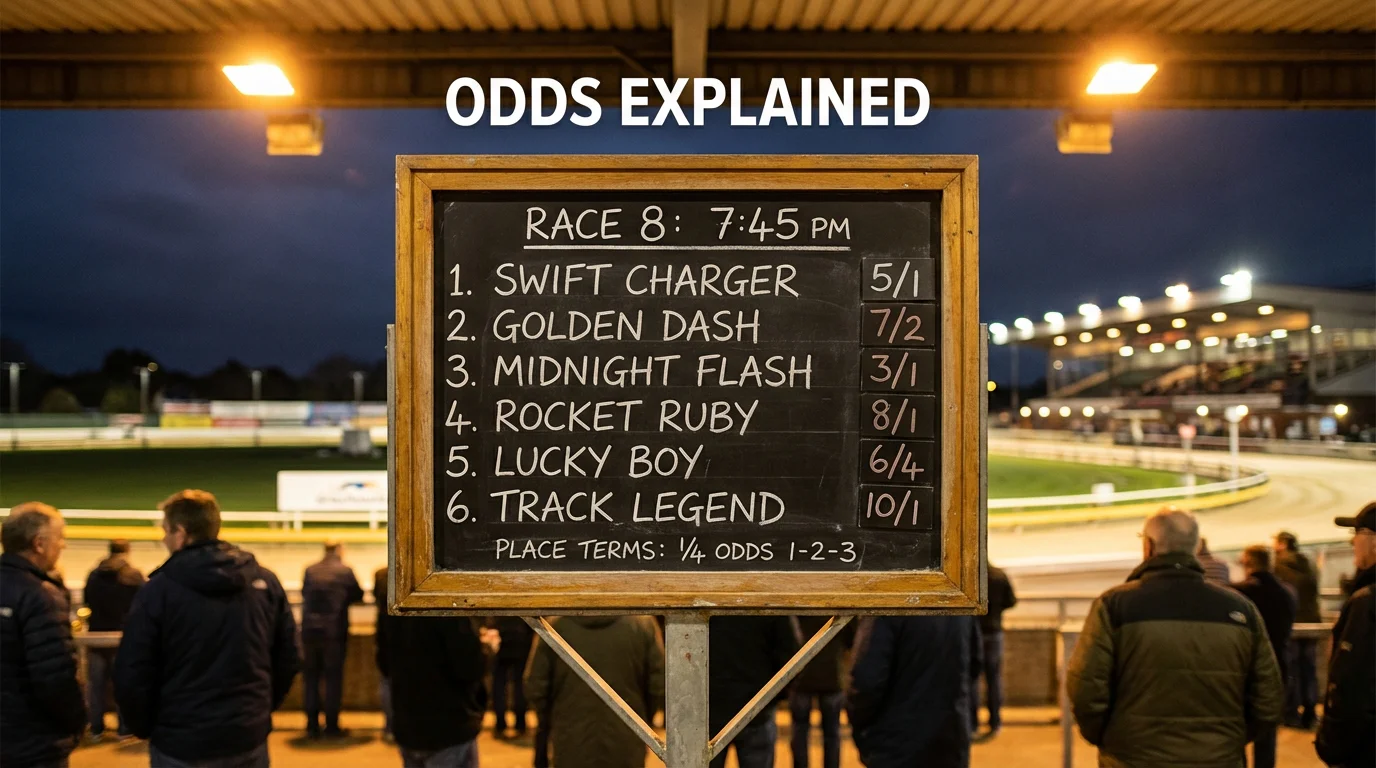
In UK greyhound racing, you’ll encounter odds displayed in two main formats: fractional and decimal. Fractional odds are the traditional British format — 5/1, 7/2, 11/4 — and remain the default on most high-street betting shop screens and many online platforms. Decimal odds — 6.00, 4.50, 3.75 — are increasingly common online and are the standard on betting exchanges. Both formats express exactly the same information. The difference is purely presentational, but bettors who can only read one format are working with half the available tools.
Beyond the format, there’s the question of when the odds are set. Greyhound racing uses three main price points: early prices (set by bookmakers hours before a race), board prices (updated in the minutes before the off), and the starting price (the official SP, determined at the moment the traps open). Each price point carries different implications for your bet, and knowing the difference is the first step toward getting consistently better value.
This guide breaks down each format, explains what SP means in practice, and gives you the tools to convert between systems quickly and confidently.
Fractional Odds — The Traditional UK Format
Fractional odds express the profit you receive relative to your stake. At 5/1, you win £5 for every £1 you stake, plus your original stake back. At 7/2, you win £7 for every £2 staked. At 11/4, you win £11 for every £4. The number on the left is the profit; the number on the right is the stake required to generate that profit.
For straightforward fractions, the maths is intuitive. 3/1 means treble your money. 10/1 means ten times your stake in profit. Where it gets less intuitive is with the more complex fractions that are common in greyhound racing: 11/8, 13/8, 100/30. These look complicated but follow the same rule. At 11/8, an £8 bet returns £11 profit + £8 stake = £19 total. Scaling down, a £1 bet at 11/8 returns £1.375 profit + £1 stake = £2.375.
Odds-on prices — where the first number is smaller than the second — indicate a short-priced favourite. At 4/6, you risk £6 to win £4 profit. At 1/3, you risk £3 to win just £1. These prices are common in greyhound racing because six-runner fields regularly produce one dog that the market considers significantly superior to the rest. Backing odds-on greyhounds is not inherently wrong, but the returns are thin and a single loss can wipe out several winning bets at those prices.
The fractional odds you see in the morning or early afternoon are the bookmaker’s opening assessment. These are called early prices. Between the early price and the start of the race, the odds may change — shortening if money comes for the dog, drifting (lengthening) if money goes elsewhere. On most UK bookmaker apps and websites, you can choose to take the current price at the time of your bet or accept SP. If you take the price, that’s the odds your bet settles at regardless of what happens to the market afterwards. If you take SP, your bet settles at whatever the starting price is when the traps open.
Fractional odds also tell you something about the bookmaker’s overround — the built-in margin that ensures the book shows a profit. In a perfectly fair book on a six-runner race, the implied probabilities of all six dogs would add up to 100%. In practice, they add up to somewhere between 115% and 130% in greyhound racing, depending on the bookmaker and the race. That excess is the bookmaker’s edge. The higher the overround, the worse the value for the punter. Comparing overrounds across bookmakers for the same race is one of the simplest ways to identify who’s offering the best prices.
One final note on fractional odds: they’re becoming less common in the online betting space, where decimal is increasingly the default display. If you grew up reading odds boards in betting shops, fractional will feel natural. If you came to greyhound betting through online platforms or exchanges, decimal may already be your first language. Either way, being comfortable with both formats gives you a significant practical advantage when comparing prices quickly across different platforms.
Decimal Odds — The Simpler Alternative
Decimal odds express the total return per unit staked, including the stake itself. At 6.00, a £1 bet returns £6 in total — £5 profit plus your £1 back. At 3.50, the total return is £3.50 per £1 staked. The calculation is always the same: multiply your stake by the decimal odds to get your total return.
This simplicity is why decimal odds have become the global standard outside the UK. There’s no fraction to decode, no mental arithmetic to convert 11/8 into something you can work with quickly. A price of 2.375 tells you immediately that a £10 bet returns £23.75. Try doing that as quickly with 11/8 and a £10 stake. Decimal wins on speed.
Decimal odds also make value comparison easier. If one bookmaker offers 4.50 and another offers 4.20 on the same dog, the better price is instantly obvious. With fractional odds — 7/2 versus 16/5 — the comparison requires a moment of conversion that slows you down. In greyhound racing, where races come every twelve to fifteen minutes and prices shift in the minutes before the off, that speed of comparison has practical value.
The relationship between decimal odds and implied probability is also cleaner. To convert decimal odds to implied probability, divide 1 by the decimal price. At 4.00, the implied probability is 1 ÷ 4.00 = 0.25, or 25%. At 2.50, it’s 40%. At 1.50, it’s 66.7%. This conversion is essential for value betting: if you believe a dog has a 30% chance of winning but the odds imply only a 20% chance (5.00 decimal), the price offers value. If the odds imply 35% (2.86 decimal), the price is too short relative to your assessment.
Most UK bookmaker apps and websites allow you to switch between fractional and decimal display in the settings. If you’re accustomed to fractional, try switching to decimal for a week. The adjustment period is short, and most bettors find that decimal becomes their preferred format once the initial unfamiliarity wears off. The maths is simply faster.
Starting Price — What SP Means and How It’s Set
The starting price is the official odds of a greyhound at the moment the race begins. In UK greyhound racing, the SP is determined by an industry-standard process that takes into account the prices offered by bookmakers at the track or, for races without on-course betting, by a panel of industry officials. It’s the baseline price that many bets settle at, particularly when you don’t take a specific price at the time of placing your bet.
For most BAGS racing — the Bookmakers Afternoon Greyhound Service, which covers the bulk of daytime and early evening meetings — SP is the standard settlement price. If you place a bet on a BAGS race without selecting a specific early or board price, your bet settles at SP. This is also the price used to calculate forecast and tricast dividends through the Computer Straight Forecast and Computer Tricast formulas.
SP can differ from early prices significantly. A dog priced at 5/1 in the morning might start at 7/2 if money has come for it, or drift to 7/1 if the market has moved away. If you took 5/1 early, that’s your price. If you took SP, you get whatever the market settles at. The decision of when to take a price versus accepting SP is one of the most important tactical choices in greyhound betting.
Best Odds Guaranteed — BOG — is a promotion offered by many UK bookmakers that resolves this dilemma. Under BOG, if you take an early price and the SP is higher, you’re paid at the higher price. If the SP is lower, you keep your original price. BOG effectively removes the downside of taking early prices, and it’s one of the most valuable promotions in greyhound betting. Not all bookmakers offer BOG on all greyhound races — BAGS meetings are usually covered, but independent evening meetings may not be. Always check before assuming BOG applies.
Understanding SP also helps you read market moves. A dog whose SP is significantly shorter than its morning price attracted late money — which can indicate insider confidence, kennel support, or simply that the form was stronger than the market initially recognised. A dog whose SP drifts from its opening price was expected to attract money that never materialised. Neither pattern guarantees anything, but tracking SP movements over time helps you understand how the greyhound betting market behaves and where the information tends to flow.
Converting Between Formats — Quick Reference
The conversion between fractional and decimal is a single formula. To go from fractional to decimal: divide the first number by the second and add 1. So 5/1 becomes (5 / 1) + 1 = 6.00. And 7/2 becomes (7 / 2) + 1 = 4.50. For 11/4: (11 / 4) + 1 = 3.75. To convert back from decimal to fractional: subtract 1, then express the result as a fraction. 4.00 becomes 3/1. 2.50 becomes 3/2.
The common greyhound racing prices convert as follows. Evens (1/1) = 2.00. 6/4 = 2.50. 2/1 = 3.00. 5/2 = 3.50. 3/1 = 4.00. 7/2 = 4.50. 4/1 = 5.00. 5/1 = 6.00. 6/1 = 7.00. 8/1 = 9.00. 10/1 = 11.00. These cover the vast majority of prices you’ll encounter in standard graded racing.
For the awkward fractions — 11/8 (2.375), 13/8 (2.625), 100/30 (4.33), 11/10 (2.10) — the decimal conversion makes them immediately usable. Most experienced punters memorise the common conversions and use the formula only for unusual prices. After a week of checking both formats side by side, the conversions become second nature.
To convert either format to implied probability: for decimal, divide 1 by the price. At 6.00, the implied probability is 16.7%. For fractional, add both numbers together and divide the second by the sum. At 5/1, that’s 1 / (5 + 1) = 16.7%. The implied probability is the market’s assessment of the dog’s chance of winning — before the bookmaker’s margin is accounted for. Comparing your own probability estimate against the implied probability is the simplest framework for identifying value.
The Price Is the Starting Point, Not the Answer
Odds are the language of betting. If you can’t read them fluently in both formats, you’re leaving value on the table before you’ve even made a selection. Fractional odds carry the weight of tradition and remain the dominant format in UK betting shops. Decimal odds offer speed and simplicity, particularly for quick comparisons and probability calculations. The starting price anchors it all — the official market verdict at the moment the traps open.
But knowing how to read odds is not the same as knowing how to use them. A price tells you what the market thinks. It doesn’t tell you whether the market is right. The punter who reads odds accurately and then compares them against their own assessment of the race is the one who finds value. The punter who reads odds and takes them at face value is the one the bookmaker relies on.
Learn both formats. Understand SP and when to take or leave it. Compare prices across bookmakers. And treat every set of odds as an opinion, not a fact — because that’s exactly what they are.
