

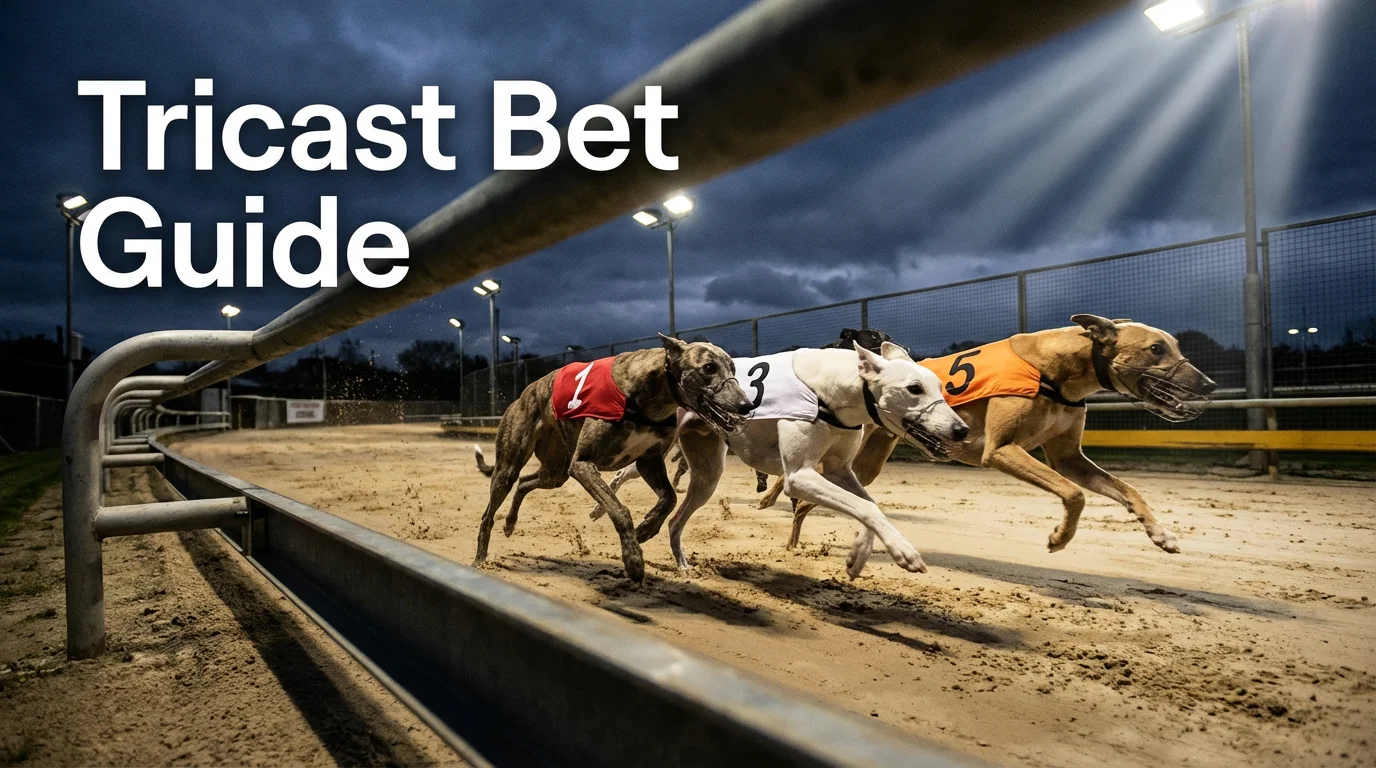
The Big Payout Bet — What a Tricast Really Is
A tricast bet asks you to name the first three finishers in a greyhound race, in the correct order. First, second, and third — all three positions, all in sequence. It’s the most demanding standard bet type in greyhound racing, and the returns reflect that difficulty. A successful tricast regularly pays multiples that make win singles and even forecasts look modest by comparison.
The maths explains the appeal and the challenge simultaneously. In a six-runner greyhound race, the number of possible first-second-third combinations is 120. A straight tricast covers exactly one of those 120 outcomes. You’re betting on a single permutation out of a field where every dog could theoretically finish anywhere. When you get it right, the payout acknowledges that improbability. When you get it wrong — which is most of the time — you lose your stake with nothing to show for it.
Tricasts thrive in greyhound racing because the small field size makes them feasible in a way that horse racing rarely allows. Naming the top three from six runners is difficult but not absurd. Naming the top three from a fourteen-runner handicap hurdle is closer to buying a lottery ticket. That distinction matters: greyhound tricasts sit in the space between skill and luck, which is exactly where the most interesting bets live.
This guide covers the two main types — straight and combination — along with realistic expectations for payouts and a framework for deciding when a tricast is worth attempting.
Straight Tricast — Exact Top Three in Order
The straight tricast is the original and simplest version. You name three dogs and assign each a finishing position: first, second, third. All three must finish in those exact positions. Dog A wins, Dog B is second, Dog C is third — and only that specific sequence pays out. Any other arrangement of those three dogs, even if all three finish in the top three, returns nothing.
Like the straight forecast, tricast dividends in UK greyhound racing are calculated using a computer formula based on the starting prices of the dogs involved. The Computer Tricast — often abbreviated CT on results pages — produces the dividend after the race. You don’t know exactly what a winning tricast will pay until the SPs are confirmed, though you can estimate based on the morning or early prices.
The dividend is heavily influenced by the prices of the second and third selections. If the favourite wins and two other short-priced dogs fill the places, the CT return might be surprisingly low — sometimes under £10 for a £1 stake. But if an outsider sneaks into second or third, the dividend escalates rapidly. A 2/1 favourite finishing first with an 8/1 shot second and a 12/1 shot third can produce a CT north of £200 for a single pound.
There’s an important distinction between the Computer Tricast and a named tricast. A named tricast uses fixed odds offered by the bookmaker before the race — you’re quoted a price for a specific 1-2-3 combination. These are rare in greyhound racing compared to horse racing, and when they are available, the margins tend to be wider. Most greyhound tricast bets settle at the CT dividend, which is calculated industry-wide and generally offers a fairer return.
The SP tricast is worth understanding too. Some bookmakers allow you to take the SP tricast, which means the dividend is calculated from the official starting prices rather than any early or board prices you might have seen. In practice, most greyhound tricasts settle this way by default, since fixed-price tricasts are uncommon. The result is that your return depends entirely on how the market closes — and in greyhound racing, late money can move SPs significantly in the final minutes before a race.
Straight tricasts suit races where you have a firm view on all three finishing positions. That’s a high bar, and it should be. If you’re confident the favourite wins, reasonably sure about the runner-up, but picking the third dog on instinct rather than evidence, the straight tricast is the wrong bet. You’re adding a weak link to a chain that needs all three parts to hold.
Combination Tricast — Any Order, Higher Cost
A combination tricast covers all possible finishing orders of your selected dogs. You pick three or more runners, and the bet includes every permutation of first, second, and third among them. If any arrangement of your selections fills the top three spots, you collect the corresponding CT dividend.
The cost is where it gets real. Three dogs in a combination tricast produce six permutations (3 x 2 x 1), so it costs six times your unit stake. A £1 combination tricast on three dogs costs £6. Select four dogs and the permutations jump to twenty-four (4 x 3 x 2), costing £24 at £1 per line. Five dogs produce sixty permutations at £60. The escalation is steep, and the economics demand that the CT dividend significantly exceeds your total outlay.
For most greyhound bettors, the three-dog combination tricast is the practical limit. Six bets. Six pounds at a pound a line. You’ve covered every possible ordering of three dogs in the top three. If you’ve correctly identified the trio — regardless of who beats whom — you collect. The freedom from having to predict exact positions is substantial, especially in races where three dogs are clearly superior but the running order is unpredictable.
The four-dog combination tricast has a narrower use case. Twenty-four bets at £1 means you need a CT return above £24 just to break even. That’s achievable when at least one of your four selections is a longer-priced runner — if a 10/1 shot finishes in the top three alongside two shorter-priced dogs, the CT will usually clear £24 comfortably. But if all four selections are priced between 2/1 and 4/1, the CT for any combination of three from that group is likely to disappoint relative to the £24 stake.
A practical approach to four-dog combination tricasts: treat the fourth selection as insurance against one of your three main picks underperforming. If you have a strong top three but one of them has a dodgy trap draw or showed signs of fading in recent races, adding a fourth dog covers the scenario where that one disappoints. It’s a specific hedge, not a scattergun approach.
Five-dog and six-dog combination tricasts exist in theory but rarely make sense in a six-runner field. A five-dog combination in a six-runner race means you’ve excluded one dog and are betting £60 to cover 60 permutations. You’re essentially betting that one specific dog won’t finish in the top three. At that point, you’re probably better off looking at a different bet type entirely.
Tricast Payouts — Expectations vs Reality
The tricast’s reputation as a big-payout bet is earned but misleading. Yes, tricasts can return hundreds of pounds for a £1 stake. They can also return £8. The range is enormous, and it depends almost entirely on the prices of the dogs involved.
When three short-priced dogs fill the top three, the CT dividend is compressed. A race where the 6/4 favourite wins, the 5/2 second favourite is second, and the 3/1 third favourite is third might produce a CT of £12 to £18. For a £1 straight tricast, that’s a tidy profit. For a £6 combination tricast, it barely breaks even — and might not. This is the most common disappointment in tricast betting: the “correct” result producing a return that doesn’t justify the stake.
The lucrative tricasts come from unpredictability. When a 10/1 outsider finishes second or third, the CT multiplies because the formula recognises the improbability. A 3/1 winner with a 10/1 runner-up and a 6/1 third might pay £150 to £200. Replace that 10/1 dog with a 20/1 shot and the return could approach £400. These are the tricasts people remember and the ones that keep bettors coming back to the bet type.
The tension, then, is this: the tricasts with the biggest payouts are the ones involving outsiders, but outsiders are by definition harder to predict. If you could reliably identify which longshot will sneak into the top three, you’d be making money from win singles on those dogs anyway. The tricast works best when you have a strong view on the top two and a reasoned case — not a hope — for a particular third dog at a decent price.
It’s also worth noting that CT dividends can vary slightly between bookmakers. The formula is standardised, but rounding, deductions, and the specific SP each bookmaker uses can produce minor differences. In practice, these differences are small enough that they shouldn’t drive your choice of bookmaker, but they’re worth checking on a big payout. A £2 difference on a £150 CT is nothing. A £20 difference on a £500 CT is worth a phone call.
Track the returns from your tricast bets over a month or a season. Most punters who do this discover that the occasional big payout doesn’t quite cover the accumulated cost of losing tricasts. That’s not a reason to avoid them — it’s a reason to be selective about when you attempt them.
Tricast Betting Strategy for Greyhounds
The first rule of tricast strategy is selection. Not every race is a tricast race. You need a specific set of conditions before the bet makes sense: a reasonably formful field where you can identify a likely top three, at least one selection priced at 5/1 or longer to ensure the CT return justifies the stake, and a race where the finishing order beyond second place isn’t entirely random.
Banker tricasts are a useful framework. A banker is the dog you’re most confident about for a specific position — usually the winner. You fix your banker in first place, then select two or three dogs for second and third in a combination tricast. With a banker first and three other dogs covering second and third, you have six bets (the three dogs in all possible second-third arrangements). It’s more targeted than a full combination tricast and significantly cheaper than covering all permutations.
Stake discipline matters more with tricasts than almost any other bet type. Because the majority of tricasts lose, the temptation is to increase the unit stake after a dry run. Resist it. The mathematically sound approach is small, consistent stakes — 50p or £1 per line — applied to races where the conditions are right. A £1 combination tricast on three dogs costs £6. Two or three of those per week puts you at £12 to £18 in tricast stakes monthly, which is manageable for a recreational bettor and sustainable for someone tracking their results seriously.
One strategic angle that gets overlooked: Derby heats. In tournament greyhound racing, heat races feature six quality dogs where only three progress to the next round. The stakes for the dogs are high, which means the stronger runners tend to assert themselves. The top three in a Derby heat is often more predictable than in a regular evening graded race. That predictability, combined with the prices on the second and third selections, can make Derby heats genuine tricast territory.
The Six-Dog Puzzle at Its Hardest
The tricast is the bet that asks the most of you. Not just the winner — the top three, in order. It strips away every safety margin and demands that your reading of a race extends beyond the first dog past the post. Who finishes second? Who holds on for third? These aren’t afterthoughts. They’re the entire bet.
That difficulty is also the appeal. A winning tricast is the closest thing greyhound betting offers to proof that you understood a race before it happened. Not just the winner, but the shape of the entire result. The dog who led early and held on, the closer who picked off the tiring runner for second, the one who stayed honest enough to grab third from the fading pack.
Use tricasts selectively. Use them in races where the form points clearly to a top three. Use small stakes and track your results. And accept that most of the time, you’ll be wrong — because 119 out of 120 possible outcomes are the wrong ones. The return, when it comes, is built on that difficulty. If it were easy, the payout wouldn’t be worth having.
