

- From White City to Towcester — A Race That Outlived Its Stadiums
- The Derby Venues — White City, Wimbledon, Nottingham, Towcester
- Derby Legends — Dogs That Defined the Race
- The Trainer Kings — Charlie Lister and Beyond
- Derby by the Numbers — Key Statistics for Bettors
- Five Finals That Changed Derby Betting
- The Modern Derby — 2020s Trends and What’s Next
- The Race That Refuses to Stand Still
From White City to Towcester — A Race That Outlived Its Stadiums
The Greyhound Derby is older than the Premier League, older than televised sport, and older than the licensed betting shop. It has outlived every stadium it has ever called home.
First run at White City in 1927, when greyhound racing was barely a year old in Britain and a crowd gathered to watch Entry Badge win at odds of 1/4, the Derby has survived world wars, stadium demolitions, industry crises, and a pandemic that shut the sport entirely for months. It has moved four times, lost three iconic venues to redevelopment, and emerged each time with its status as the most prestigious greyhound race in Britain intact.
This is not a Wikipedia timeline. This is the narrative of a race that tells you something important about both the sport and the betting market. Every venue change altered the race’s character. Every era produced dogs and trainers whose records still shape how punters approach the modern competition. And the statistical patterns that stretch back across nearly a century of finals carry real implications for anyone trying to find value in the Derby betting market in 2026.
Understanding the Derby’s history is not nostalgia. It is context. The race rewards certain types of dogs, favours certain types of trainers, and produces certain types of results that repeat with remarkable consistency. Knowing what those patterns are puts you ahead of the punter who sees each Derby as a fresh event with no connection to what came before.
The Derby Venues — White City, Wimbledon, Nottingham, Towcester
Each venue gave the Derby a different identity — from the roar of White City to the Northamptonshire countryside.
White City Stadium in west London hosted the Derby from 1927 to 1984, a span of 57 years that established the race as a national institution. Built for the 1908 Olympic Games and converted for greyhound racing in 1927, White City was an enormous venue that regularly attracted crowds of 50,000 or more for major events. The track was fast, the atmosphere was electric, and the Derby became the event that defined the stadium. White City’s closure in 1984 — the site was redeveloped for the BBC White City complex — was the first of several property-driven upheavals that would force the Derby to relocate.
Wimbledon Stadium took over in 1985 and held the Derby for 32 years, a period that many current punters consider the race’s golden era. Wimbledon’s track was shorter and tighter than White City’s, which changed the race dynamics — early pace and trapping became even more critical, and the style of dog that won the Derby shifted accordingly. Charlie Lister won five of his record seven Derbys at Wimbledon, and the venue produced some of the most iconic finals in the race’s history. Wimbledon’s closure in March 2017, when the stadium was sold for housing development by its owner Galliard Homes, ended greyhound racing in London entirely and forced the Derby to move outside the capital for the first time.
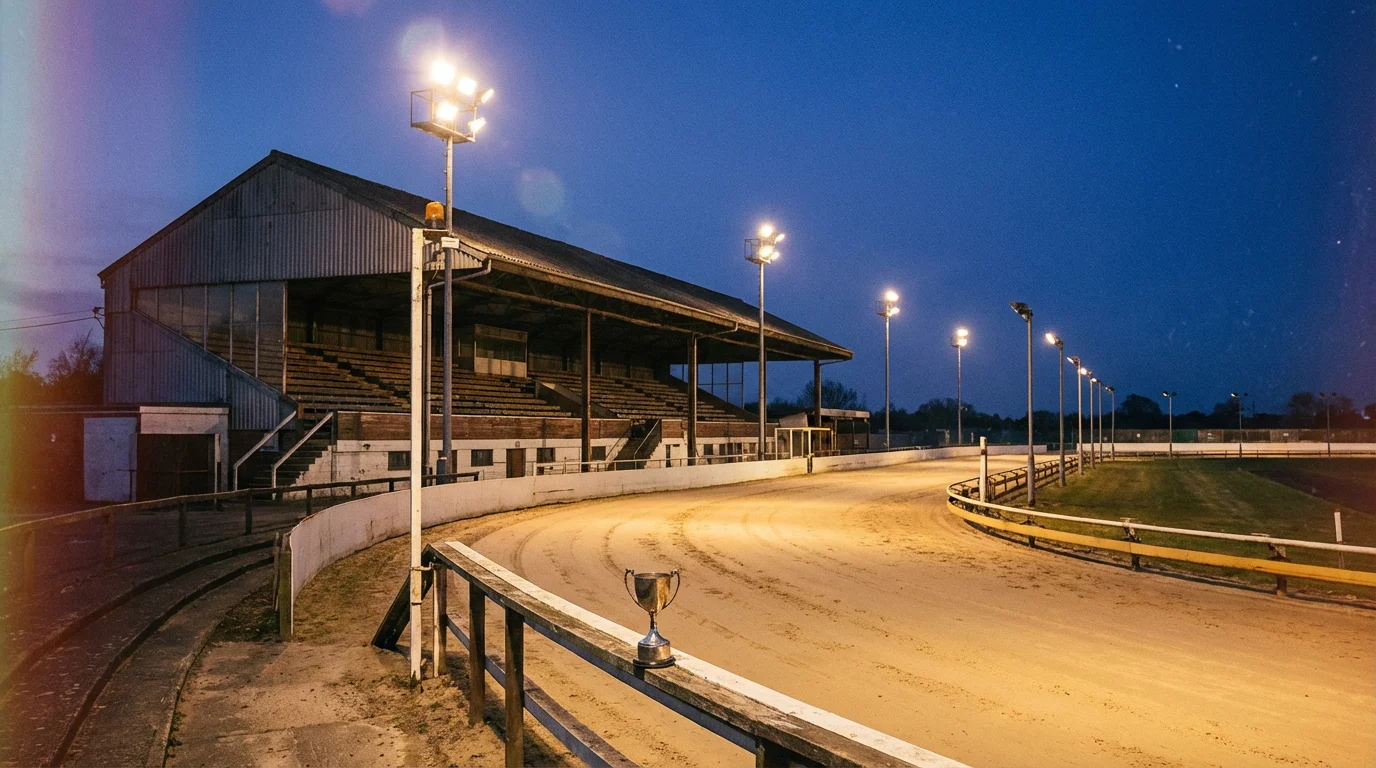
Towcester Greyhound Stadium, purpose-built at the Northamptonshire racecourse, became the Derby’s new home in 2017. The transition was not seamless. Towcester hosted the 2017 and 2018 editions before financial difficulties forced the racecourse into administration, and the Derby was temporarily relocated to Nottingham Greyhound Stadium for 2019 and 2020. Nottingham provided a capable venue but was always seen as a temporary solution — the track geometry and facilities were not designed for an event of the Derby’s scale.
Towcester reopened in 2021 under new ownership and the Derby returned, this time on a 500-metre sand track that has since become the definitive modern Derby circuit. The shift from Wimbledon’s surface and geometry to Towcester’s sand fundamentally changed the type of dog that succeeds in the competition. Towcester rewards dogs with sustained pace and stamina around wide, sweeping bends, rather than the pure early speed that was decisive at Wimbledon’s tighter circuit.
Towcester — The Modern Home of the Derby
Towcester is not just hosting the Derby — it is defining the modern era of the race.
The current circuit is a 500-metre sand track, part of the Towcester Racecourse complex on the London Road in Northamptonshire. The facility underwent significant investment before its reopening, with upgraded kennelling, improved trackside amenities, and broadcast infrastructure capable of supporting the Derby’s streaming and media requirements. The venue’s rural location is a marked contrast to the urban settings of White City and Wimbledon, and attending a Derby round at Towcester is a different experience entirely — more country event than metropolitan spectacle.
The 2026 English Greyhound Derby is confirmed at Towcester, with the winner’s prize set at a substantial purse that reflects the event’s continued commercial importance. Star Sports continues as a key sponsor alongside Towcester Racecourse and Leisure. The track’s sand surface, its 500-metre standard distance, and the specific geometry of its bends now form the baseline against which all Derby contenders are assessed. Irish-trained dogs, who make up an increasing proportion of the Derby entry, must demonstrate they can handle Towcester’s specific characteristics — a factor that has caught out several highly-fancied entries in recent years when their home-track form did not translate to Northamptonshire.
For bettors, Towcester’s recent track data is now the most relevant form database for Derby analysis. Dogs with proven Towcester form — whether from the Derby itself, the Blue Riband in January, or regular graded meetings — carry an informational advantage that no amount of Irish trial form can fully replicate.
Derby Legends — Dogs That Defined the Race
Four dogs in nearly a hundred years. That is how hard it is to win the Derby twice.
Mick the Miller set the standard. An Irish-bred brindle dog purchased for 800 guineas — more than the cost of a London house at the time — he won the Derby in 1929 and 1930 at White City, the first dog to achieve the double. His fame extended far beyond the track: Mick the Miller appeared in a feature film, and after his death his preserved body was displayed in the Natural History Museum. His record of 19 consecutive race wins stood as a benchmark for decades, and his cultural impact arguably did more to establish greyhound racing as a mainstream British sport than any marketing campaign before or since.
Forty-two years passed before another dog matched the feat. Patricias Hope won in 1972 under Adam Jackson’s training at Clapton, starting at 7/1, then returned in 1973 under new trainer Johnny O’Connor from Ireland and took the final at 7/2. That second win was broadcast live on ITV, bringing the Derby into living rooms across Britain. Patricias Hope also completed a Triple Crown in 1972, adding the Scottish and Welsh Derbys to his English title — a feat that underscored his dominance of that era.
Rapid Ranger, trained by Charlie Lister, brought the double into the modern age. His 2000 victory at Wimbledon was emphatic — more than three lengths clear of the field. Connections considered retiring him to stud but decided to pursue the double, and in 2001 he delivered again. Rapid Ranger even returned for a tilt at an unprecedented third consecutive victory in 2002, reaching the competition before his campaign ended. His career demonstrated the stamina and mental toughness that the Derby’s six-round format demands.
Westmead Hawk completed the quartet in 2005 and 2006, trained by Nick Savva. Unlike the front-running styles of previous dual winners, Westmead Hawk was a closer — a dog who ran from the back and relied on a devastating turn of finishing speed to overhaul the leaders. His come-from-behind style made him a crowd favourite, and his 2006 defence was a masterclass in timing, going unbeaten through every round. He was the last dog to achieve this feat, and his Madame Tussauds waxwork became a symbol of the sport’s celebrity appeal during its Wimbledon heyday.
In the recent era, the Derby has produced notable champions without a dual winner. Thorn Falcon won in 2021 for Patrick Janssens at the Derby’s return to Towcester. Priceless Blake took the 2019 edition at Nottingham for Paul Hennessy. De Lahdedah, the 2024 champion for Liam Dowling, broke the Towcester 500-metre track record in his final and attempted to defend the title in 2025, reaching the final before finishing behind Droopys Plunge. The absence of a back-to-back winner since 2006 speaks to the increasing intensity and depth of the modern competition.
The Trainer Kings — Charlie Lister and Beyond
If you want to find a Derby winner, start by finding the right trainer.
Charlie Lister OBE holds the record with seven Derby victories, earning him the title “Derby King” among followers of the sport. His winners spanned from 1997 to 2013, a period of sustained dominance that included Rapid Ranger’s famous double in 2000 and 2001, Farloe Verdict in 2003, and the brilliant Taylors Sky in 2011, who set the Wimbledon track record with 28.17 in the final. Lister retired from training in 2018, and his record of seven wins appears likely to stand for a very long time. Leslie Reynolds, who trained five winners between 1948 and 1954, was the previous record holder.
In the modern era, Graham Holland has emerged as the dominant force. Based at Riverside Kennels in Ireland, Holland won back-to-back Derbys in 2022 and 2023 with Romeo Magico and Gaytime Nemo, and regularly fields multiple entries in the later rounds. In the 2025 Derby, three of his dogs — Bockos Diamond, Cheap Sandwiches, and Bombay Pat — reached the final, though the title ultimately went to Droopys Plunge. Holland’s strategy of entering several high-quality dogs and relying on kennel depth to progress multiple runners is a defining feature of the modern competition.
Patrick Janssens has now won the Derby twice — Thorn Falcon in 2021 and Droopys Plunge in 2025 — establishing himself as a trainer who excels at Towcester specifically. Liam Dowling’s 2024 victory with De Lahdedah, who broke the track record, marked the Kerry-based trainer as another serious player at the highest level. Nick Savva, Westmead Hawk’s trainer, won three consecutive Derbys with two different dogs between 2005 and 2007, a hat-trick that remains unique in the competition’s history.
For bettors, the practical takeaway is that the Derby is not an open lottery. A disproportionate share of winners comes from a small pool of elite trainers, and backing a dog from a kennel with no proven Derby pedigree at a short price represents a risk the statistics do not support.
Derby by the Numbers — Key Statistics for Bettors
Numbers do not lie — but they do not always tell the whole truth. Here is what the Derby statistics actually say, and what they mean for anyone approaching the betting market.
The Derby favourite’s win rate since the move from White City in 1985 sits at roughly one in three — a figure that has remained remarkably stable across different venues and eras. This rate is comparable to flat horse racing and tells bettors something useful: the market is generally good at identifying the most likely winner, but not good enough to make backing the favourite a profitable long-term strategy at the typical short prices offered.
The spread of winning starting prices across recent decades is revealing. Since the move to Towcester, winning SPs have ranged from De Lahdedah’s 5/1 in 2024 to Astute Missile’s 28/1 in 2017, with most winners falling in the 3/1 to 10/1 range. The 2025 winner Droopys Plunge went off at 10/1, continuing a pattern where the winner comes from outside the top two in the betting more often than not. Only a handful of recent winners — Romeo Magico at 5/2 in 2022, Taylors Sky at 7/4 in 2011 — have gone off at odds-on or close to it.
Irish-trained dogs have dominated the Derby in the modern era. Of the last six winners before 2026, five were trained in Ireland or by Irish-based handlers: Deerjet Sydney for Pat Buckley (2020), Romeo Magico and Gaytime Nemo for Graham Holland (2022, 2023), De Lahdedah for Liam Dowling (2024), and the 2019 winner Priceless Blake for Paul Hennessy. The exceptions — Thorn Falcon and Droopys Plunge, both for UK-based Janssens — are notable precisely because they bucked the trend. Ireland produces the majority of elite greyhounds racing in Britain, with over 80 per cent of dogs registered for racing in the UK bred in Ireland, and this pipeline directly feeds the Derby’s entry lists.
Trap statistics at Towcester show a relatively even distribution over a large enough sample, though certain traps have shown marginal edges in specific Derby rounds. The key statistical insight for bettors is not which trap wins most often overall, but how trap draw interacts with running style in the context of each heat’s specific composition. A trap-1 railer in a heat with no other early pace dog is a very different prospect from a trap-1 railer drawn alongside two other confirmed front-runners.
The fastest winning time at Towcester belongs to De Lahdedah, whose 28.58 in the 2024 final set the current track record for the Derby. At Wimbledon, the record was Taylors Sky’s 28.17 in 2011. These times are venue-specific and not directly comparable, but they establish the ceiling of performance that Derby contenders are measured against. A dog consistently recording times within half a second of the track record is operating at the required level. One recording times more than a second off the pace is likely to struggle against Derby-calibre opposition.
Five Finals That Changed Derby Betting
Some Derby finals teach you more about betting than a hundred form guides. These five illustrate the principles that shape every renewal.
Astute Missile, 2017, 28/1. The biggest upset in modern Derby history arrived in the first year at Towcester. Seamus Cahill’s Hove-based runner was unfancied in a final dominated by Irish challengers, but a clean break from trap 2 and a sustained run on the rail proved decisive. The lesson: at a new venue with no established form book, the market’s confidence in established names was misplaced. Every venue change in Derby history has produced at least one surprise result, because form from other tracks transfers imperfectly.
Westmead Hawk, 2006, 4/7. The most dominant Derby defence on record. Hawk went off at prohibitively short odds but justified every penny, swooping from the rear of the field with a trademark late surge that left the opposition standing. The betting lesson is counterintuitive: sometimes the overwhelming favourite genuinely is the best dog in the race, and the value lies not in opposing it but in forecast and tricast combinations beneath it. Punters who backed other dogs to finish second behind Hawk collected healthy dividends while the winner’s return was minimal.
Kinda Ready, 2009, 25/1. Mark Wallis’s runner provided the Wimbledon era’s biggest shock, a reminder that the six-round format is an endurance test as much as a talent contest. Kinda Ready progressed steadily through the rounds while more fancied dogs faltered under the pressure of consecutive weeks of racing. The lesson: late-developing form matters. A dog improving through the rounds while others plateau is a dog whose trajectory is more important than its starting price.
Droopys Plunge, 2025, 10/1. The most recent Derby final produced a finish that crystallised the favourite-longshot dynamic. Bockos Diamond, the Irish Derby champion and 11/10 favourite, was undone in a blanket finish after Droopys Plunge posted the fastest sectional of the final. The lesson: in a six-dog final where every runner is elite, the race shape — who gets the first bend, who finds clear running room — matters as much as raw ability. Droopys Plunge’s trap-1 draw gave him the inside rail, and that positional advantage proved decisive against a field of superior reputation.
Salad Dodger, 2014, 16/1. Bruno Berwick’s runner was a classic outsider story — privately trained, carrying no significant kennel reputation, but possessing the raw speed to compete at the top level. His victory was built on early pace from a wide draw, a route to the first bend that avoided trouble, and a gutsy run down the back straight. The lesson: the Derby does not care about reputation. Dogs from major kennels carry expectations, but the traps do not know who the trainer is.
The Modern Derby — 2020s Trends and What’s Next
The Derby’s past is written. Its future is being shaped by forces the sport has not seen before.
The most striking trend of the 2020s is the accelerating dominance of Irish-trained greyhounds. What was once a healthy cross-border rivalry has become a one-sided flow: the majority of Derby entries now come from Irish kennels, the majority of finalists are Irish-trained, and the winner has been trained in Ireland or by an Irish-based handler in five of the last six years before 2026. The pipeline of Irish breeding and the concentration of elite training expertise at kennels like Holland’s Riverside and Dowling’s Ballymac operation has created a structural advantage that UK-based trainers are struggling to match.
Prize money has risen significantly. The 2025 Derby offered a top prize of 175,000 pounds to the winner, maintaining the level set in recent years and a figure that reflects both the commercial importance of the event and the investment by sponsors Star Sports and Towcester Racecourse and Leisure.
The democratisation of coverage through streaming has transformed how punters follow the Derby. Where previous generations relied on attending trackside or reading results in the Racing Post the next morning, every round of the modern Derby is available to watch live through bookmaker streaming services, SIS Racing, and dedicated platforms. The Gone To The Dogs YouTube channel and social media coverage from Star Sports and the GBGB have created a secondary layer of analysis and commentary that keeps the Derby in conversation throughout its six-week run. For bettors, this means more information, more analysis, and a more efficient market — which paradoxically makes finding value harder but makes informed betting more accessible.
Looking ahead to 2026, the Derby returns to Towcester with several questions for the market. Can any UK-based trainer break the Irish stranglehold? Will a dog attempt the elusive English-Irish Derby double, a feat last achieved by Toms The Best in the late 1990s? And with the race approaching its centenary in 2027, the commercial and cultural significance of the next few renewals is difficult to overstate.
The Race That Refuses to Stand Still
Stadiums close. Dogs retire. Trainers pass the torch. The Derby keeps running.
That resilience is the thread that connects Entry Badge in 1927 to Droopys Plunge in 2025. The venues have changed — from the roar of 50,000 at White City to the Northamptonshire countryside at Towcester. The sponsorship landscape has shifted from Spillers pet food and the Daily Mirror to Star Sports and TRC Events. The breed has evolved, the training methods have advanced, the betting market has moved from cash at the trackside to instant exchanges on mobile phones. But the fundamental proposition remains the same: the best dogs in Britain and Ireland, six weeks of elimination, one final, one winner.
For bettors, history is not decoration. The patterns that recur across decades — the favourite win rate hovering around one in three, the tendency for outsiders to emerge from lower-profile kennels, the decisive influence of the trap draw in tight finals, the advantage held by trainers with multiple entries — these are structural features of the competition, not historical curiosities. They recur because the format of the Derby creates them. Six rounds of progressive elimination, with draws reshuffled at every stage, produces a specific type of variance that the betting market does not always price efficiently.
The 2027 centenary will inevitably bring renewed attention to the Derby — media coverage, retrospectives, perhaps an enhanced prize fund. But the race does not need an anniversary to justify its significance. The English Greyhound Derby has survived the demolition of White City, the closure of Wimbledon, the financial collapse of Towcester, and a global pandemic. It has adapted to each upheaval not by staying the same but by evolving — new venues, new audiences, new commercial partners — while keeping its six-round format and its status as the race every trainer and every dog owner dreams of winning.
That continuity, across nearly a century and through every kind of disruption, tells you everything you need to know about the competition’s importance. The next chapter starts this summer. The odds are already forming.
