

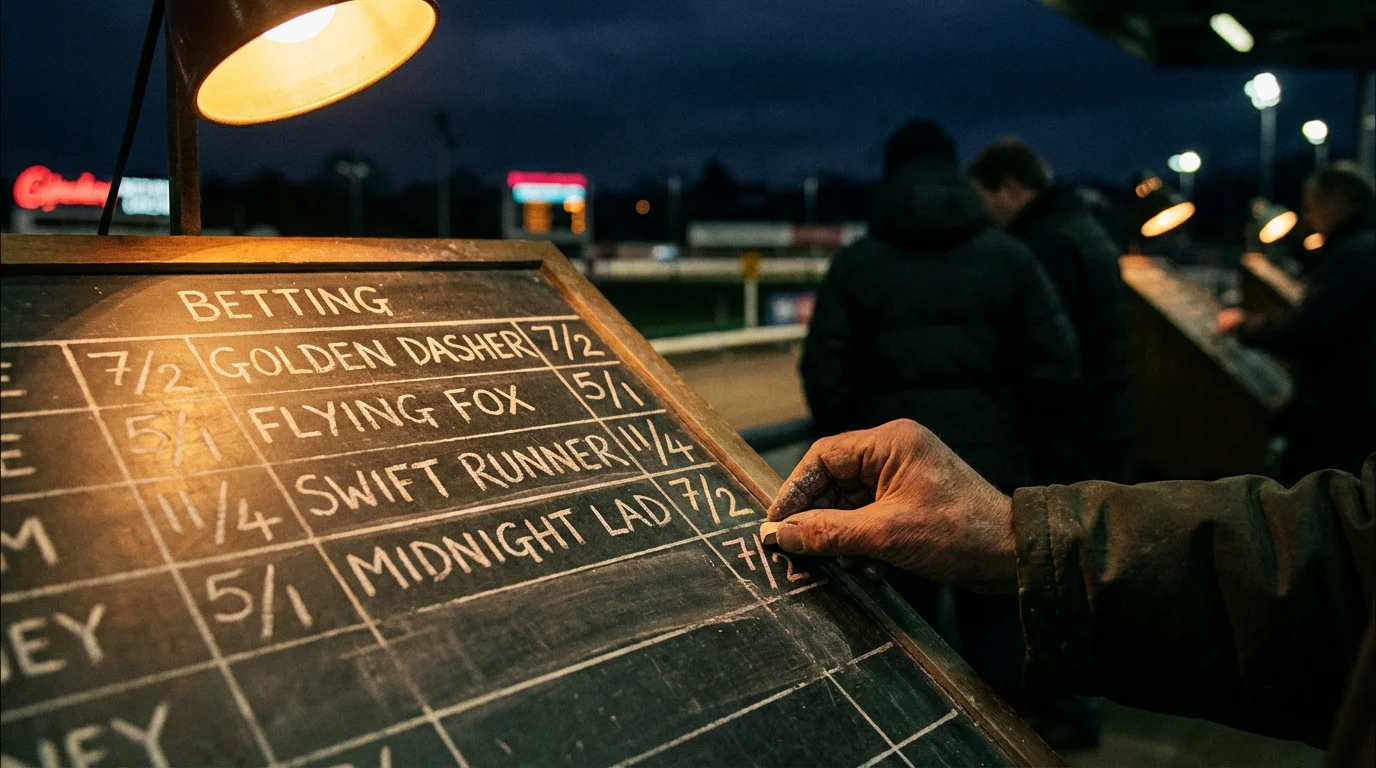
- The Six-Week Price War That Starts Before a Dog Even Runs
- How Greyhound Derby Odds Are Set and Why They Move
- Ante-Post Derby Betting — Timing, Risk and Reward
- Finding Value in Derby Betting Markets
- Where to Get the Best Derby Odds — Bookmaker Comparison Points
- What Past Derby Odds Tell Us — Favourite Performance Data
- Price Is Temporary — Position Is Everything
The Six-Week Price War That Starts Before a Dog Even Runs
Derby odds start moving the day entries close. If you are waiting for the final to bet, you have already missed the market.
Most greyhound races have a lifespan of about twelve minutes in the betting ring. Early prices are published, money comes in, the SP is formed, and the race is run. The English Greyhound Derby operates on an entirely different timescale. From the moment the entry list is confirmed to the night of the final, roughly six weeks elapse. During those weeks, 192 dogs are whittled down to six through five rounds of heats, and at every stage the odds shift — sometimes gradually, sometimes violently — in response to performances, draw results, injuries, and withdrawals.
This extended betting window is what makes the Derby unique in the greyhound calendar. It creates a genuine ante-post market with all the opportunities and risks that come with it. Prices at entry stage can be double or triple what they are by the quarter-finals, which means the rewards for early conviction are real. But so are the costs of backing a dog that gets eliminated in round two, because ante-post rules mean you lose your stake with no refund.
Understanding how Derby odds form, how they move, and when to engage with the market is the difference between punting on the final and investing across the tournament. This is not a one-race event. It is a six-week price war, and the information advantage you hold at each stage determines whether you end up on the right or wrong side of it.
How Greyhound Derby Odds Are Set and Why They Move
Bookmakers do not set Derby odds based on guesswork. They use the same data you have access to — they just price in the risk you have not thought about.
Opening prices for the Greyhound Derby are typically published once the entry list is confirmed, several weeks before the first round of heats. These initial prices are based on a combination of factors: the dog’s recent open-race form, Irish or UK trial performances, trainer reputation, and any available information about the dog’s fitness and track suitability. Dogs that have won Category One events or performed well at Towcester previously will be priced shorter. Unknowns from smaller kennels start at longer odds, sometimes 33/1 or beyond.
The initial market is thin. With nearly 200 dogs entered, bookmakers do not price every single one individually. They will typically offer odds on the top 20 to 30 most fancied runners and group the rest under a generic “others” price or simply not quote them. As the competition progresses and dogs are eliminated, the market narrows and the remaining prices become more precise.
What moves Derby odds between rounds is a mixture of performance data, market money, and information asymmetry. When a fancied dog wins its first-round heat in a fast time, bookmakers shorten the price — not because one fast time changes the dog’s fundamental ability, but because the market response to that performance forces an adjustment. In the 2025 Derby, the defending champion De Lahdedah recorded 28.50 in the opening round — eight-tenths of a second faster than his previous year’s final time — and the market reacted immediately despite De Lahdedah having been available at 33/1 ante-post.
Conversely, a sluggish performance or a narrow escape from elimination causes prices to drift. During the same 2025 campaign, ante-post favourite Bockos Diamond posted an unremarkable 29.03 in his first-round heat and was allowed to drift despite being the reigning Irish Derby champion. He returned to form in round two with a 28.51, the fastest time of the round, and was cut back to 3/1. This kind of volatility — prices moving 30 or 40 per cent between rounds based on a single race — is routine in Derby betting and is the primary reason ante-post engagement exists.
The comparison with horse racing ante-post markets is instructive. In a horse racing Classic like the Epsom Derby, ante-post prices move based on trials, work reports, and draw outcomes over several months. In the Greyhound Derby, you get fresh, conclusive performance data every single week. Each round eliminates a chunk of the field and provides verified times, sectional data, and trap-performance evidence. The information density is far higher, which means the market is more efficient after each round — and the value available gets compressed as the final approaches.
Reading Market Movement — Steamers, Drifters and False Moves
When three bookmakers cut the same dog from 12/1 to 8/1 in a single morning, someone knows something. Whether that something is inside information about a training performance, a reaction to a trial result, or simply a large bet from a confident punter, the direction of the move matters more than the reason behind it.
Market movement in greyhound racing follows patterns that experienced bettors learn to read. A “steamer” is a dog whose price shortens rapidly — money is piling in, confidence is growing, and the market is adjusting to reflect that weight of opinion. A “drifter” is the opposite: a dog whose price lengthens as money goes elsewhere, suggesting the market has lost faith or that insiders are not backing what the public expects. Both signals carry information, though neither is infallible.
The trick is separating genuine money from false moves. In a sport with relatively thin betting markets compared to Premier League football or horse racing Classics, a single large bet can move greyhound odds significantly without reflecting any real change in the dog’s prospects. Bookmakers also adjust prices defensively — if they are overexposed on one dog, they will shorten the price to discourage further money and lengthen others to attract balancing bets. This is market management, not intelligence.
The best tool for reading Derby market movement is an odds comparison service. Watching how prices change across multiple bookmakers simultaneously tells you whether a move is market-wide — suggesting genuine information — or isolated to one or two firms — suggesting liability management. Betting exchange prices, where available, provide another layer. Exchange odds are driven purely by punter-to-punter supply and demand, with no bookmaker margin built in. If a dog’s exchange price shortens while bookmaker prices remain static, it often means informed money is hitting the exchange first. When both exchange and bookmaker prices move in the same direction, the signal is stronger.
During the Derby, the most significant market moves typically occur in two windows: immediately after the draw for each round is announced, and within the first few hours after a round of heats is completed. Draw day moves are particularly sharp because trap position has a material impact on a dog’s chances, and the market reprices accordingly within minutes. A confirmed railer drawing trap 6 might drift from 8/1 to 14/1 before the race is even run.
Ante-Post Derby Betting — Timing, Risk and Reward
Ante-post is where you pay for information you do not have yet. The question is whether the discount is worth the blind spot.
The fundamental trade-off in any ante-post market is simple: you accept a higher risk of losing your stake in exchange for a better price. In the Greyhound Derby, that risk is concrete and specific. If you back a dog ante-post and it is eliminated in round three, your stake is gone. No refunds, no dead-heat deductions, no consolation. The dog does not need to be injured or withdrawn — it simply has to lose. In a competition where only the first three in each heat progress, elimination is the default outcome for half the field at every stage.
The reward for accepting that risk is access to prices that will never be available again. A dog priced at 16/1 before the first round, if it wins its opening heat impressively, might be 8/1 after round one and 5/1 by the quarter-finals. Anyone who took 16/1 is sitting on twice the value of the quarter-final bettor. If that dog reaches the final and wins, the ante-post punter’s return dwarfs the day-of-race return. This is the engine of ante-post betting: the time value of information creates price gaps that are impossible to replicate once the market has absorbed each round’s results.
The risk profile is not uniform across the competition. Betting at the entry stage carries the highest risk — you know almost nothing about how the dog will handle Towcester’s track, what trap it will draw, or how it will cope with the intensity of six consecutive weeks of racing. But entry-stage prices reflect that ignorance, and the potential discount is largest. By the quarter-final stage, you have three rounds of Towcester-specific form to analyse, but the market has priced in most of that information and the available odds are compressed.
Non-runner rules add another dimension. Most bookmakers treat ante-post Derby bets under their standard ante-post terms, which means no refund if your dog does not run for any reason — injury, illness, kennel decision, or failure to qualify. Some bookmakers occasionally offer “non-runner, money back” promotions on specific Derby markets, particularly closer to the final, but these are exceptions and should never be assumed. Always check the terms at the point of placing the bet.
One concept worth understanding is “dead money” in ante-post pools. As dogs are eliminated, the stakes placed on them remain in the bookmaker’s pocket. This means the effective overround on the surviving market increases with every round. Bookmakers are not redistributing the stakes from eliminated dogs across the remaining runners — they are banking them. This is partly why ante-post Derby betting is so profitable for bookmakers and why the prices offered at early stages can afford to be generous. They know a significant portion of ante-post money will never generate a payout.
Round-by-Round: When the Smart Money Lands
Each round of the Derby reveals a specific type of information, and the smart money lands at the point where that information creates the widest gap between price and probability.
The first round tells you who can trap at Towcester. Many Derby entrants — particularly Irish-trained dogs — arrive with strong open-race form but no Towcester experience. Round one is their introduction to the track. A dog that traps well and shows early pace at Towcester in the first round confirms a crucial variable. A dog that is slow away or struggles around the bends raises a flag that its home-track form may not transfer. This is the round where informed bettors identify the dogs whose pre-tournament form is Towcester-compatible, and where the biggest price adjustments tend to occur.
The second round narrows the field and introduces the first genuine competitive pressure. Dogs that coasted through round one may face stiffer opposition. Heat compositions become more meaningful because the top three from each heat progress, creating situations where a good dog can be eliminated simply by landing in the wrong heat. Bettors who waited through round one can now assess two Towcester performances and make a more informed ante-post decision with significantly more data. Prices by this stage have already adjusted for round-one results but still carry a healthy premium over what will be available later.
The quarter-finals are the pivot point. By this stage, roughly 24 dogs remain from the original 192, and the quality of each heat rises sharply. The quarter-final is often where the real Derby contenders separate from the merely good. A dog that wins its quarter-final heat convincingly, setting a fast time from a clean trap, is confirming its credentials at the highest level. For many bettors, the quarter-final stage represents the optimal balance between information and price — you have three rounds of verified form and the odds still offer meaningful value compared to the semi-final and final prices.
After the semi-finals, only six dogs remain and the market contracts to its tightest point. Prices at this stage are largely a reflection of what everyone has already seen, and the value available is minimal unless the draw creates a specific opportunity — a proven front-runner drawing the rail, or a known closer drawing the widest trap where it can swing into the first bend from outside. Adding to a position after the semi-finals makes sense only if the draw has created an edge the market has not fully absorbed. For most bettors, the semi-final is the point to sit still and let existing positions play out.
Finding Value in Derby Betting Markets
Value is not about finding the winner. It is about finding the dog whose price does not reflect what you already know.
This distinction trips up a lot of bettors, including experienced ones. A dog at 2/1 can be terrible value if its true chance of winning is only 20 per cent. A dog at 14/1 can be outstanding value if its true chance is 12 per cent rather than the 7 per cent implied by the price. Value is a relationship between probability and odds, not a function of how much you like the dog.
In the Greyhound Derby, value tends to appear in specific, predictable places. The most common is the favourite-longshot bias — a well-documented tendency in greyhound betting markets where favourites are slightly underbet relative to their true probability, and longshots are overbet. Punters love the narrative of a 25/1 outsider winning the Derby, so they overpay for the dream. Meanwhile, the 3/1 favourite, which wins roughly once in three renewals, is priced just about correctly — but the each-way terms on that favourite are often poor value because the place fraction at short odds returns very little.
The most fertile ground for value in the Derby outright market is in the 6/1 to 16/1 range. These are dogs with genuine credentials — proven form at the track, strong trainers, competitive times — but who are not the headline favourite. The market’s attention is concentrated on the top two or three in the betting, which means dogs in the middle tier can sometimes be available at prices that underestimate their actual chances of reaching the final and winning it.
Each-way value is particularly relevant in the Derby outright market. Many bookmakers offer each-way terms on the Derby outright — typically quarter odds for three places, meaning your dog needs to reach the final to trigger the place portion. Given that reaching the final from a field of 192 requires five consecutive qualifications, the each-way element is a serious ask. But for dogs from powerful kennels — trainers running three or four entries who are likely to have at least one in the final — the cumulative probability of at least one making the final can be much higher than the individual price implies.
Assessing value requires a framework, however crude. Before backing any dog, estimate its chances in percentage terms. If you think a dog at 10/1 has a 15 per cent chance of winning, the implied probability of 10/1 is just over 9 per cent, making it a value bet. If you think it has a 7 per cent chance, it is not. You do not need a spreadsheet for this — a rough mental model based on form, draw, and trainer record gets you surprisingly far. The discipline is in walking away from dogs where your estimate does not support the price, no matter how appealing the narrative.
Where to Get the Best Derby Odds — Bookmaker Comparison Points
The best bookmaker for the Derby is not the one with the biggest welcome offer — it is the one with the most Derby markets and the sharpest prices across them.
Not every bookmaker treats the Greyhound Derby with the same level of attention. Some offer only a basic outright winner market, priced with a wide overround, and nothing else until the final approaches. Others provide round-by-round heat betting, without-the-favourite markets, trap specials, and each-way outright terms that extend to four places rather than three. The range of markets available to you shapes the bets you can make, and more options mean more opportunities to find value.
When comparing bookmakers for Derby betting, prioritise four things. First, the depth of ante-post markets. How many dogs are individually priced? How early in the competition are the markets available? A bookmaker that opens ante-post odds at the entry stage and prices 30 or more runners gives you a far wider canvas than one that waits until the quarter-finals to offer an eight-dog market.
Second, each-way terms on the outright. Quarter odds for three places is the standard, but some firms extend to four places on the outright for major events like the Derby, which significantly improves the value proposition. Reaching the final is the place qualification — four places means only two of the six finalists leave your each-way bet empty. Third, the availability of streaming. Being able to watch every round live — ideally through the bookmaker’s own platform — is not a luxury in Derby betting. It is essential intelligence. Watching a dog’s runs in the flesh gives you information that times and form figures alone cannot convey: body language out of the traps, how it handles crowding, whether it is visibly tiring or still full of running.
Fourth, cash-out options. In a six-week tournament, your position can change dramatically. A dog you backed at 16/1 might be 4/1 after three rounds, at which point cashing out locks in a profit regardless of the outcome. Not every bookmaker offers cash-out on ante-post greyhound markets, and among those that do, the terms vary. Some apply a significant margin to the cash-out offer, giving you less than the theoretical value of your position. Others are more generous. Having the option, even if you do not use it, gives you tactical flexibility that outright-only betting does not.
The practical advice is to hold accounts with at least two bookmakers that take greyhound racing seriously, and to compare odds on every bet. A half-point difference in odds across a six-week competition of multiple bets compounds into meaningful money.
What Past Derby Odds Tell Us — Favourite Performance Data
History does not predict Derby winners. But it does expose patterns that the market consistently misprices, and those patterns are worth understanding before you place a single bet.
The starting price of the Derby favourite tells one story. The actual results tell another. Since 1985, when the Derby moved from White City to Wimbledon, roughly one in three finals has been won by the SP favourite. That conversion rate — around 34 per cent — is comparable to the favourite strike rate in flat horse racing over similar distances. It means betting the favourite is a viable strategy but far from a certainty. Two out of three years, the favourite does not win.
What makes this statistic particularly relevant for Derby bettors is the price of the winning favourites versus the losing ones. Winning favourites tend to go off at relatively short prices — between evens and 5/2 — reflecting strong confidence in a single dominant dog. When the favourite is at 4/1 or longer, the market is expressing uncertainty, and those situations have historically produced a lower favourite conversion rate. In other words, the wider the field of contenders, the less reliable the favourite becomes.
At the other end of the spectrum, the longest-priced Derby winner in modern history was Astute Missile, who won the 2017 final at 28/1 for trainer Seamus Cahill. The shortest-priced winner remains Entry Badge, who took the very first Derby in 1927 at 1/4 — though that race bore little resemblance to the modern six-round tournament. In recent decades, the typical winning SP has ranged between 2/1 and 10/1, with most winners falling in the 3/1 to 7/1 band. This is the sweet spot where the dog is good enough to be respected by the market but is not the overwhelming favourite.
The 2025 final illustrated the pattern vividly. Bockos Diamond, the ante-post favourite throughout the competition and reigning Irish Derby champion, went off at 11/10 — the shortest-priced finalist in years. He was beaten by Droopys Plunge, who had been available at 10/1 before the final and much longer before the draw. The dog who had been backed as the near-certainty was undone in a blanket finish, and the dog who had come through quietly, winning his semi-final as a 10/1 chance, collected the prize money. For anyone who had followed the ante-post market closely, Droopys Plunge was never a 10/1 dog — his form trajectory and Patrick Janssens’s track record both supported a much shorter price. The market had simply been fixated on the headline name.
The lesson from the historical data is not that favourites cannot win — they clearly can, and they do so at a reasonable clip. The lesson is that the Derby’s six-round format creates enough attrition and variance to make the outright favourite vulnerable in roughly two out of every three finals. This is a competition where the selection pressure is intense, where trap draws reshuffle the competitive dynamics at every stage, and where the cumulative fatigue of six weeks of racing can blunt even the most talented dog. Pricing that reality into your assessments is the first step toward making better Derby bets.
Price Is Temporary — Position Is Everything
In a six-round tournament, the odds you take at entry stage are a bet on position and trajectory, not just ability. The fastest dog in the field at trial stage is not necessarily the fastest dog by the semi-finals. Injuries happen. Bad draws happen. A dog that was dominant in Ireland might struggle with Towcester’s bends. A dog that was 40/1 at entry might peak at exactly the right moment and reach the final running its best times when it matters most.
The punter bets on a dog. The trader bets on where the price will be three rounds from now. The distinction is not academic — it changes how you approach every decision in the Derby market. A punter sees a 12/1 chance and asks “will this dog win the Derby?” A trader sees a 12/1 chance and asks “will this price be shorter after the next two rounds?” If the answer to the second question is yes, the bet has value regardless of whether the dog ultimately wins the competition, because the trader can lock in profit by hedging or cashing out at the improved price.
This trading mentality does not require you to never hold a position to the final. Some bets are meant to run. If you backed a dog at 16/1 and it reaches the final at 4/1, there is nothing wrong with letting it ride. But having the awareness that your ante-post position has an evolving market value — and that the value changes with every round — transforms Derby betting from a single-event gamble into a managed campaign.
The Greyhound Derby runs across six Saturday nights. The betting market runs alongside it, repricing, recalibrating, and punishing anyone who mistakes conviction for stubbornness. The information improves every Saturday night when a new round of heats is completed. The prices tighten with every elimination. And the final, when it arrives, is the moment where six weeks of patient analysis either pays off or reminds you that greyhound racing, for all its data and form figures and market signals, still comes down to six dogs, one bend, and thirty seconds of chaos.
Start early. Stay informed. Take prices that reflect what the market has not yet learned. And accept that in a sport where the entire race lasts less time than it took to read this sentence, certainty is the one thing no price can buy.
