

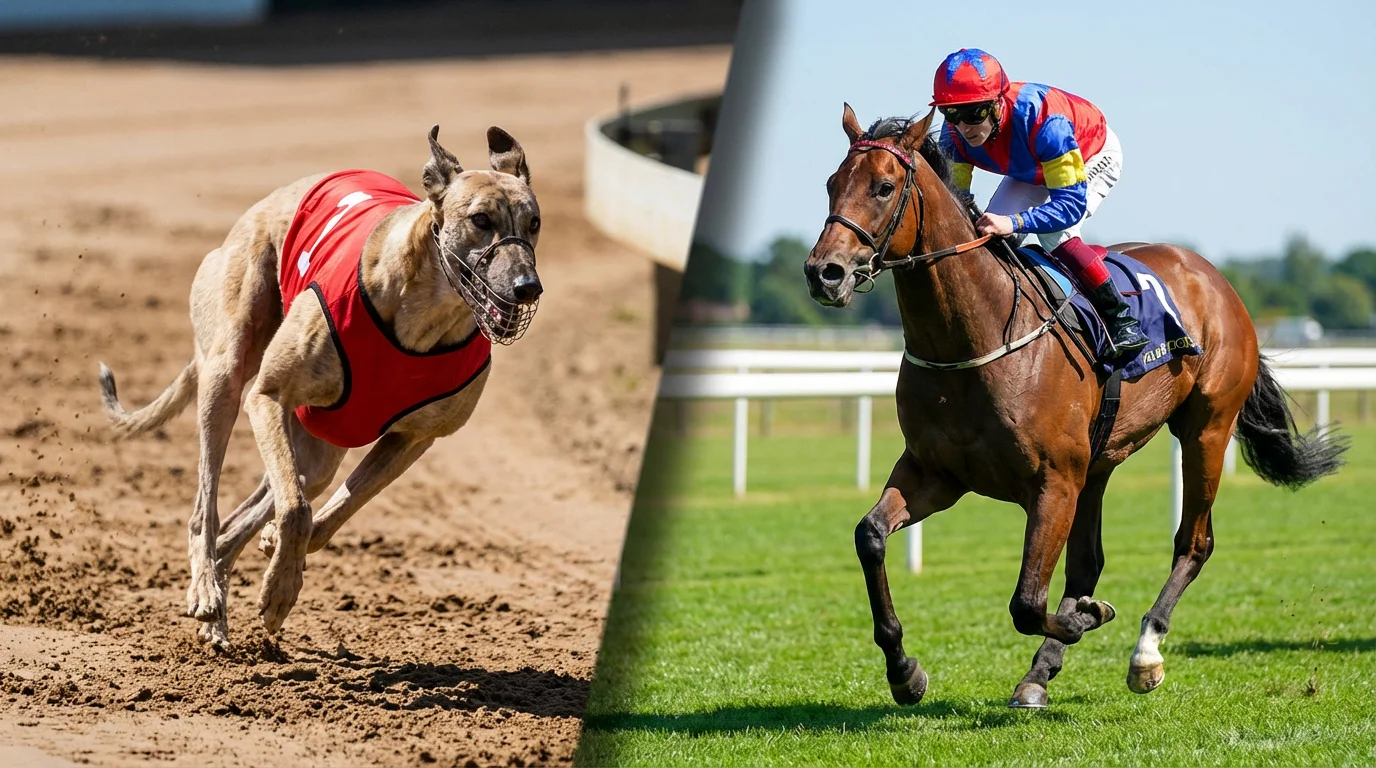
Same Industry, Different Sport, Different Game
Most people who bet on greyhounds also bet on horses. The two sports share bookmakers, share bet types, share the basic premise of animals racing around a track while punters try to pick the winner. From the outside, they look like variations on a theme. From the inside, they are fundamentally different betting propositions — and the punter who treats them interchangeably is making mistakes in both.
The differences are structural, not cosmetic. Field sizes, race frequency, form depth, odds behaviour, market efficiency and the volume of available data all diverge in ways that change how you should think about selection, staking and value. A profitable approach to horse racing does not automatically translate to greyhounds, and the habits that serve you well at Cheltenham can actively hurt you at Romford.
Understanding where the two sports differ is not about declaring one superior to the other. It is about recognising that each demands its own approach — and that the gaps between them are where the sharpest bettors find their edge.
Field Size — Six Dogs vs Fourteen Horses
The most obvious difference is the number of runners. A standard UK greyhound race has six dogs. A typical handicap at a midweek horse racing meeting might have twelve to sixteen runners. A big-field race at a festival can have twenty or more.
This single variable cascades through every aspect of the betting. In a six-runner greyhound race, the favourite wins roughly 30 to 35 percent of the time. In a sixteen-runner horse race, the favourite wins around 15 to 20 percent of the time. The probability distribution is compressed in greyhound racing — there are fewer possible outcomes, the market prices are tighter, and the gap between favourite and outsider is smaller in both ability and odds.
For bettors, smaller fields mean that each runner carries more weight in the market. A single non-runner in a greyhound race removes a sixth of the field and can dramatically alter the dynamics. In horse racing, one withdrawal from a field of sixteen barely changes the complexion. The small-field dynamic in greyhound racing also makes forecast and tricast betting more practical — there are only 30 possible straight forecast outcomes in a six-runner race, compared to 240 in a sixteen-runner field.
The flip side is that smaller fields leave less room for the market to be wrong. In a twenty-runner handicap, a horse priced at 25/1 might be significantly underestimated because the form is complex and the market cannot accurately assess every runner. In a six-runner greyhound race, the bookmaker has far less work to do and the prices are usually tighter to the true probabilities. Finding value in greyhound markets requires sharper analysis because the margin for market error is thinner.
Form Depth — A Line of Numbers vs a Library of Data
Horse racing form is a deep, layered dataset. A horse’s race record might span years and dozens of outings across different courses, distances, ground conditions, jockeys and race classes. The form book is supported by an industry of analysts, ratings providers, sectional timing services and official databases. You can spend hours assessing a single horse’s profile for a single race and still feel you have only scratched the surface.
Greyhound form is thinner by comparison. A dog’s racing career is shorter — typically two to three years at the top level — and the data recorded on each outing is more limited. The race card shows recent form figures, best times, sectional splits, trap records and trainer details. There is no jockey variable, no ground going in the horse racing sense — though track conditions do vary — and no equivalent to the sprawling form databases that horse racing enjoys.
This is sometimes framed as a weakness of greyhound racing, but for bettors it is actually an equaliser. The sheer volume of data in horse racing creates an information hierarchy: professional form analysts, algorithm-driven syndicates and well-resourced tipsters have access to data and processing power that the recreational bettor cannot match. In greyhound racing, the data is leaner and the tools are simpler. The gap between the professional and the amateur is narrower. A disciplined recreational bettor who understands trap records, sectional times and trainer patterns can compete more effectively than their horse racing counterpart.
The absence of a jockey variable is particularly significant. In horse racing, jockey bookings carry enormous signal — a leading rider taking a spare ride in a minor race tells the market something. In greyhound racing, there is no human intermediary between the dog and the result. The animal’s form, fitness and trap position are the inputs. This removes a layer of complexity and a layer of information asymmetry, both of which benefit the smaller bettor.
Odds and Market Volatility
Horse racing odds are set by a combination of bookmaker trading, exchange markets and on-course activity. The market for a major race like a Group 1 at Royal Ascot is deep, liquid and efficiently priced — the odds reflect a huge volume of informed money and the scope for mispricings is small. For midweek sellers at a minor track, the market is thinner and the prices less reliable, but the principle is the same: more money flowing through the market produces sharper prices.
Greyhound racing odds are set primarily by bookmaker traders, with a smaller contribution from on-course activity and very little exchange liquidity. The exchange market for greyhounds is thin at best and often non-existent outside major events like the Derby. This means that bookmakers have more control over greyhound prices and less market pressure to keep them accurate.
For the bettor, this creates a dual effect. On one hand, the lack of exchange liquidity means there is no reliable benchmark price to identify mispricings. In horse racing, you can compare the bookmaker price to the Betfair exchange price and quickly see where the market sits. In greyhound racing, that tool barely exists. On the other hand, the thinner market means that mispricings persist longer. A horse racing value bet might be corrected within minutes as sharp money moves in. A greyhound value bet might sit untouched for hours because the volume of money is too small to move the price.
Starting price drift is also more common in greyhound racing. The on-course market at a dog track is volatile — fewer bookmakers, fewer large punters, and more susceptibility to late money. This is what makes Best Odds Guaranteed particularly valuable for greyhound bettors: the SP frequently deviates from the early price, and BOG captures that deviation in your favour.
Bet Types — Shared Names, Different Applications
The core bet types are identical across both sports: win, place, each-way, forecast, tricast, accumulator. The mechanics are the same. But how these bets function in practice differs because of the structural differences in the racing.
Each-way betting on greyhounds uses standard terms of 1/4 odds for two places in a six-runner field. In horse racing, each-way terms vary by field size and race type — 1/5 odds for two places in a small field, 1/4 for three places in larger fields, and enhanced terms for big handicaps. The greyhound each-way calculation is simpler and more consistent, which makes it easier to assess value but harder to find situations where the each-way terms are in your favour.
Forecast and tricast bets are more practical in greyhound racing because of the smaller fields. A straight forecast in a six-runner race has a one-in-thirty chance of landing at random. In a sixteen-runner horse race, the same bet has a one-in-two-hundred-and-forty chance. This makes forecasts a viable regular bet type in greyhound racing rather than the speculative punt they represent in most horse racing contexts.
Accumulators work identically in both sports, but the higher favourite strike rate in greyhound racing means that short-priced trebles and four-folds are more likely to land than the horse racing equivalent. The trade-off is that the combined odds are lower because the individual prices are shorter. A greyhound acca might pay 8/1 for three winners; the same acca structure in horse racing might pay 25/1 because the individual selections are longer prices. The maths is different, but the principle is the same — accas amplify both returns and risk.
Two Sports, Two Strategies
The punter who succeeds at both greyhound and horse racing is the one who adjusts their approach to fit each sport rather than forcing one method across both. Greyhound racing rewards discipline, frequency management and tight form analysis across a narrow dataset. Horse racing rewards deep research, information sourcing and the ability to navigate complex, large-field markets.
Neither sport is inherently better value than the other. The value depends on who you are, what tools you have, and how much time you can invest. For the bettor with limited time and a preference for simplicity, greyhound racing offers a leaner, more accessible market. For the bettor who enjoys deep form study and thrives on complexity, horse racing provides a richer puzzle. The worst strategy is treating them as the same thing. They are not, and the sooner you respect that difference, the better your results will be in both.
