
Six Jackets, Six Traps — The Colour Code Explained
Every greyhound that races in the UK wears a coloured jacket that identifies its starting trap. The system is universal — the same six colours are used at every licensed track, every BAGS meeting, every Derby final. Once you know the colour code, you can identify which trap a dog started from at a glance, whether you’re watching trackside, streaming on your phone, or checking results on a bookmaker’s app.
The colours serve a purely practical purpose: identification at speed. Greyhounds look similar in build and movement, and a race lasting under thirty seconds doesn’t give spectators much time to distinguish one dog from another. The bright, contrasting jacket colours make it possible to follow your selection through the pack from the traps to the finish line. They’re not decorative. They’re functional.
This guide covers each colour and its corresponding trap, the markings used for reserve runners, and the connection between trap colours and the betting decisions that depend on them.
The Six Trap Colours in UK Greyhound Racing
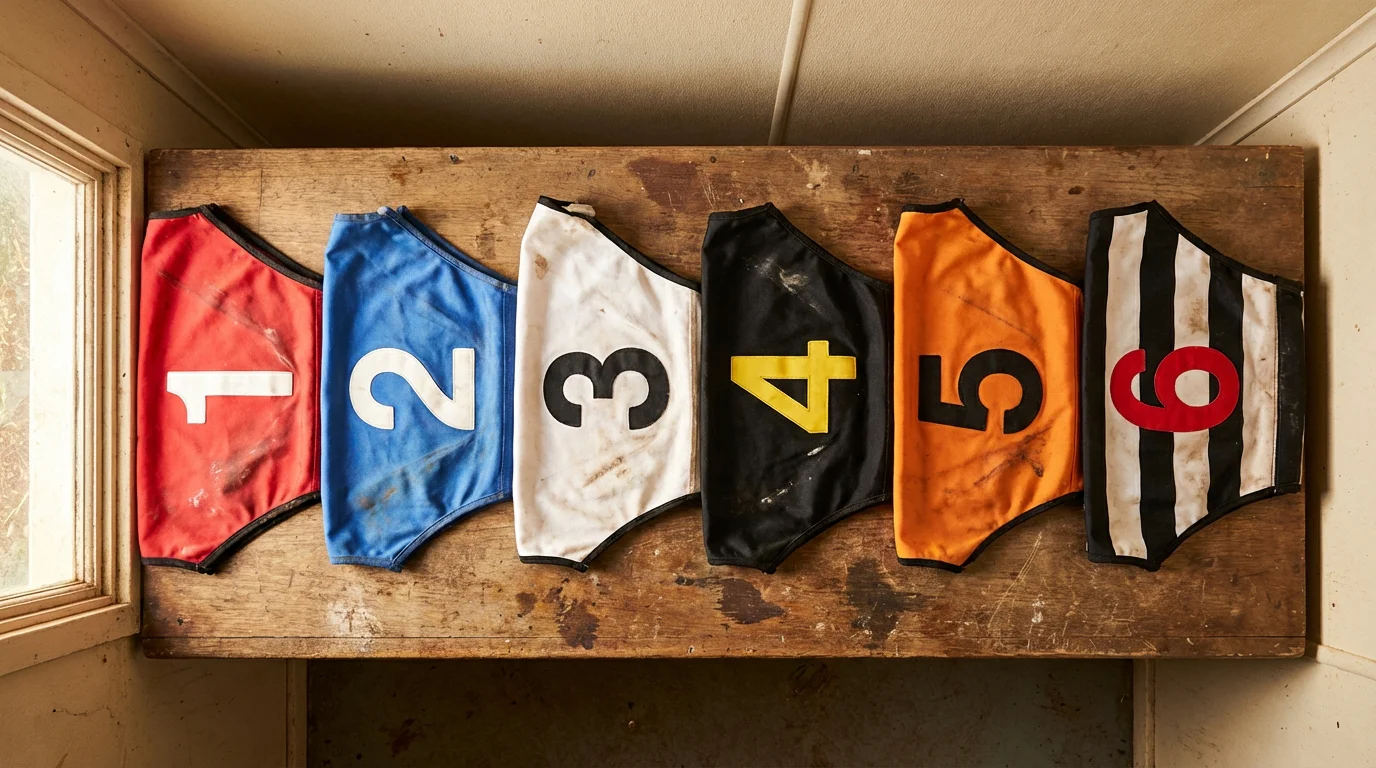
Trap 1: Red. The inside berth. The dog in red starts closest to the inside rail, which at most UK tracks means the shortest route to the first bend. At tracks with a pronounced inside bias, the red jacket is the one the crowd watches most closely from the traps. Trap 1 is typically assigned to railers — dogs whose running style favours the inside line.
Trap 2: Blue. The second inside position. Blue sits immediately outside the red jacket and shares many of the same positional advantages, with slightly more room to manoeuvre at the first bend. Dogs drawn in blue often benefit from a clean run if the trap 1 dog breaks sharply and takes the rail, leaving blue to tuck in behind without interference.
Trap 3: White. The first of the middle traps. White occupies a versatile position — not far enough inside to be trapped on the rail, not far enough outside to lose ground on the first bend. Dogs in white can go either way: rail to the inside if there’s space, or push wider if the inside traps are congested. Trap 3 is frequently assigned to middle-seed runners in seeded competitions like the Derby.
Trap 4: Black. The second middle trap. Black shares trap 3’s versatility and tends to produce consistent aggregate results across most UK tracks. In terms of national win statistics, traps 3 and 4 often show the closest performance to the theoretical 16.7% expected frequency. The black jacket is easy to lose sight of during a race, particularly on evening meetings with darker lighting, which is a purely visual challenge rather than a competitive one.
Trap 5: Orange. The first wide trap. Dogs in orange start towards the outside of the field, which generally means covering more ground to the first bend. The orange jacket has a notable association in Derby history — no dog has won the final from trap 5 since 2009. Whether that reflects genuine positional disadvantage at Towcester or a statistical quirk across a small sample of annual finals is debated, but the streak is long enough to register in the betting market whenever a contender draws trap 5.
Trap 6: Black and white stripes. The widest starting position. The striped jacket is the most visually distinctive and often the easiest to track during a race. Trap 6 dogs need to be wide runners by nature — starting from the outside and attempting to hold a wide line through the bends. At tracks with sweeping bends, the disadvantage is minimal. At tight tracks with sharp turns, trap 6 can lose significant ground to inside runners in the opening strides.
The colours are identical at every licensed UK track. There are no track-specific variations, no seasonal changes, and no exceptions for major events. The Derby final uses the same jacket colours as a Tuesday afternoon BAGS race at Crayford. Consistency is the entire point — the colours are a universal language that every participant in the sport, from trainers to bettors to broadcast commentators, uses to identify dogs in real time.
Reserve Runner Markings — How to Spot a Substitute
When a dog is withdrawn and replaced by a reserve, the reserve takes the same trap number and wears the same coloured jacket as the original entry. However, reserve runners carry an additional marking to distinguish them from the dog originally listed on the race card. The standard marking is a white armband or a distinctive “R” marking on the jacket.
The reserve marking is important for bettors because the substitute dog has different form, different abilities, and potentially a different running style from the dog it replaces. If you’re watching a race and see the reserve marking on a jacket, it’s a signal to check whether the substitution has changed the race dynamics — particularly if the original dog was the favourite or a key component of your forecast or tricast bet.
At trackside, the reserve is announced over the public address system. On bookmaker platforms and streaming feeds, non-runner information and reserve substitutions are typically displayed in the race card updates before the off. The earlier you notice a reserve substitution, the more time you have to reassess the race and adjust or cancel your bet before the market closes.
In the Derby and other major tournaments, reserves are drawn from a published list and their form is known in advance. This gives bettors advance warning of which dogs might appear as substitutes and allows pre-emptive assessment of how a reserve’s inclusion would change the heat dynamics. For regular BAGS and evening meetings, reserves are assigned by the racing office and may not be publicly known until shortly before the race.
Why the Colour System Exists — History and Function
The trap colour system predates televised racing. When greyhound racing was exclusively a trackside spectacle — tens of thousands of spectators packed into stadiums like White City and Wimbledon — the bright jacket colours were the only way for the crowd to distinguish between dogs moving at speeds of up to forty miles per hour around the bends. Without colours, following a specific dog through a pack of six similarly built greyhounds would have been effectively impossible for spectators standing at track level.
The system has remained unchanged because it works. The six colours are sufficiently distinct from each other — red, blue, white, black, orange, and black-with-white-stripes — that even in poor light or on a small screen, each dog is identifiable. Television broadcasting and online streaming have reinforced the system’s utility, since the overhead camera angles used for live coverage rely on jacket colours to provide commentary and identify race positions.
In markets outside the UK, different colour systems are used. Australian greyhound racing uses a different set of colours for its eight-runner fields. Irish racing broadly follows the UK system but with occasional variations. For UK-focused bettors, the six-colour system is the only one that matters, and memorising it takes a single evening of watching races.
The mnemonic most people use: Red, Blue, White, Black, Orange, Stripes. RBWBOS. Some bettors memorise it by the first letters — R-B-W-B-O-S — while others learn it naturally by watching a few races and associating the colours with the trap numbers as the dogs break from the boxes.
Trap Colours and Betting — The Practical Link
Knowing the trap colours by heart allows you to follow any race in real time without needing to check which trap your selection started from. When you’ve backed the dog in trap 4, you’re watching the black jacket. When your forecast pairs trap 1 and trap 5, you’re watching red and orange. This sounds basic, and it is — but it’s the foundation of live race-watching, and it matters more than you’d think when a race unfolds at speed and you need to see what happened at the first bend.
The trap colour also connects to trap bias data. If you know that trap 1 (red) wins 21% of sprint races at Romford, every race that begins with the red jacket bursting to the front from the inside is a data point that reinforces or challenges your analysis. The colour becomes a shorthand for the positional advantage or disadvantage associated with each trap at each track.
For televised or streamed Derby races, the jacket colours take on extra significance because the commentary team uses them as primary identifiers. Knowing the colours lets you follow the race commentary without needing to look up which dog is in which position. In the heat of a Derby semi-final, that fluency makes the difference between understanding what happened and having to piece it together from the results after the fact.
Learn the Colours Once — Use Them Every Race
Red, blue, white, black, orange, stripes. Six colours. Six traps. It’s the simplest piece of knowledge in greyhound racing and one of the most frequently useful. Every race card, every broadcast, every results page, and every conversation about greyhound racing assumes you know which colour corresponds to which trap. Learning the sequence takes five minutes. Using it fluently takes one evening of watching races. After that, it’s second nature — and it’s the foundation for everything from live race-watching to trap bias analysis to following your forecast through the final bend.
