

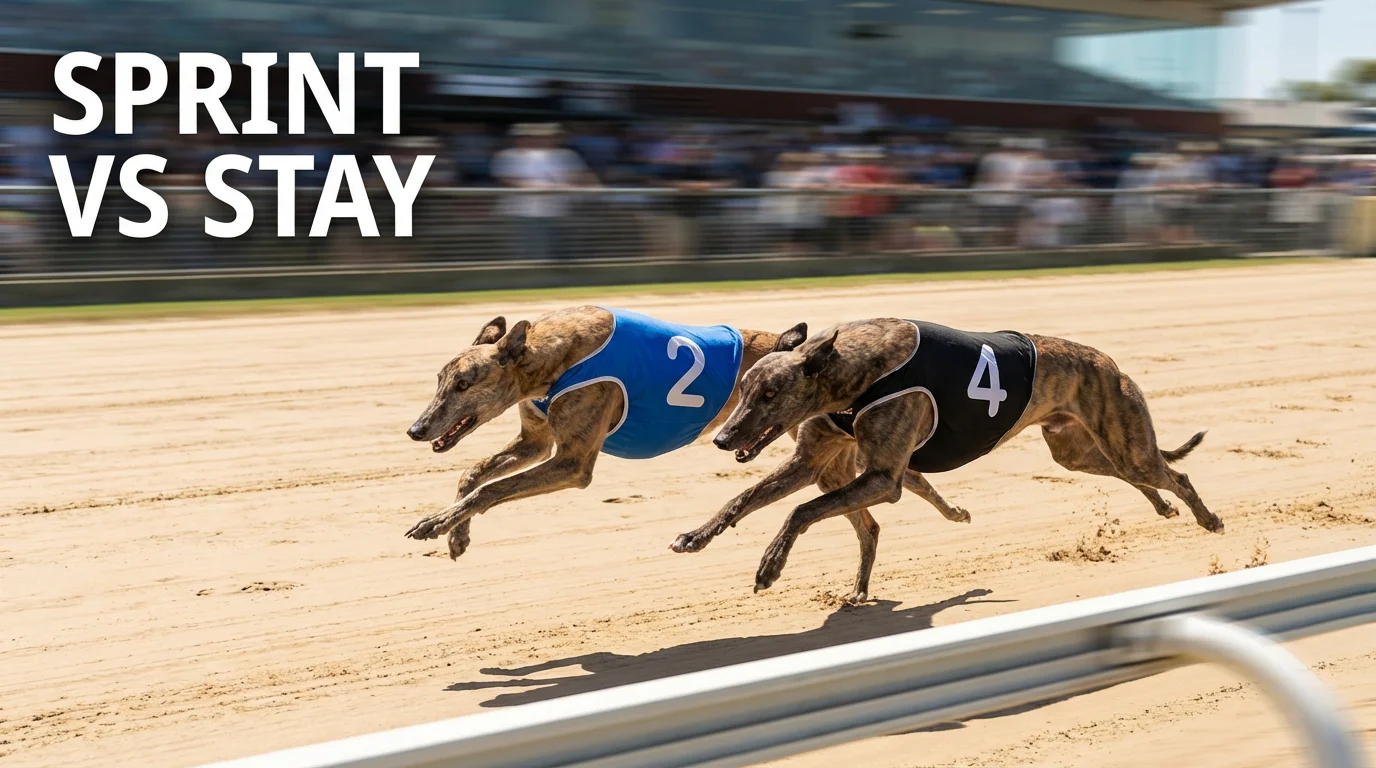
Not Every Dog Is Built for Every Distance
The standard UK greyhound race covers a distance somewhere around 480 metres, give or take depending on the track. Most bettors treat all greyhound races as essentially the same product — six dogs, one result, move on. But the distance of a race changes everything about how it unfolds: which running style dominates, how much the trap draw matters, where form reliability breaks down, and where the betting value sits.
UK greyhound racing offers three broad distance categories. Sprint races run over approximately 260 to 300 metres. Standard races — the most common — cover 450 to 500 metres. Staying races extend beyond 600 metres, with some marathon events reaching 700 metres or more at tracks that support them. Each category produces a different type of race, rewards a different type of dog, and demands a different approach from bettors.
Understanding how distance shapes race dynamics is not academic. It is the difference between backing a confirmed sprinter in a staying race because its form figures look good, and knowing that the form was earned over a distance where its strengths dominate and its weaknesses never appear.
Sprint Races — Pure Speed, Minimal Margin for Error
Sprint races are the shortest events on the greyhound card, typically run over one bend at most tracks. At 260 to 300 metres, the entire race is over in fifteen to seventeen seconds. There is no time for a slow beginner to make up ground. There is no second bend to change the dynamic. The race is decided in the first fifty metres, and everything after that is a procession.
This makes trap draw disproportionately important in sprints. A dog that breaks fast from a favourable trap has an enormous advantage because there simply is not enough distance for rivals to recover. Inside traps — one and two — tend to overperform in sprint races at most tracks because the single bend is tighter, the rail provides a navigational advantage, and there is no room for wide runners to use their stride length. The data from tracks like Romford and Crayford, which run regular sprint cards, consistently shows inside-trap bias at short distances.
For bettors, sprint races are the most volatile. The margins between first and last are tiny — often a length or less. A fractional stumble at the traps, a slight bump going into the bend, and the result changes completely. Form is less reliable over sprints because the small margins mean that race-to-race variation is higher. A dog that wins a sprint by a neck one week might finish fourth the next, not because its ability has changed, but because the margins allow it.
Sprints favour early-pace dogs — those with fast sectional times and quick trap exits. Late closers, dogs that rely on stamina to overhaul the field in the final straight, are at a severe disadvantage. If you are assessing a dog for a sprint race, the sectional time is more important than the overall time. A dog that records a fast first split but a modest overall time in a standard race is telling you it has sprint speed. A dog with a slow first split and a fast finish is telling you the opposite.
Standard Distance — The All-Round Test
The standard distance of 450 to 500 metres is where the majority of UK greyhound racing takes place, and it is the distance around which the grading system, form assessment tools, and betting markets are built. Most race cards, from Monday evening BAGS meetings to the English Greyhound Derby final, are run over this range.
Standard races typically involve two bends. The race develops in three phases: the break and run to the first bend, the mid-race positioning through the two turns, and the finishing straight where closing speed matters. This structure rewards versatility. A dog needs enough early pace to avoid trouble at the first bend, enough tactical sense — or physical ability — to hold its position through the turns, and enough stamina to maintain its speed through the final hundred metres.
Trap draw matters at standard distance, but less decisively than in sprints. The longer run to the first bend at many tracks gives outside seeds time to cross over and find a racing line, which reduces the inside-trap bias. At Towcester, for instance, the standard 500-metre distance includes a generous run-up that allows all six traps a fair shot at a clean first bend. Track geometry matters more than trap number at this distance.
From a betting standpoint, standard-distance form is the most reliable indicator of ability. A dog’s grading, its recent race times, its trap record, and its consistency across multiple outings all carry more weight at this distance than at sprint or staying distances, because the standard race tests the widest range of attributes. The form guides and race cards are built for this distance. If you are learning to read greyhound form, start here.
Staying Races — Stamina, Tactics, and the Long Game
Staying races cover 600 metres and above, involving three or more bends depending on the track layout. These are the longest events on the greyhound card, and they produce the most tactically complex racing. Marathon events at 700 metres or beyond are relatively rare but feature in some track schedules and in specific staying competitions.
At staying distances, the early-pace advantage diminishes. A dog that blazes to the front from trap one but lacks stamina will fade in the third and fourth bends, often dramatically. The dogs that excel over staying trips tend to be rangy, longer-striding animals that settle into a rhythm rather than sprinting from the traps. They are often middle-of-the-pack at the first bend and pick off tiring leaders in the second half of the race.
This creates a different betting dynamic. Trap draw is less predictive at staying distances because the extra bends give the field more time to reorganise. A dog drawn wide in a 700-metre race has four hundred metres of running to find its position — a luxury that does not exist over 270 metres. Form from standard-distance races translates imperfectly to staying trips. A dog that wins graded races over 480 metres may lack the stamina to sustain that form over 640 metres, or it may discover an untapped gear that the shorter distance never required.
Sectional times become less useful for assessing stayers because the first split only tells you about early pace, and early pace is not what wins staying races. Instead, look at finishing sectionals where available, closing speed relative to the field, and whether the dog has proven form at the specific distance. Race cards that show a dog’s distance record will tell you if it has been tried over longer trips — and crucially, whether it performed better or worse than its standard form suggested.
How Distance Shapes Betting Decisions
The practical application of distance analysis comes down to three principles. First, match the dog to the distance. A sprint specialist entered in a staying race is a poor bet regardless of its form figures. The reverse is equally true. Check whether the dog has form at the specific distance of today’s race, and if it does not, treat the bet with more caution.
Second, adjust how you weight different form factors by distance. In sprints, prioritise trap draw and early pace. In standard races, balance all factors. In staying races, prioritise stamina evidence and closing speed over sectional times and trap position.
Third, be aware that odds markets are less efficient at non-standard distances. Most punters focus on standard-distance racing, and the form tools are optimised for it. Sprint and staying races attract less attention, less data analysis, and less market sharpness. This is where value can emerge — not because the races are easier to predict, but because the market is thinner and mispricings persist longer.
Some bookmakers offer race-specific markets on staying events at major meetings. These tend to have wider margins than standard-distance equivalents, reflecting the bookmaker’s own uncertainty about form translation across distances. That uncertainty is mutual — you have less reliable data, but so does the bookmaker. The playing field, unusually, is close to level.
The Distance Your Dog Was Born to Run
Every greyhound has a distance profile. Some are born sprinters — explosive, front-running, devastating over one bend and ordinary over two. Others are natural stayers that need distance to unwind their stride and assert their class. Most sit somewhere in between, capable at standard distance but exposed when the trip gets shorter or longer.
The bettors who do well across all distance categories are the ones who recognise which profile a dog fits and bet accordingly, rather than treating every race as the same puzzle with the same solution. Distance is not a footnote on the race card. It is the frame that shapes everything else.
