

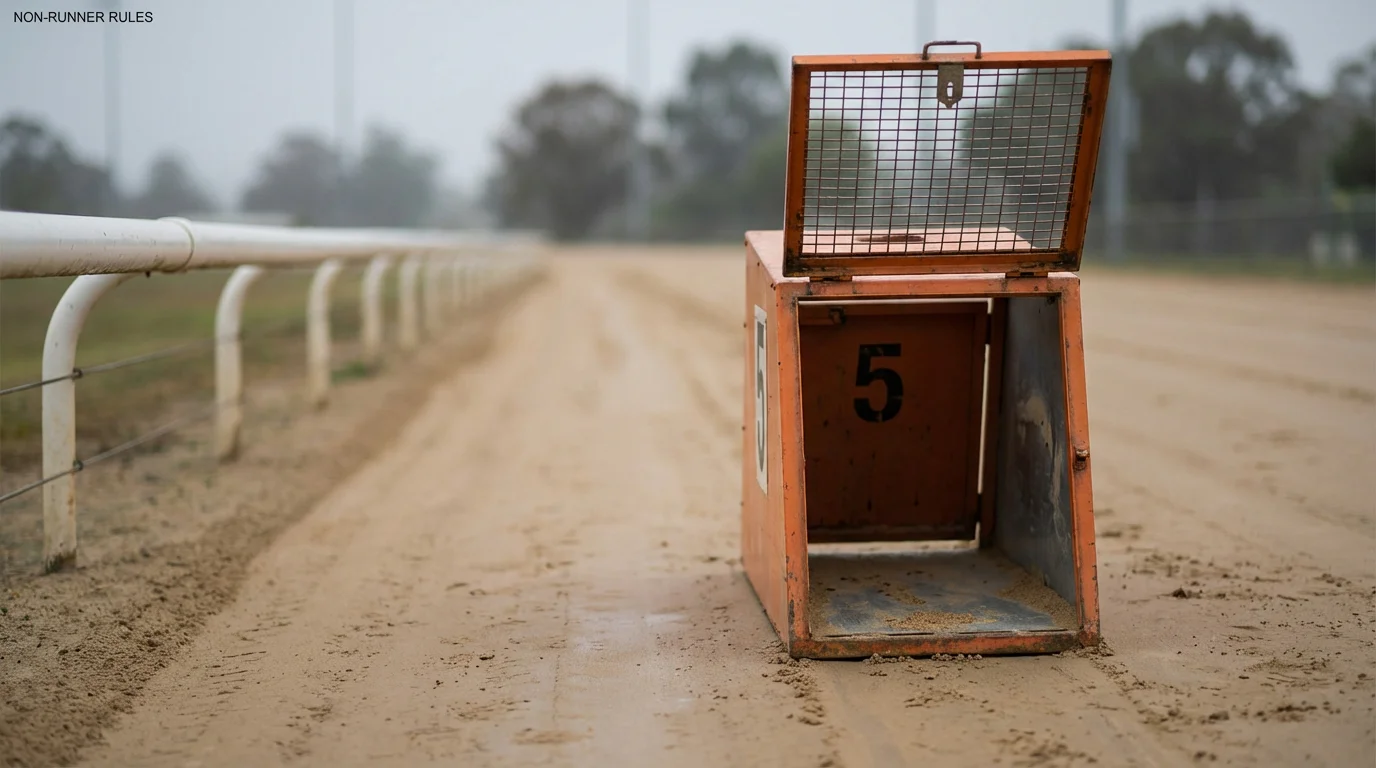
When a Dog Doesn’t Run — What Happens to Your Bet
Non-runners are a regular occurrence in greyhound racing. A dog might be withdrawn before the race due to injury, illness, being in season, or a trainer’s decision. Unlike horse racing, where non-runners can sometimes be identified hours in advance, greyhound withdrawals often happen closer to race time — sometimes at the track itself after the dog has been inspected by the veterinary team.
What happens to your bet when the dog you backed doesn’t run depends on the type of bet, the timing of the withdrawal, and the bookmaker’s specific policies. The rules are generally consistent across UK operators, but the details vary enough to catch out bettors who assume one bookmaker’s policy applies to all of them.
This guide covers the standard non-runner rules for UK greyhound racing, how withdrawals affect different bet types, and the reserve runner system that keeps races at full strength.
Standard Non-Runner Rules — Refunds, Voids and Deductions
The default rule for race-day greyhound betting is straightforward: if your selected dog is a non-runner, your bet is void and your stake is refunded. This applies to win singles, each-way bets, and the individual legs of multiples. The non-runner leg is treated as though it never existed, and the rest of the bet continues with adjusted calculations.
For accumulators and multiple bets, a non-runner reduces the bet by one leg. A four-fold with one non-runner becomes a treble. A treble with one non-runner becomes a double. The remaining legs are settled normally, with the non-runner leg removed from the calculation. The potential return decreases because there’s one fewer multiplying factor, but the bet itself survives. Two non-runners in a four-fold reduce it to a double. If all but one leg are non-runners, the bet becomes a single.
Forecast and tricast bets have different rules. If one of your selected dogs in a forecast or tricast is a non-runner, the bet is void and your stake is refunded in full. This is because the bet’s outcome depends on the specific relationship between named dogs — removing one of them makes the bet meaningless. You can’t have a forecast if one of the two named dogs isn’t running. Some bookmakers offer alternative settlement in rare cases, but the standard position is a full refund.
There is one critical exception: ante-post bets. As discussed in depth elsewhere, ante-post bets are “all in, run or not.” If you placed an ante-post bet on a dog to win the Derby outright and the dog is withdrawn at any stage, your stake is lost. There is no refund. This distinction between race-day and ante-post non-runner rules is one of the most important things to understand in greyhound betting, and it catches out bettors who assume the refund policy applies universally.
The timing of the non-runner declaration also matters. If a dog is withdrawn before the market is formed — typically more than an hour before the race — the race is usually re-priced with the remaining runners and a reserve is called in. Bets placed before the withdrawal are voided and must be re-placed at the new prices if desired. If the withdrawal happens after the market has been formed and bets have been placed, existing bets on the withdrawn dog are voided, and bets on the remaining runners stand at the original prices. Some bookmakers apply a Rule 4 deduction to winning bets to account for the removed runner, though this practice is more common in horse racing than greyhound racing.
How Non-Runners Affect Trap and Market Betting
When a dog is withdrawn and replaced by a reserve, the reserve takes the same trap number and wears the same coloured jacket. This is important because trap-based betting — where you bet on a trap number rather than a named dog — is affected differently from named-dog betting.
If you placed a “trap 3 to win” bet and the original trap 3 dog is withdrawn, most bookmakers will settle the bet on whichever dog ends up running from trap 3 — which will be the reserve. Your bet transfers to the new dog automatically. Some bookmakers void trap bets in the event of a substitution. The policy varies, and it’s worth checking the specific terms if you regularly bet on traps rather than named dogs.
For the named-dog bettor, the substitution creates a secondary consideration: the reserve runner changes the dynamics of the race. A reserve is typically a lower-quality dog that was not originally selected for the race. Its inclusion may weaken the overall field, which can benefit the remaining runners — particularly the favourite. Or the reserve may happen to have a running style that disrupts the expected pace of the race, creating unexpected outcomes. Either way, a late substitution is new information that the pre-race analysis didn’t account for, and adjusting your assessment — or at least acknowledging the change — is prudent.
In Derby heats, non-runners and reserve substitutions are closely watched because the quality gap between the original entry and the reserve can be significant. A Derby heat featuring five contenders and one reserve effectively becomes a five-dog race for the three qualifying places, which changes the dynamics and often the betting value of the remaining runners.
The Reserve System — How Replacements Work
UK greyhound racing uses a reserve system to maintain full six-dog fields. When a dog is withdrawn, the track’s racing office calls up a reserve from a pre-assigned list. The reserve is typically a dog already at the track or one that can be transported quickly enough to meet the pre-race veterinary requirements.
Reserves are assigned based on grade and availability. The racing office aims to replace a withdrawn dog with one of comparable quality, though in practice the reserve is often slightly below the standard of the original entry. At BAGS meetings and regular evening cards, the reserve system works smoothly and substitutions are routine. At major events like the Derby, the reserve list is formally published and the pool of potential replacements is known in advance.
For bettors, the key question with any reserve runner is: does this dog change my assessment of the race? If the withdrawn dog was the favourite and the reserve is significantly weaker, the remaining dogs all become more likely to fill the top places. If the withdrawn dog was a 10/1 outsider and the reserve is of similar quality, the impact on the race is minimal. Checking the reserve’s form before the race — even a quick glance at its recent results and grade — takes seconds and can prevent you from betting on a race where the field composition has changed more than you realised.
Reserves are also relevant for forecast and tricast planning. If you had planned a forecast involving the withdrawn dog, that bet is void and you need to reassess. If the reserve has a similar running style to the withdrawn dog, the race dynamics may not change much. If the reserve is a completely different type of runner — a closer replacing a front-runner, for example — the expected pace and shape of the race shifts, and your forecast selections may need to shift with it.
Bookmaker Policies — Where the Rules Diverge
The broad non-runner framework is consistent across UK bookmakers, but the details diverge in ways that matter. Some bookmakers apply Rule 4 deductions to winning greyhound bets when a runner is withdrawn late. Others don’t apply any deduction and settle all remaining bets at the original prices. The difference can affect your return, particularly if the withdrawn dog was a short-priced favourite whose removal significantly increases the chances of the remaining runners.
Trap betting policies vary more widely. As noted, some bookmakers transfer trap bets to the reserve runner while others void them entirely. If trap betting is part of your regular approach, it’s worth identifying which policy each of your bookmaker accounts follows and choosing accordingly.
Cash-out treatment after a non-runner also differs. Some bookmakers adjust cash-out values immediately when a non-runner is announced, reflecting the changed race dynamics. Others are slower to update. If you’re holding an active bet with a cash-out option and a non-runner is declared, checking the cash-out value promptly can occasionally reveal a temporary mispricing before the system fully adjusts.
The simplest way to protect yourself is to check the non-runner rules in your bookmaker’s terms and conditions before you need them. Every UK bookmaker publishes greyhound-specific non-runner policies in their help section or rules pages. Reading them once, before you encounter the situation, saves confusion and potential disputes when a dog is withdrawn and your money is at stake.
Know the Rules Before You Need Them
Non-runner rules are the least exciting aspect of greyhound betting. They’re also one of the most consequential. A withdrawal can void your forecast, reduce your accumulator, or — in ante-post markets — cost you your entire stake with no recourse. The rules handle these situations, but “handled” doesn’t mean “identical” across every bookmaker and every bet type.
Check the rules for your bookmaker. Understand the difference between race-day and ante-post non-runner treatment. Know how reserves work and how substitutions affect your bets. And when a non-runner is announced, take thirty seconds to reassess the race before placing or adjusting your bet. The dog may have changed, but the race hasn’t disappeared — and the new race might offer better value than the old one did.
