

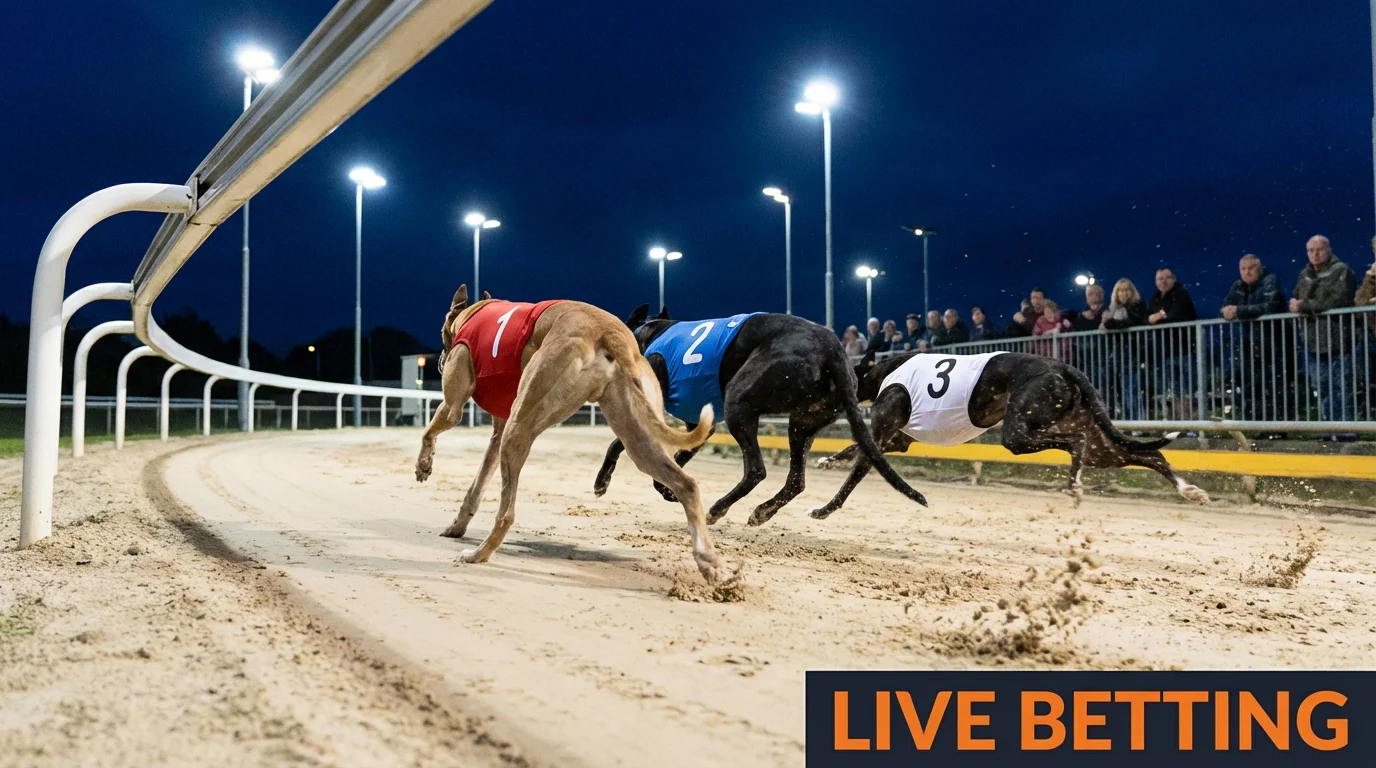
Betting While the Dogs Are Running — What’s Actually Possible
In-play betting on greyhound racing exists, but it operates within tighter constraints than the in-play markets for football, tennis, or horse racing. A greyhound race lasts roughly twenty-eight seconds. The window for placing a bet after the traps open is measured in moments, not minutes, and the opportunities available are narrow by design.
That doesn’t mean live greyhound betting is irrelevant. Understanding what is and isn’t available in-play, how to access live coverage, and where the few genuine in-running opportunities sit can add a dimension to your greyhound betting that pre-race analysis alone doesn’t cover. The key is knowing the limitations before you encounter them in real time.
This guide covers what in-play greyhound betting looks like in the UK, how to watch races live, and the tactical adjustments that matter when the action is unfolding in front of you.
What In-Play Greyhound Markets Exist
The in-play greyhound betting market is far more limited than what most bettors expect. The speed of the race is the primary constraint — from the moment the traps open to the moment the first dog crosses the line, there’s barely enough time for a bookmaker’s system to update prices and process a bet, let alone for a punter to assess what’s happening and react.
Most UK bookmakers do not offer traditional in-running betting on greyhound races. The markets close when the traps open, and the next available betting opportunity is the next race on the card. This is the standard experience for BAGS racing and most evening meetings. If you’re looking for a bet-in-play option comparable to what you’d find on a horse race or a football match, greyhound racing doesn’t provide it through conventional bookmaker platforms.
Betting exchanges have historically offered more flexibility. Betfair, for example, has allowed in-play trading on some greyhound events, though the liquidity is thin and the delays make it impractical for most bettors. The exchange model suits greyhound in-play slightly better than the bookmaker model because prices are set by other users rather than by a system that needs time to react, but the reality is that by the time you’ve seen what happened at the first bend and placed a trade, the race may already be over.
Where live betting does have practical application is in the period immediately before the race — the five to ten minutes between the dogs parading and the traps opening. This isn’t in-play in the technical sense, but it’s live in the practical sense. You’re watching the dogs in the parade ring, assessing their condition, noting their behaviour, and using that information to make or adjust a pre-race bet. Some bettors consider this the most valuable live betting window in greyhound racing, because it provides visual information that the race card can’t capture.
Cash-out is the one in-play-adjacent feature that most bookmakers do offer on greyhound bets. If you’ve placed an ante-post bet on a Derby contender and the dog wins its heat impressively, the cash-out value of your bet increases. You can lock in a profit before the next round without waiting for the competition to finish. Cash-out availability varies by bookmaker and by market, but it provides a form of in-running position management that is available for greyhound betting even when live in-play markets are not.
The Pre-Parade Window — Live Information Before the Off
The parade ring is where live greyhound assessment happens. In the minutes before a race, the dogs are led around the parade ring in their trap jackets, giving bettors — both trackside and watching via stream — a chance to see each runner’s physical condition and demeanour.
What to look for: a dog that’s relaxed, moving freely, and showing alertness without excessive agitation is presenting well. A dog that’s pulling hard, appears stiff in its movement, or is distracted by the crowd may underperform. Weight changes visible from the parade — a dog looking heavier or lighter than its card weight suggests — can indicate recent condition shifts. None of these observations are conclusive on their own, but combined with form analysis, they provide a final data point before the off.
Experienced trackside punters treat the parade as the confirmation step. They’ve done their form analysis, identified their selections, and then watch the parade to confirm that the dog looks right. If the selection looks off — agitated, stiff, or uninterested — they adjust. If it looks sharp, they commit. This process is harder to replicate via a streaming feed, where picture quality and camera angles limit what you can see, but it’s still worth incorporating into your pre-race routine.
Market movements in the final minutes before the off often reflect parade observations. If a well-fancied dog’s price suddenly drifts in the last two minutes, someone with a better view may have noticed something. Conversely, a late shortening in price might indicate that the dog looked particularly sharp in the parade ring. These late moves aren’t always reliable signals — they can reflect nothing more than a single large bet — but they’re worth noting as part of the overall picture.
Where to Watch Greyhound Racing Live
Live coverage of UK greyhound racing is available through several channels, each with different access requirements and coverage quality.
SIS Racing is the primary provider of live greyhound pictures to UK bookmakers. Most major online bookmakers — including bet365, William Hill, Paddy Power, Coral, and Ladbrokes — stream SIS Racing content through their platforms. Access typically requires a funded account and, in some cases, a bet placed on the relevant meeting. The picture quality is reliable, the coverage includes pre-race commentary and post-race analysis, and the stream is synchronised closely enough with the live action to be useful for pre-race assessment, though not for genuine in-play reaction.
RPGTV (Racing Post Greyhound TV) is a dedicated greyhound channel available through some digital TV packages and via online streaming. It covers selected meetings with more detailed pre-race analysis than the standard SIS feed, including kennel visits, trainer interviews, and form discussions. For serious greyhound bettors, RPGTV is the most comprehensive broadcast source available.
YouTube channels, including “Gone To The Dogs,” provide free coverage of some meetings and Derby-related content. These streams are less consistent in quality and scheduling than the SIS or RPGTV options, but they’re accessible without a bookmaker account and useful for casual viewing.
Attending the track in person remains the gold standard for live greyhound assessment. The parade ring view, the atmosphere, the ability to see the track conditions first-hand — none of these are fully replicated by a screen. For major Derby rounds and finals, being at Towcester provides a level of information and engagement that remote viewing can’t match. For the bettors who make the trip, the experience also includes access to on-course bookmakers, whose prices occasionally differ from the online market.
Tactical Tips for Live Greyhound Betting
Use the early races on a card to assess track conditions. The first two or three races will tell you whether the surface is riding fast or slow. If times across the early races are consistently slower than standard, the track is heavy, and closers are more likely to benefit later in the evening. If times are fast, front-runners on the inside are in business.
Watch for dogs that race below their expected level in one race and then appear on the card again later the same week or the following week. A dog that was slowly away or crowded in running on Tuesday might represent value on Saturday if the market hasn’t fully forgiven the poor result. The comment code from the earlier race is your evidence — it’s not always a declining dog. Sometimes it’s just an unlucky one.
If streaming a meeting, watch every race — not just the ones you’ve bet on. Patterns emerge across a card. A particular trap might produce three winners from four races, suggesting a track bias that evening. A trainer might have two or three runners on the same card, and the earlier results give you a sense of how the kennel is running. This accumulation of small observations adds up to a richer understanding of the meeting than any race card analysis alone can provide.
Finally, resist the urge to chase. Greyhound meetings are structured for rapid turnover — ten to twelve races, twelve to fifteen minutes apart. The speed of the schedule makes it easy to chase a losing bet with an impulsive one in the next race. Set a plan before the meeting starts: which races you’ll bet on, what stakes, and what your stop-loss is for the evening. The live environment rewards discipline more than any other setting in greyhound betting.
The Race Happens Once — The Preparation Happens Before
Live greyhound betting is less about reacting in real time and more about arriving at the meeting with your preparation done and your selections confirmed. The parade gives you a final check. The stream gives you visual data that the race card lacks. The early races give you a read on the track. But the core betting decisions are still made before the traps open.
Watch more races than you bet on. Use the live feed as an information source, not an adrenaline source. And treat the speed of the schedule as a reason for discipline, not a licence for impulse. The punters who last longest in greyhound racing are the ones who understand that watching and betting are two different activities — and the first one should always come before the second.
